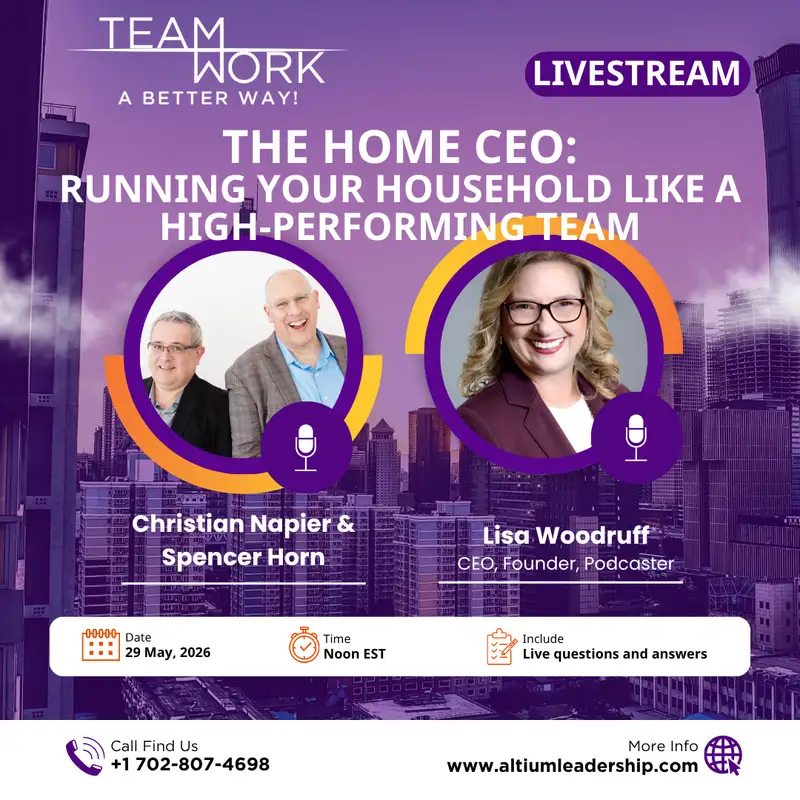
The Home CEO: Running Your Household Like a High-Performing Team
https://www.youtube.com/channel/UC2w8BMBq25cswE7mVRX1bDA
https://organize365.com/podcast-landing-page/
https://www.linkedin.com/in/lisawoodruff/
http://instagram.com/organize365
Christian Napier
00:13 - 00:25
Hello, everyone, and welcome to another episode of Teamwork a Better Way. I am Christian Napier. I am joined by His Royal Highness in purple, Spencer Horn. Spencer, how you doing?
Spencer Horn
00:25 - 00:35
Doing fabulous, fantastic, fantabulous. Good to be with you. I was combining those two words in my brain and it just didn't come out right.
Christian Napier
00:35 - 00:43
Hey, I'm all for concatenation and unique combinations of words and phrases. I think that's fantastic.
Spencer Horn
00:44 - 00:48
You pulled concatenation right off the top of your head. That's impressive.
Christian Napier
00:49 - 01:03
You gotta tell me a little bit about your trip to Seattle last week, because I'm a huge fan of Seattle, my daughter lives in Seattle, I worked in Seattle, so give me the deets.
Spencer Horn
01:03 - 01:28
Absolutely, our guest, who I'm excited to introduce in just a second, I was just listening to her podcast, because she has this organized 365 podcast, 24 million downloads, And just recently, her most recent topic that dropped was talking about vacations and the difference between that and trips and sick days. So she's talking about how to manage that well. But I learned a lot about our guest here.
Spencer Horn
01:28 - 01:52
And growing up, all her vacations turned out to be like educational experiences or, you know, family vacations, Christian, when you go and usually the wife ends up doing all the meals and all the laundry and everything that you normally do. So for them, it's not really a vacation. So this, I find with my wife and I, you know, we're empty nesters. We have 11, almost 11 grandchildren now.
Spencer Horn
01:53 - 02:33
And so for her, the life of managing the household, which we're going to talk about today, you know, there, there, there tends to be a mental load that builds up and that impacts the relationship after a while, because we're all kind of going our separate ways and we don't In my relationship anyway, it seems like we don't always stop to connect as much as we should. So we look forward to going on these trips. It's a business trip for me, but I bring my business partner and my life partner along with me and I do my thing on Wednesday up in Seattle and then on Thursday, Friday, Saturday, We go together anywhere we can.
Spencer Horn
02:33 - 02:41
We love food. We find this little bakery in Poulsbo. I don't know if you've heard of Poulsbo. It's this little Norwegian village just close to Bainbridge Island.
Spencer Horn
02:41 - 02:54
So we take the ferry across from Seattle. And we find this bakery, and oh my goodness, Sly's Bakery. It's been there since the 60s. And we visit this thing three times.
Spencer Horn
02:54 - 03:05
The third time we go is this Saturday. And there's a line out the door. This is how popular this bakery is. And we're like, we're getting in that line, even though we didn't experience it before.
Spencer Horn
03:06 - 03:21
So we buy like $25 of baked goods between the two of us each time. So we come out with bags of stuff that we should not be eating. We just can't help ourselves. And then we go see Olympic National Park.
Spencer Horn
03:21 - 03:28
We go up to Hurricane Ridge. We go hiking. But the key is we're together. We're eating out.
Spencer Horn
03:29 - 03:34
We're just renewing, refreshing. It was wonderful. So thanks for asking.
Christian Napier
03:36 - 03:57
Well, it sounds like you had an amazing weekend there and a wonderful time there in Seattle. I'm a little jealous. We were there last month as our daughter had our third grandchild and then number four just came last week. So we got some catching up to you, uh, to do with you, Spencer, but we're going to do that today for lunch.
Spencer Horn
03:57 - 03:57
Aren't we?
Christian Napier
03:58 - 04:11
Yes, we, we certainly, we certainly are. I'm super excited about, uh, talking with our guests. They'll have you introduced in a minute. You know, our, the title of our episode, you, you, you kind of paraphrase it.
Christian Napier
04:11 - 04:31
the home CEO, running your household like a high performing team. This is a different take for us, right? We're typically talking about professional things. As leaders, we spend years, you know, mastering, uh, leadership principles, team alignment, delegation, strategic planning, blah, blah, blah.
Christian Napier
04:32 - 04:38
We do all that at work and then we go home and, uh, all that stuff may just fall by the wayside, you know?
Spencer Horn
04:39 - 04:43
So, uh, same level of care and planning and preparation at home.
Christian Napier
04:43 - 04:50
Yeah. I'm so excited to dive into this with our guests. So maybe we should just go ahead and get on with it. Spencer, why don't you go ahead and introduce her?
Spencer Horn
04:51 - 05:01
Absolutely. I'm going to bring her smiling face up on the screen while we talk about. This is Lisa Woodruff, everyone. And she is the founder and CEO of Organize 365.
Spencer Horn
05:01 - 05:17
And she and 87% of Americans believe organization is a learnable skill. I agree with that. Yet fewer than 18% of those same Americans feel they are organized. That's a pretty big gap.
Spencer Horn
05:18 - 05:43
There's some cognitive dissonance going on there. Something's happening. But as the host of the top-rated Organize 365 podcast with 24 million downloads, as I said, Lisa shares strategies for reducing overwhelm, clearing mental clutter, and living a productive, organized life. We are so excited to have you, Lisa.
Spencer Horn
05:43 - 05:45
Thank you for joining us on Teamwork a Better Way.
Lisa Woodruff
05:46 - 05:52
Yeah, thank you so much for having me on and being open to thinking about expanding our leadership into the household.
Spencer Horn
05:53 - 06:06
Well, yeah, to that very point, you know, it's interesting, you know, you've said household management is CEO level work. So why do we treat it not like real work?
Lisa Woodruff
06:08 - 06:28
Well, I think we don't want to admit that we're doing 20 to 40 hours worth of work at home per week. And that is what statistics will show. That's about how much work we're doing. And when we look at the work, we're just looking at the visible work, the laundry, the dishes, the cleaning, and we're not really thinking about the managerial, the invisible work that we do to make sure that we're getting all of our projects done.
Lisa Woodruff
06:28 - 06:48
harmonious family relations, and we look at visible work and doing the work, and we work on the business, the invisible work, I want us to take us even one step further into that CEO, strategic, visionary, mission-driven work in our household, not just managing the invisible work and doing the visible work.
Christian Napier
06:49 - 07:17
Well, yeah, go for it. Sorry, sorry to cut in here, Spencer, because I think this is a super fascinating topic. But, but one question that really popped into my mind as you're talking, we use this word CEO, you know, so, you know, one of the things that could be potentially challenging is, okay, maybe I'm in this leadership position at work, but when I come home, Do I really want my life partner or my kids to, do I wanna look at them like employees?
Christian Napier
07:17 - 07:49
I feel like maybe, I don't know, the lessons, could they apply? Maybe, but I'm like, I don't know if I feel comfortable thinking of them as employees. So how do you get around that idea of like, okay, well, I'm the CEO of my organization, or I'm the founder, I'm the executive director or whatever it is, and come home and have these kinds of, and apply the same skills, but not treat the people in your family like they're your employees.
Lisa Woodruff
07:52 - 08:10
Yeah, I never mentioned that the people in my family are my employees. As a matter of fact, running a household is much more like a solopreneur business, and that you are actually doing all of the things. You are working in the business, you are working on the business, and you are setting the strategic directive. Now, if you have family members that want to partner with you in that, that's great.
Lisa Woodruff
08:10 - 08:25
If you have financial resources where you can offload some of those tasks and delegate them, that is great. But what I have found for myself personally is only I can control myself. I can't make my spouse do something, make my children do something. They have a bad day.
Lisa Woodruff
08:25 - 08:40
At the end of the day, the buck stops with me. So I take ownership of all three levels. But I also employ myself differently when I'm doing laundry versus managing projects and budgets versus setting the goals for our entire household.
Spencer Horn
08:41 - 08:52
Yeah. And so that's the, you're making this distinction between household management and housework. Right. So, so, so most people use those terms interchangeably though, don't they?
Spencer Horn
08:53 - 09:23
So I want you to explain what actually is the difference and does that matter? Because I think this idea of managing the household has maybe a really negative stigma today. I mean, so many people say, well, usually falls to a certain party in a relationship. While, you know, somebody outside of the home has more of the glory and is bringing home more pecuniary benefits and assets.
Spencer Horn
09:23 - 09:33
And so we tend to maybe diminish the value of what happens at home. And I want to hear why that's a mistake, because I think it is.
Lisa Woodruff
09:34 - 09:57
Okay, I'm gonna take you through three hops in order to get to where I am now at the age of 54 with a PhD, where I'm studying this at an academic level. Step one, my entire goal in life was to get married, become a wife, mother, be a stay-at-home mom. Did that for a decade, checked the box, loved doing every single bit of the housework. Then I started this company at the age of 40, and it was a solopreneur company.
Lisa Woodruff
09:57 - 10:27
I did all the work in the company, started to build a team, and started to become a CEO at work and have W2 employees. And I was like, I have to think differently about my business because I'm working in the business, I'm managing my team, but also if I'm not thinking strategically about the profitability and where the company is going, then we're all going to be out of business very soon. And I started to look back at my household and I had worked my way out of some of my work at home. Some by abdicating my role and just being like, well, this isn't going to get done anymore.
Lisa Woodruff
10:27 - 10:53
Some by hiring it out and some by doing it in different off hours. And I was like, I wonder if I take my managerial and CEO strengths I'm learning as a solopreneur and apply it to my household. if I can manage more, if I can have more capacity and get more done at home and reduce my expectations on the housework and the things that are never going to be done, just like at work. I would never spend a lot of time at work optimizing email.
Lisa Woodruff
10:53 - 11:07
Like email is just something we do in order to get work done. I reduced meetings like crazy so we have more time to work on projects. I started to apply those principles into my household. And then I learned a couple of statistics.
Lisa Woodruff
11:07 - 11:23
68% of US GDP is household spending. So in that way, the American household is a business. The money that we bring into our household from working, working somewhere and getting paid, we bring it into the household. We then redistribute that into society.
Lisa Woodruff
11:23 - 11:31
And if we don't do it, then we're in a recession. And then we get a stimulus check. So we are a business entity. And governments are looking at us.
Lisa Woodruff
11:31 - 11:41
Businesses are looking at us. We are the product. So even as a stay-at-home mom, when I wasn't earning money in the workplace, I was running a household. I was in charge of a P&L.
Lisa Woodruff
11:41 - 11:54
I had a market impact. And so I thought, oh, we all are running a small business in our households. It takes 20 to 40 hours to do it without children. and it has an economic impact in the community.
Lisa Woodruff
11:54 - 12:12
So let's treat it like the business it is. Let's reduce the amount of hours we work and be really purposeful with how we use those hours and maximize the productivity of those hours and our dollars. So we do have leisure time at home, because that's ultimately what we all want. We want more leisure time, more of our time to do what we want to do with it.
Spencer Horn
12:13 - 12:14
For vacations?
Lisa Woodruff
12:16 - 12:17
Well, I mean, if you can get one.
Spencer Horn
12:18 - 12:20
Well, as long as there's no sharks involved.
Christian Napier
12:22 - 12:39
Good listening. Again, I find this conversation really, really intriguing. If we're the business, if the family or the home is the business, then what's the product, right? In business, the goal is often profit or growth.
Christian Napier
12:39 - 13:02
So in your experience and also in not just as running a home, but also transitioning it to be this business owner and also the academic work you're doing, What would you consider the product of a well-run home to be? Is it peace? Is it efficiency? Is it character?
Christian Napier
13:02 - 13:23
I'm just curious, from your perspective, does it matter? When I try to think of my home as a business, then my mind goes to, well, typically businesses have products or services. So what is the product or what is the service of the home?
Lisa Woodruff
13:23 - 13:38
So now that I officially got my PhD last Friday, like one week ago today, so it's very fresh. My mind is now able to start thinking about, thank you. What is my theory? very much.
Lisa Woodruff
13:38 - 13:52
Thank you. My mind is now able to go to what is my theoretical orientation. I have been in households and helping organize households and now working on this academic work. The current conversation is a he said she said conversation.
Lisa Woodruff
13:52 - 14:06
Women are doing too much men get it together and do more. That's great. If you're in a coupled relationship, which only 17.9% of Americans are married with children under the age of 18. None of us on this call have children under the age of 18.
Lisa Woodruff
14:06 - 14:15
So none of us are even in the academic studies that are going on. So what are these other 80% of Americans? What are these households that they're in? How is that work divided?
Lisa Woodruff
14:15 - 14:30
You know, if you are a single mother, 40% of children this year will be born to a single mother. You can't divide the housework if you're the only adult in the relationship, right? So some of the solutions we have are not solving the problem. So your question was, what is the purpose of the home?
Lisa Woodruff
14:30 - 15:06
And I think that is a great question that I don't think has been asked. And my personal answer to that and what Organize 365's mission is, is that the self-actualization of all of the people living in that residence. So what I mean by that is when my children, when I was a stay-at-home mom and my children wanted to get piano lessons or soccer lessons, like I would sign them up, I would drive them them. I don't have a concert pianist or a professional soccer player today and my children are adults, but there was nothing I wouldn't do to provide opportunities for them to explore if this is a way in which they might excel future in life.
Lisa Woodruff
15:06 - 15:15
But we don't tend to do that once we are adults. We do in our work. But we don't necessarily in our household, like, what do you want to do? What do you want to learn?
Lisa Woodruff
15:15 - 15:29
What do you want to explore? How could you become a more well-rounded human? Just what do you want to do for your hobbies? And I think that self-actualization that we can experience at work is what we are also supposed to be able to experience at home.
Spencer Horn
15:41 - 16:18
Lisa, I think you actually answered that question earlier when you were talking about creating an environment where those relationships flourish, where the mental load is managed. That's part of the self-actualization you're talking about. I envision that. Think about those 18-year-old kids and them wanting to come home, bringing their friends to their house because there's an energy and a a calm from the world, if you will, you walk in those doors and it's like, ah, even though there's all the things that have to happen,
Spencer Horn
16:18 - 16:41
it's I'm home. And you know, we hear at Christmas time, these songs, I can't wait to come home when we're older. We want to come to that place where we are loved and appreciated. And that means we have to manage that household in such a way that.
Spencer Horn
16:41 - 17:16
that the activities don't take precedent over the connections, the relationships, the mental load isn't so great that we can, which is even harder for many single households because they're having to do everything. Where do you find the time to self-actualize? Where do you find the time to connect and empower and strengthen when You gotta go fight outside of the castle. Sorry.
Lisa Woodruff
17:17 - 17:39
Yeah, and I think, you know, the times when you get the most worn out is when you're in caregiving relationships. So when you're caring for children, caring for spouses, sometimes caring for yourself, when you're ill, caring for parents. And those caregiving relationships and seasons can be very, very long and draining. And so those are the most unpredictable seasons that you may get in.
Lisa Woodruff
17:39 - 17:56
They're going to have a lot of cognitive load, a lot of additional stress. However, when you're not in those seasons and you've got a period of a little bit of time, we talk a lot about household management. And to be honest, for the last decade, I've elevated us from housework to household management. I'm like, let's put all these management principles in place.
Lisa Woodruff
17:56 - 18:18
But now I want to take us up to the CEO level because CEOs lead and they lead through influence. As John Maxwell will say, leadership is influence, nothing more and nothing less. If you are managing your household, and you're overwhelmed, you will micromanage and no one wants to work for a micromanager, right? But leaders, you will follow true leaders.
Lisa Woodruff
18:18 - 18:22
You will want to do what they're doing. It will be fun. It will be exciting. They will trick you into working.
Lisa Woodruff
18:22 - 18:58
You won't even realize that you're working. And when you're all working for a common goal and you understand the mission, vision, and values of your company, you understand the mission and vision and values of the holidays that you're about to put on for your children and your grandchildren, the multi-generational family that you're living in for economic reasons or other reasons. Once you understand why your family is commuting the way it is, and you have that mission and that vision, you then can manage the projects and deploy the resources for the benefit of all from that visionary standpoint.
Spencer Horn
18:59 - 19:19
Okay, so this, sorry, I got a little emotional last segment there, but you know, we've got this question about what is, what are we producing? And you're talking about, we're getting all this stuff done. So if you were to, if you were to put a dollar value on household management role, What would the most families discover? Because you talked about having an impact.
Spencer Horn
19:20 - 19:32
So I'm kind of going back to this idea that 66% of all world GDP really comes from household spending. So what is that dollar value on doing this well?
Lisa Woodruff
19:33 - 19:50
You know, that is what academia is trying to do through their research and trying to propose policy change that you would give money to household managers so that they can stay home and raise children and run households and there's an economic value to it.
Spencer Horn
19:50 - 19:54
There is an economic value and engine. There is. Absolutely.
Lisa Woodruff
19:55 - 20:16
And I understand that that's not really my theoretical orientation. I really want to, if you can't afford to outsource, if you don't have a spouse, if your spouse isn't participatory, if your children aren't able to do the chores, I mean, you who are running the household, you're still going to need to do it. So as a leader, I always look at what can I do? Like if my employees in my company, don't do what I asked them to do.
Lisa Woodruff
20:17 - 20:25
I don't feel like we hit the mark on an initiative. The first question I asked myself is where was I unclear? Where didn't I get the right resources? How did I not communicate the vision?
Lisa Woodruff
20:25 - 20:45
What's going on in the economy? I look at every other thing other than the employee to answer why that wasn't, why that didn't happen. Occasionally it's the employee, but most often there's usually something I didn't do or I didn't take into account as the CEO that made that initiative not actually happen.
Spencer Horn
20:45 - 20:53
If more leaders ask that question, the world would be a better place, not even in the home, in the workplace. Those are great questions. Keep going.
Lisa Woodruff
20:55 - 21:12
So if you are then as the CEO running your household, yes, the work has to get done. It can get done on different days and different cadences. But at the end of the day, I just was at home with my grandchildren while my daughter went to a parent-teacher conference, missed work for that. Grandson wanted to build Legos, we're building Legos.
Lisa Woodruff
21:12 - 21:19
I don't know how, when you open the Lego package and it's all in front of you, the pieces are already missing. What is up with that? Multiple pieces. And I know how to do Legos.
Lisa Woodruff
21:19 - 21:25
And I was like, this isn't working. All right, I'll move to the other part. And he made some robot out of the thing. And I was like, yeah, who cares about the directions?
Lisa Woodruff
21:25 - 21:42
We're now just making robots. Is the purpose to build the Legos that I bought him, or is the purpose to spend time with your grandson no matter what happens? We need to be able to let go of those Check the box task oriented things. So the value of a CEO in the home.
Lisa Woodruff
21:43 - 21:59
I mean, you can't put a price on it because yeah you could put a price on replacing the actual physical work that is done in the home. Most households aren't run from a visionary standpoint. And CEOs sometimes are worth more than they're paid, and sometimes they're worth less than they're paid. They're whatever the market will bear.
Lisa Woodruff
21:59 - 22:09
In this case, the market is your family. It's your legacy. Does your family want to come home? Are you the family that they want to go see?
Lisa Woodruff
22:09 - 22:27
Are you the person that they call at 3am? Are you the one who has organized your life and has enough cognitive capacity and taking care of yourself and your family so that when the emergency happens they call you because they know that you can handle even more and you will have good clear head about it?
Christian Napier
22:39 - 23:19
serious lag christian sorry man yeah well you know technology what are you gonna do it's the beauty of live shows right um so this leads me to a question that is important for me personally because um uh if If we're talking about in a business, I come from a software or an IT background. So we often talk about success criteria or acceptance criteria. What does success look like?
Christian Napier
23:19 - 24:02
You talk about these things. And I think it's important to figure out how to frame that correctly so that you don't become really disappointed if your family doesn't meet expectation. We're seeing, and I'm seeing this in my own family, the challenge of estrangement. where certain family members peel off because they have different political or religious or other fundamental beliefs and they're not comfortable around other family members and they're just like, oh, I'm out of here.
Christian Napier
24:02 - 25:12
And when that happens, then those holidays that you once cherished, that you all got together, Thanksgiving and Christmas or whatever it is, where you all got together and not everybody's there, can be very hard for people. And so I'm curious what kind of advice you would give to people Looking through that lens of self actualization to help them find peace even if they don't in their own view have the perfect family, you know, like There's divorce there's there's all kinds of things that happen and It can be difficult for somebody for some family or some people to to look and say you know, well, compared to Spencer, my family's a failure, because I can't get everybody together for Christmas or Thanksgiving, or, you know, Mother's Day or whatever it is, because of these situations that have happened over the course of time.
Christian Napier
25:12 - 25:28
And And those times that should be joyful become times of sorrow. So I'm just curious how you address those kinds of feelings with people who I'm like, yeah, I'm gung ho. I want to do this. I want to be the CEO of the home.
Christian Napier
25:28 - 25:50
I want to do these things. And then I face these realities that, well, I have some circumstances that many of them are kind of outside of my control that are impacting my own view on whether I'm a good CEO of the home or not.
Lisa Woodruff
25:53 - 26:18
Yeah, this is a unique way to think about this. So a couple of things I would say. As a CEO of a small business, the work level, the intensity is different when you're having a team week and you're celebrating and getting ready for the next year, or you're busy shipping for a Black Friday initiative, or you're in one of the slower months where there's not a lot of revenue coming in and you're not working on a new project.
Lisa Woodruff
26:19 - 26:38
As a CEO, you manage differently in all those different times, right? And I'm going to keep pulling it back to business because we have a lot of understanding. When we bring things into the household, our understanding of how households run is very small. We know our household, maybe a couple of friends, our family of origin, and maybe some extended family members.
Lisa Woodruff
26:39 - 26:55
But almost always when we're at other people's houses, they're on best behavior and their house is organized. So we think their house is always organized, just so you know, it's not. So we are measuring ourself against everyone else's best effort. and what we see on social media or what's portrayed in TV and movies.
Lisa Woodruff
26:56 - 27:27
And we think that that's what our household should look like. So there's the day-to-day running of the household as a CEO, and then these special events like vacations or holidays. So on the day-to-day running of the household as the CEO, that's where I think self-actualization should be the ultimate aim and or at least a thought. Like, is every single member of this family have at least one outlet in which they are expressing their uniqueness and being supported with some time to further themselves as a human?
Lisa Woodruff
27:27 - 27:56
Maybe not a lot of time, but they have, you know, I don't know, 20 minutes a day to read a book or go for a walk or, you know, take a golf class or something like that. So everybody has some time to be working on their own personal and professional development. Now, when we get to holidays, when we get to vacations and we're doing larger family gatherings, my parents got divorced when I was in my 30s and my mom and dad were high school sweethearts. So when I was born, I had aunts and uncles that were still in middle school and high school.
Lisa Woodruff
27:57 - 28:14
So, uh, it was very much, you know, these families were very intertwined and my mom and dad's families actually celebrated Thanksgiving and Christmas together. Like they would be at each other's houses for the holidays. And that was my entire lived experience. And then in my thirties, they got divorced and it literally didn't only break my holidays.
Lisa Woodruff
28:15 - 28:38
It brought all, it broke all of my extended family members holidays because there was just so much uncoupling that happened at that time. I also think a lot about coven and, you know, during that lockdown, people got certain perceptions, had certain ideas. The political climate right now is very divided. And so people are drawing a line in the sand.
Lisa Woodruff
28:38 - 28:46
I'm not putting up with this anymore. I don't have to do this. I am going to have my own opinions. I am or I'm not going to spend time with you.
Lisa Woodruff
28:46 - 29:07
I am or I'm not going to talk about these different things. And that really has been since the pandemic and this really big political divisiveness we have in our country. My personal orientation has always been, I love humans. I have yet to meet a person I did not enjoy having a conversation with.
Lisa Woodruff
29:08 - 29:42
I don't usually talk about religion and politics. I have a religion that I believe in. I have a political persuasion, but I could talk to pretty much anyone of any religion or any political persuasion at length because I like people and I love diversity of thought and I love learning new things. in families it's a blessing and a curse in that we have a family and they come together and we don't have the same lived experience and we don't have the same political or religious views sometimes and some people just won't they're like a dog with a bone they
Lisa Woodruff
29:42 - 30:09
just won't let that that bone go and they just want they come in and they come in hot and they just want to have this conversation So what I have learned to do personally myself is I literally write down a whole bunch of other things we could talk about. So when I get cornered by anyone, you know, at a party or in a, in some kind of an event, I've got a whole list of topics that I can change things to. My kids are so funny, like something's going on and I'll be like, so, and I'll start another topic.
Lisa Woodruff
30:09 - 30:23
And you know, most people are like, how are those reds doing? I'm from Cincinnati, Ohio, like they'd move to sports. I'm not that obvious about it, but I move her to some topic and my son will be like, she's, she's directing us again. She's moving us on to a new topic, like off of this hot one.
Lisa Woodruff
30:23 - 30:36
And you know, that's what a CEO would do. That's what a CEO would do is they would make sure that there's, you know, they would orchestrate that conversation. They would think about it in advance. They would know what the hotspots are going to be.
Lisa Woodruff
30:36 - 30:43
And they'd have some kind of a plan to. you know, as best they can move us off of that topic.
Spencer Horn
30:58 - 31:04
You made me think of that sketch that Brian Regan does, if anyone knows who Brian Regan is.
Lisa Woodruff
31:05 - 31:05
Yes, I do.
Spencer Horn
31:05 - 31:20
Where he's like, I go to parties, when people say something I don't agree with, I don't know what to do. This lady says that animals are smarter than people. And he's like, what do you say? No one's going to say anything?
Lisa Woodruff
31:21 - 31:25
Right, right. Yeah. And just, you know, start a new conversation.
Spencer Horn
31:26 - 31:32
Right. I love that you do that. So, um, that's fantastic. Well, let's, let's come, let's come a little bit back.
Spencer Horn
31:32 - 31:44
Um, hopefully this kind of fits along this, the same vein of what you were talking about. You know, most teams fail, not from a lack of knowledge, but from a lack of shared behavior.
Lisa Woodruff
31:46 - 31:46
Hmm.
Spencer Horn
31:46 - 31:54
Where do you see that show up most clearly inside of families? And if you could maybe give an example, that would be terrific.
Lisa Woodruff
31:56 - 32:26
Yeah, so I've been thinking about this a lot. I really do not feel that men are holding women back, period, full stop. I think that our housework is holding us back and our expectation of what done housework looks like and that women have a never-ending checklist of what they want to do, what they think should be done, and what they think an end-all organized house looks like. And so we are running ourselves ragged, checking things off of a checklist that nobody is checking, trying to get a gold star that no one is giving us.
Lisa Woodruff
32:26 - 32:36
And you get to a point in life, at first it's fun, playing house is fun. And then you get to your late 30s, early 40s, you're like, this is for the birds. Why am I doing all this work? Why isn't everybody helping me?
Lisa Woodruff
32:37 - 32:54
And by the time you get to that point where you're like, I don't want to do this anymore, You have not created any SOPs. You haven't created any checklists that other family members can see. You haven't taken and created a binder about how the household operates. It's all in your brain.
Lisa Woodruff
32:54 - 33:07
It's all motor memory. You just go through your day and you get everything done. You are the family's Google. They have any question, they're asking you a question and you're spouting out the answer like you're Siri and you're moving on.
Lisa Woodruff
33:07 - 33:17
And they can't find information themselves without getting it from you. And then you say, this is a baloney. Uh, family, you need to be doing more work around here. And they say, okay, how can I help?
Lisa Woodruff
33:17 - 33:23
And you're like, you should know you live here. And I've lived in my same house for 30 years. Like I do the same day. I'm like, how do you not know where the backup ketchup is?
Lisa Woodruff
33:24 - 33:29
We've lived in the same house for 30 years. And my husband's like, you keep moving it. I'm like, no, I don't. I'm not moving the ketchup.
Lisa Woodruff
33:29 - 33:35
You should know where the ketchup is. But the truth of the matter is I buy the ketchup. I put the ketchup away. I know where the ketchup is.
Lisa Woodruff
33:35 - 33:43
He really doesn't know where it is. He doesn't know. And you could say, well, maybe he should ask. And yeah, that is definitely the conversations that's being had in the media.
Lisa Woodruff
33:43 - 34:00
But that doesn't really solve the problem. So how do I think we solve the problem, especially for middle-aged women? is that we have to take the time and think through either how we've done things or how we want things to be done. And we need to operationalize it.
Lisa Woodruff
34:01 - 34:09
And then we need to say, hi, husband, welcome to the home. Invite them in the door and say, hi, this is your house. Here's where we live. Here's how I do this.
Lisa Woodruff
34:09 - 34:16
Here's how I do this. Here's how I do this. I was wondering, would you be able to do one of these three things for me? Because I can't do all three anymore.
Lisa Woodruff
34:16 - 34:25
They will say, of course, yes, I would like to do category B. Great. You give them category B and then you move on and you do A and C. A couple of things I want to say about this.
Lisa Woodruff
34:25 - 34:38
Number one, first, before we even decide to operationalize it and hand it off to somebody else, can we eliminate it? There's a lot of things that we're doing in the household. I don't even know why we're doing them. We don't need to do them.
Lisa Woodruff
34:38 - 34:51
Case in point, when COVID happened, our house was being cleaned by someone else, which is glorious if you can afford it. And I know how to clean the house. I used to clean other people's houses. So I started, you know, doing the toilets, the bathrooms, the kitchens, yada, yada, yada.
Lisa Woodruff
34:51 - 35:04
We're week seven of lockdown and all of a sudden there's dust everywhere. And I was like, oh yeah, totally forgot we need to dust. So if you're dusting any more often than every six weeks, you're over dusting. Just a silly example.
Lisa Woodruff
35:04 - 35:28
Second, you can take the time and be really business-like about it and write down your SOPs and hand things over to somebody else in your family. Or you can just decide that something in your household isn't really something that you can handle anymore. So about 10 years ago, driving my kids. They were in early high school, two different schools, 25 hours a week, driving the kids, driving for my professional organization job.
Lisa Woodruff
35:29 - 35:45
I was eating all fast food. The children were eating all fast food. I was still going to the grocery store on the weekend, buying food because my husband comes home and has lunch from work, comes home from lunch, eats lunch, goes back to work. And then most of the rest of the groceries we were throwing out every week before I went and got more groceries.
Lisa Woodruff
35:46 - 35:53
So I came home one night and I said to my husband, I said, you know what? I don't go to the grocery store anymore. And he's like, what? How are we going to get food in the house?
Lisa Woodruff
35:53 - 36:10
I said, fun fact, you have a credit card, you have a car and you know where the grocery store is. So I literally dropped that hot potato. And I, I still don't go to a grocery store to this day. Then when COVID happened and grocery stores were the only place you would go, he started his four grocery store per weekend habit.
Lisa Woodruff
36:11 - 36:30
So now he goes to a lot of grocery stores and we have really great food and I still don't go to grocery stores. So there are a lot of ways in which you can just abdicate like I did with the food. You can eliminate the role entirely because we just don't really need to do that anymore. But it's all about conversation and really taking the time to say, here's the end goal.
Lisa Woodruff
36:31 - 36:42
This does or doesn't have to happen. I don't have the capacity to do all of these things anymore. Is there any of this that you could take?" And then when they take it, like my husband does with the grocery store, he can do it any way he wants. I really don't care.
Lisa Woodruff
36:43 - 36:44
So he goes to four stores.
Spencer Horn
36:45 - 37:02
I love that. I just, we had this philosophy, my wife and I, that is embodied in the sign that we had on the wall. And it said, you know, my house is not always clean, but my kids are loved, fed and hugged every day. And part of it is, you know, sometimes you got to let some things go, right?
Spencer Horn
37:02 - 37:11
And be okay with the fact that the house is messy. But that means the person who's not in the household all the time doesn't come home and say, well, what have you been doing?
Lisa Woodruff
37:13 - 37:13
Yeah.
Spencer Horn
37:13 - 37:40
Cause that, that happened, you know, my, my wife will always like, I feel like you think I don't do anything all day. And so there's this judgment that happens that creates dysfunction in the organization, in the team. So you have to have both, again, be on board with the fact that this is how we're going to operate and not everything can be done with the capacity that we currently have and the responsibilities that we currently have.
Christian Napier
37:45 - 38:06
Yeah. One of the things that I'm curious to hear, Lisa, is Sometimes people will say, well, okay, I go to work to work and I do all my work and then I come home and I'm mentally exhausted. And my time at home is supposed to be recovery time, right? And so, but there's a lot of stuff that has to be done, right?
Christian Napier
38:07 - 38:51
So I guess one of the questions I have for you is how do you ensure that there is time for respite, and that you have your full-time job, then you come home, and then if it's all work, then you don't have the self-actualization. So how do you help people figure out how to way, okay, well, I got to go to four grocery stores, so we have the food. But also, I need to also take care of myself emotionally and spiritually and all those other things.
Lisa Woodruff
38:53 - 39:07
Yeah, that's when I think you realize that, okay, yeah, we have 24 hours a day. You have 168 hours in a week. You have more time than you think. You can have 40 hours a week of work and you can have what is 8 times 6, like 68 hours of sleep.
Lisa Woodruff
39:07 - 39:25
You're still going to have, you know, 90 more hours to yourself. The problem is a lot of that time is from like 7 to 10 o'clock at night where you're not going to sit down and be like, all right, I'm going to do our taxes now. Like you just don't have that kind of energy for that kind of work. I really don't want to run laundry at nine o'clock at night on a Tuesday.
Lisa Woodruff
39:26 - 39:41
So matching that work to the energy becomes a problem. This really comes to a head when you're in a caregiving situation. So in the parenting years, academic literature will show that women do not have leisure time. They just flat out don't have it.
Lisa Woodruff
39:41 - 40:11
Men do, women don't in coupled relationships because there's the parenting, there's the housework, there's the work, and there literally is no free time for them for decades. And I think that's why women get so worn out in midlife is because they haven't had a lot of that time. Secondly, you will find if you don't have children or you aren't in active parenting years, when something happens to an extended family member and you become the person who's the power of healthcare, power of attorney, stepping in to help with caregiving, all of a sudden all of your leisure time goes away.
Lisa Woodruff
40:11 - 40:29
You'll be taking some extra PTO or sick time from work in order to support that person. And you'll be working all the hours and you don't have that extra free time and is very stressful. Caretaking is very stressful on caretakers. We don't really talk about it a lot.
Lisa Woodruff
40:29 - 41:04
There is some research that is done with it, but when you're not in a caregiving season, you don't really realize how much people who are in a caregiving season are kind of landlocked next to that person they're caring for, and they lose a lot of their leisure time. Now with all those depressing facts laid out, the way in which I have been able to always be learning and growing is listening to podcasts, listening to audio books. Like you could do that while you're driving to and from. I'll even doing it when I'm caretaking, like I'm outside with my grandson and he's playing on the, Running around like I'll be listening to a podcast reading listening to a podcast.
Lisa Woodruff
41:04 - 41:17
So I'm getting that little bit of Growth and professional development, but I can't physically go to a conference I can't take time to sit down and just read a whole book. So it's not on audible I'm probably not listening to it right now
Spencer Horn
41:19 - 41:33
Love those ideas. I have, you know, a daughter who's in her mid 30s and with five children, you know, including a four month old. And, you know, she is. I mean, their oldest is 16 now.
Spencer Horn
41:34 - 41:53
So in high school, junior high, elementary school, babies. And life is just crazy, because so many things that they have going on. They're tennis, and learning instruments, and church, and all these activities. Yet she does a really good job of finding time to listen, just like my wife.
Spencer Horn
41:53 - 42:04
She's constantly listening to books. And there's so many things you can do while you're multitasking. It's amazing. you can accomplish when you have something in your ear just listening.
Spencer Horn
42:05 - 42:24
So much learning passively is really, really powerful. You know, you've coached thousands of people on organization. What's one thing that, really the most common thing that leaders get right at work and wrong at home?
Lisa Woodruff
42:28 - 42:49
Planning. Planning. So when I was doing my dissertation and I was studying housework, you know, we often study housework based on the division of male-female work, which doesn't always work in all households. But I found an interesting study in the workplace where they evaluated planning, two kinds of planning, contingency planning and time management planning.
Lisa Woodruff
42:49 - 43:16
Time management planning is the planning you're used to doing on a calendar when you'll look at your your next week before you leave on Friday, you'll make sure like, okay, I've got everything I need for all the meetings next week, following up on emails, sending out emails, make sure all these meetings are going to hold, you know, pulling anything I want to read over the weekend in order to be up to date for whatever I've got on tap next week and making sure my calendar is up to date. That's time management planning. And then there's contingency planning.
Lisa Woodruff
43:16 - 43:29
Contingency planning says, okay, If there's a big fire that needs to be put out, someone comes in your office at 8 a.m. on Monday and says, do you have a minute? Can I talk to you? We all know what that means, they're quitting.
Lisa Woodruff
43:30 - 43:37
So it's like 8 a.m. on a Monday. So this is contingency planning. If that happens Monday at 8 a.m., what still needs to happen Monday?
Lisa Woodruff
43:37 - 43:56
How can Monday's tasks move to Tuesday? Do we have any wiggle room in the calendar? At the end of the week, what must have gotten done in order to call this week a success? So in that study, they found that if you had time management planning or contingency planning, both of those people were more successful than people who did not have planning.
Lisa Woodruff
43:57 - 44:21
But if you had both, you were more successful than everyone because you were able to get done what you needed to get done and it didn't necessarily happen when you thought it was going to happen. However, even if you had both kinds of planning in place, you would only get 80% done of what you needed to get done. So said another way, one day every single week is a wash. Every single week, you're going to have one day where it's just like, well, the wheels came off.
Lisa Woodruff
44:21 - 44:36
I guess we will come back in tomorrow and we will make that work. So saying that, now taking it into the home. In the home, we'll make checklists. And when you have a checklist, and you go to work from a checklist, and you only have 15 minutes, you're going to go down there.
Lisa Woodruff
44:36 - 44:54
You're going to go, what one 15-minute task can I do? Or what three five-minute tasks can I do in this 15 minutes? So if you have a task on there that's 30 minutes, 60 minutes, two hours, you're not even going to do part of that task because you're used to like, how many things can I check off? So it's not a very efficient way of doing work.
Lisa Woodruff
44:54 - 45:22
Secondly, if you're making the plan, we often will put down appointments on our calendar, but we won't put down travel time because we think that we can just teleport from one thing to the other and there won't be the driving time. And to your point, your daughter who has five kids, you have driving time. You better also put the 30 minutes in there to get kids in the car, because of course the baby's going to have a blowout, the four-year-old is going to forget to go to the bathroom, go to the bathroom, and my grandson is four, and my other grandson is four months.
Lisa Woodruff
45:22 - 45:31
So I know you got to make sure the diaper bag is done. Did we, you know, do we have the bottles? Do we have everything we need? So it takes about an hour to get somewhere.
Spencer Horn
45:31 - 45:37
Which is why the partner comes home and says, what have you even been doing all day? That.
Lisa Woodruff
45:38 - 46:02
You've been doing all that. So that's that contingency planning. And then I was thinking in the last point that I was making, because it was kind of depressing, all the work that we need to do, or if you're in a caregiving role, how do you self-actualize during that time? What you really need is not to go, well, maybe you do need to go to a Pilates class, but you really need to have protected planning time for the week and for the month.
Lisa Woodruff
46:02 - 46:31
So for me, I have 90 minutes a week where I'm actually looking at the schedule and making sure I have everything in the house that I need, the right groceries, everybody's covered. I'm going to watch my grandkids so my daughter can go to the teacher meeting that she had to have today. Everybody's got coverage wherever they need to be. Then I also take another two to three hours once a month where I just do CEO work once a month, where I'm like, okay, let's review the budget, let's look at me, myself personally, what do I need?
Lisa Woodruff
46:31 - 46:45
And you really need to be able to do that without having other caregiving responsibilities. It's hard to find, but when you can find that time, you just feel so much more organized, put together, purposeful, and like you could do another seven days.
Christian Napier
46:47 - 47:22
So I would say my wife is like your spirit sister, because she is the queen of planning. She loves to have everything planned. And this is actually something that I've thought about a bit lately because she is honestly the glue that holds the whole thing together. Like she is the glue and this is kind of a, I don't know, I don't even know, it sounds kind of morbid to even bring this up, but in business, another kind of planning is succession planning.
Christian Napier
47:22 - 47:55
Because what happens if my wife becomes stricken with disease or worse? How does the family stay together? Because I have seen it in other families where the person that's the glue, something happens to them and the family basically disintegrates. And I'm curious to hear from your perspective, how you address that with people, because in business, we try to eliminate a single point of failure, right?
Christian Napier
47:56 - 48:22
I have this at work, there's a person on the team and if this person gets hit by a bus, we are in like, Like we are going to have a major problem if this one person, and so we're trying to figure out how do we make sure to skill up other people around that person so if something happens to this person, we're not at risk. And I kind of feel like that can happen in homes as well. I mean, heaven forbid.
Christian Napier
48:22 - 48:41
I really hope my wife outlives me, you know, because she, honestly, she's amazing and she is the glue that just kind of brings it all together. You know, what do you do to help families to kind of prepare for these eventualities? Because we're not going to be around forever.
Lisa Woodruff
48:44 - 48:58
Well, statistics will show your wife probably will outlive you. My husband's like, you know, he's older than me. So he's like, Lisa, you're going to outlive us. Like the children and my husband walk around and say, well, mom will outlive us.
Lisa Woodruff
48:58 - 49:16
And that's our plan. Their plan is that I will outlive everyone in the family. But this is a real issue. When your parents, when you need to step in for your parents as power of attorney and power of healthcare, which I had to do for my dad, he had a health scare.
Lisa Woodruff
49:16 - 49:28
And I, that's when I found out I was the power of attorney because my parents were divorced and I had to step in and look at his bills and everything. And I was like 20 or 31 years old. And I was like, okay, I'll just pay the bills. As soon as he came back, I was like, here are your bills.
Lisa Woodruff
49:29 - 49:50
Well, another year later he was hospitalized and now we knew that he popped, probably was going to pass away. It was nine months later than he did. And when I stepped in as power of health care and power of attorney that time, we knew I was going to maintain that. And I now see that more often than not, you're going to have this shot across the bow where all of a sudden you find out, hey, you are the executor of your parents' estate and you didn't know it.
Lisa Woodruff
49:51 - 50:20
Or your aunt who was never married, she listed you as the executor of their estate and they're having a little procedure or they've fallen and they're going to be in rehab for a week. So you kind of step in and when you step in, you're like, whoa, I don't know anything about this person's finances, their household, their passwords, any of this. And we don't want to ask because, I mean, that's invading their privacy. But also they listed you as the power of health care and executor of their state.
Lisa Woodruff
50:20 - 50:47
So you better tell them some information. So having settled in the state, and knowing that my husband and I are listed on seven other estates as the executor, this is not the first one I'm going to do, there is just some basic homework we need to do as humans so that if we can't run the ship, other people can step in on our behalf for a period of time or when we ultimately pass away, because we are all mortal. Now, this is going to happen thousands of years from now.
Lisa Woodruff
50:47 - 51:02
No one is passing away anytime soon. But when you are in that emergency situation, there's already a lot of stress. and information can get lost. And if all of the information in your family is in your head, how are people going to know what that information is?
Lisa Woodruff
51:02 - 51:16
Like when my father passed away, the file cabinet had car catalogs and golf scores in it. So that didn't do me very good. And I never got into his computer. So I went to each bank and each lawyer, and that's how I got all the information, which was very expensive.
Lisa Woodruff
51:16 - 51:37
So Organize 365 has created binders, one's for your house, one's for your healthcare, and one is for your finances. And they have Mad Lib worksheets in there. For those of us that are Gen X or baby boomers, you just fill things in and then you're able to take those to the estate attorney or your accountant. And you have usually about 80% of what you need.
Lisa Woodruff
51:37 - 51:50
It's a great place to start. And most of my clients fill those out proactively, update them annually, So that if anything happens, there's at least a starting point for where is all that information that lives in your head.
Spencer Horn
52:00 - 52:23
Lisa, for those partners who don't share their enthusiasm for this level of structure in their life, what's your advice for creating alignment without creating friction? Somebody just, they just wanna resist planning altogether. How do you handle that?
Lisa Woodruff
52:23 - 52:31
Yeah, my husband doesn't plan. But yeah, I've got the binders done and I did the planning. So I just do it. Like I just do it.
Spencer Horn
52:31 - 52:33
Yeah.
Lisa Woodruff
52:33 - 52:34
They don't have to do it.
Spencer Horn
52:34 - 52:40
So as long as somebody, but what if neither of them want to do it? Then, then obviously, uh, you have a failed business.
Lisa Woodruff
52:41 - 52:45
Yeah. Don't be the executor on that estate.
Spencer Horn
52:45 - 52:50
Right. Well, Christian, we're, we're running out of time here, man. We're getting the clock is running out.
Christian Napier
52:52 - 52:54
Yeah, we got to get to the lightning round, Spencer.
Spencer Horn
52:55 - 53:00
Would you have anything else before we? I would love to know what that little folder is.
Christian Napier
53:00 - 53:01
I do have one.
Spencer Horn
53:01 - 53:06
Make sure she has time to tell us what the folder and book are about behind her, that little folder.
Christian Napier
53:06 - 53:16
Yeah, that's what I was going to ask. You got a book back there. You got stuff back there. We wanted to give you an opportunity to tell us what you got behind you there.
Lisa Woodruff
53:16 - 53:20
Oh. Uh, thanks so much. Okay. So this is the Sunday basket.
Lisa Woodruff
53:20 - 53:41
This is that weekly planning system that I teach household managers how to plan and keep track of their projects and all of their ideas that come in. My latest book is coming out in June called escaping quicksand. This is the mental mindset shifts. I went through my forties that allowed my productivity and positivity to stick because I changed some of my thoughts in my forties.
Lisa Woodruff
53:42 - 53:55
And then the binders are part of the paper solution. So you can buy them individually or they're a set and they have a workbook in there and some slash pockets that you can put all the information in. And so that's called the paper solution.
Spencer Horn
53:55 - 53:57
And that's where the Mad Libs are.
Lisa Woodruff
53:58 - 53:59
Yes, the Mad Libs.
Spencer Horn
53:59 - 54:18
So I remember, you know, when I was young as a manager, we had those accordion files with like the dates of the week or the months, you know, and you could put things, you know, you could put your papers in that day to follow up. Those are things you needed to do. I used a lot of those files. That's what that little file cabinet back there reminded me of.
Spencer Horn
54:18 - 54:32
All right, got days of the week I need to check. So we have what's called the lightning round. And this is where you just get basically a few seconds. We don't want you thinking about it.
Spencer Horn
54:32 - 54:38
We want you one word answers, one sentence answer very, very quick. And you ready?
Lisa Woodruff
54:39 - 54:40
Yep.
Spencer Horn
54:40 - 54:46
Okay. Speaking of fill in the blank, household management is best described in one word as?
Lisa Woodruff
54:46 - 54:49
Organization.
Spencer Horn
54:50 - 54:54
Task list or shared calendar. Which one actually works?
Lisa Woodruff
54:56 - 54:57
Shared calendar.
Spencer Horn
54:58 - 55:01
The most underrated skill in running a household is?
Lisa Woodruff
55:03 - 55:03
Planning.
Spencer Horn
55:04 - 55:07
Finish the sentence, great teamwork happens when?
Lisa Woodruff
55:09 - 55:10
You communicate.
Spencer Horn
55:11 - 55:15
Biggest myth about organized people, true or false? They're just naturally that way.
Lisa Woodruff
55:17 - 55:21
That is the biggest myth, true.
Spencer Horn
55:21 - 55:25
Morning routine or evening reset, which matters more?
Lisa Woodruff
55:27 - 55:28
Evening reset.
Spencer Horn
55:30 - 55:33
Delegate or do it yourself? What's your honest default, Lisa?
Lisa Woodruff
55:35 - 55:36
Delegate.
Spencer Horn
55:37 - 55:40
Oh, wow. What's one app or tool?
Lisa Woodruff
55:40 - 55:41
CEO, come on.
Spencer Horn
55:42 - 55:48
Right? All right, you employee kids. That's why Christian was asking that. We know now.
Spencer Horn
55:49 - 55:53
What's one app or tool every household team should be using?
Lisa Woodruff
55:55 - 55:56
Google Calendar.
Spencer Horn
55:57 - 56:03
If your home had a performance review, what would be on the improvement plan?
Lisa Woodruff
56:05 - 56:21
Hmm. Hmm. We need a new roof. I keep my house pretty well maintained, so I don't let the fire smolder.
Lisa Woodruff
56:21 - 56:30
Nothing's labeled. There are no color-coded bins. It doesn't look like Better Homes and Gardens, but there's nothing that needs to be done. Everything is just maintained.
Spencer Horn
56:30 - 56:31
No dusting.
Lisa Woodruff
56:33 - 56:35
I still have somebody doing that for me. COVID's over.
Spencer Horn
56:35 - 56:42
Finish the sentence. The one thing leaders never think to apply at home is,
Lisa Woodruff
56:44 - 56:47
self-actualization for themselves in the household setting.
Spencer Horn
56:48 - 56:49
All right, that's all I have.
Christian Napier
56:52 - 57:13
All right, well, this has been an awesome conversation, Lisa. We appreciate you spending an hour with us here and with our viewers and listeners. If people want to learn more about the work that you're doing and how your organization could potentially help them, what's the best way for them to reach out and connect with you?
Lisa Woodruff
57:15 - 57:22
Yeah, so the podcast is called Organize 365. It's been going on for almost 12 years and the website is Organize365.com.
Spencer Horn
57:23 - 57:33
We'll put those in the show notes, Lisa, your YouTube, your LinkedIn, your Instagram, we'll put all those in the show notes. So if anyone's listening, wants to get ahold of you, they can easily do that.
Christian Napier
57:34 - 57:52
Yeah, we encourage you to do so. And Spencer, you've been helping organizations build high-performing teens for a long time, decades. I mean, I've known you for more than 20 years, and you've been doing it longer than that, not to age you or anything. But if people want to connect with you, how do they do that?
Spencer Horn
57:53 - 58:04
Luckily, my eyebrows have not yet turned gray. I don't know what that... They reach me on LinkedIn, Christian, and same. I mean, what's the best way to find you, my friend?
Christian Napier
58:05 - 58:17
LinkedIn, that's easy. So yeah, just look up Christian Apier, happy to connect with folks there. All right, thank you. Thank you so much.
Christian Napier
58:18 - 58:26
I learned a lot today, and I really appreciate you taking the time. And listeners and viewers, we're so grateful for you as well. Please like and subscribe to our podcast. We'll catch you again soon.
All audio, artwork, episode descriptions and notes are property of Spencer Horn, for Teams Unleashed, and published with permission by Transistor, Inc.
Broadcast by