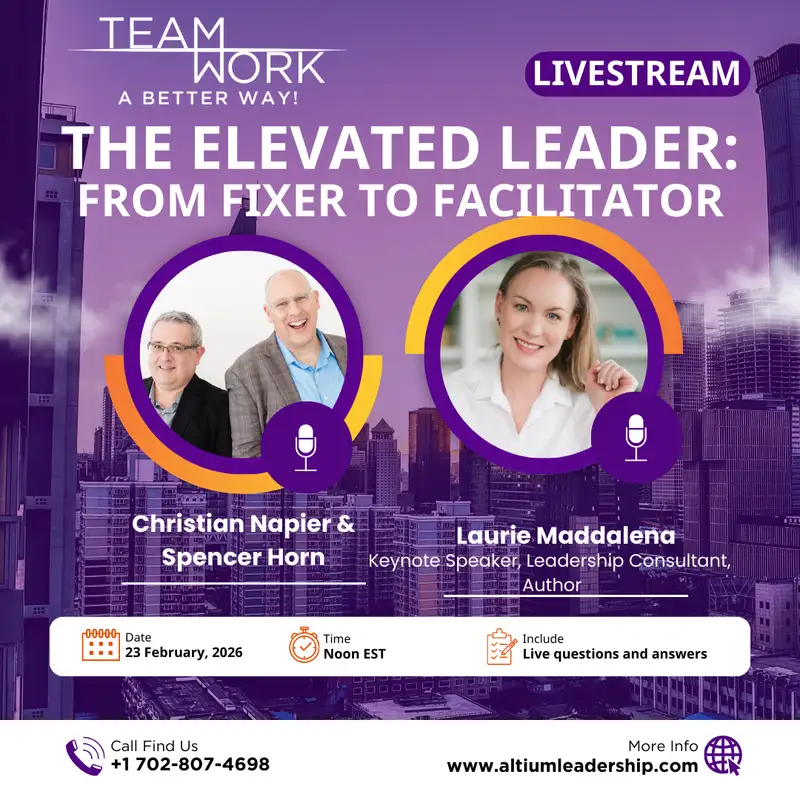
The Elevated Leader: From Fixer to Facilitator
Spencer Horn
00:12 - 00:38
Good morning, good afternoon, good evening, good middle of the night, wherever you are. We're so excited that you have joined us on Teamwork a Better Way podcast. I'm Spencer Horn, and my regular host for the last six years, I think he's missed one show, this is his second. Christian Napier was called away on an emergency when you're important like you are, Christian.
Spencer Horn
00:38 - 00:49
I know you're out there somewhere. It's good to be needed. And we miss you, my friend. But I am so excited to have my good friend, Lori Maddalena, who is filling in.
Spencer Horn
00:49 - 00:59
She's going to help me carry the show today. So good to have you, Lori. And I'm so excited to introduce you to our listeners. Welcome.
Laurie Maddalena
01:00 - 01:04
Thank you, my friend. So excited to be here and have this conversation with you.
Spencer Horn
01:04 - 01:23
We need to share all the bona fides. You and I have had the opportunity to talk. We're part of the National Speakers Association where you're a certified speaking professional, one of the few, very few in the world. I was looking at your resume online and just an amazing, talented woman.
Spencer Horn
01:23 - 01:43
So, for those of you who don't know Laurie, she is the CEO of Envision Excellence. For the last 17 years, she has been out consulting and working with organizations to develop leadership. She is an author. Several times over, her latest book is Envision Excellence.
Spencer Horn
01:43 - 01:48
Oh, excuse me. That's the company, The Elevated Leader. Sorry. The Elevated Leader.
Spencer Horn
01:48 - 01:58
Boost your confidence and transform your team by mastering coaching, accountability, and difficult conversations, which is just about everything that leaders struggle with. Right, Laurie?
Laurie Maddalena
01:58 - 01:59
100%.
Spencer Horn
01:59 - 02:27
Yeah. We're going to talk about that. And so as a keynote speaker, she helps her audiences and leaders shift from overwhelmed fixers to confident facilitators, which is really the theme of today, in addition to your book talking about how do we make that shift. And your mission is to help leaders and organization create cultures where people love to come to work.
Spencer Horn
02:28 - 02:41
You know, that's something I talk about a lot. How do you get people to love what they do? And so that's gonna be a big part of our theme today. I wanna make sure that when our listeners come away that they know exactly what to do with that.
Spencer Horn
02:42 - 02:54
So let's start off with this, where did your love for making this shift with leaders from, you know, fixers to facilitators come from? Where did that all start?
Laurie Maddalena
02:54 - 03:32
Yeah, well, I think it was really a progression because when I was first promoted to a leadership role in my early 20s, I had no training whatsoever. And so I was kind of thrown in there and it wasn't easy. And over the past few decades, leadership has evolved even more to where the skills that are required to be successful today are much higher. And I've seen this pretty common practice that still happens in companies, which is promoting people for technical ability and not promoting for leadership qualities.
Laurie Maddalena
03:32 - 04:17
And so we put people in these roles where they were rewarded for success as individual contributors to fix problems, to solve problems, to be in the trenches and the tasks. And then we promote them to leadership roles and in most cases, don't give them any training, and they do what they thought they should do, which is get in the trenches, move things along, solve problems, and they become fixers. And I think you could be somewhat successful a few decades ago being a fixer leader, a more traditional leader, but in today's environment, it requires so much more. And so it's usually the thing that holds people back from being successful in a leadership or executive role.
Spencer Horn
04:17 - 04:40
Yeah, because the skill set required in that leadership role is very different than the technical skills that got them the success that they had. And as you said, they get in the trenches because that's what they know. And in many cases, Laurie, isn't that where they feel They get the most satisfaction because they're good at it. I mean, we want to do things that we're good at.
Spencer Horn
04:40 - 04:57
We want to solve the problems that we have the ability to solve. And so we jump in and do those things where we naturally feel comfortable. And especially if you don't have the new skills to do something different, we just follow in those patterns of what we have developed, right, without any other direction.
Laurie Maddalena
04:58 - 05:18
Yeah, and I think for a lot, this is, this is absolutely my story. When I was promoted to a Director of HR after being an HR Generalist, which was a sole contributor position, I thought that I should keep doing what I was doing before, because that was my talent. I had gained all this expertise in HR. So I was,
Spencer Horn
05:18 - 05:19
And you're good at it.
Laurie Maddalena
05:20 - 05:51
I was very good at it. And I don't know if you've read Gay Hendricks books, book, The Big Leap. I love he talks about the zones, the four operating zones, zone of incompetence, which yes, can do zone of competence, you know, we have some talent or skill, but probably not the best at zone of excellence and zone of genius. And the key shift here is that many of us stay in our zone of excellence, which is maybe our technical abilities, things that we've done well.
Laurie Maddalena
05:52 - 06:14
But when we're promoted to a new role, it's the zone of genius where we're now at a place where we're the value to the organization. So when I was first promoted, I was getting in the trenches, still doing the things I was doing before. So I might have been a value to that one person, but I wasn't being a value to the organization. because I wasn't leading at that strategic level.
Laurie Maddalena
06:14 - 06:35
But I think for a lot of people, telling them to be strategic doesn't feel, it's not tactical, right? Because in our previous roles, we could check things off the list. And so moving into a leadership role, where things are a little bit more fluid, you have to facilitate in a different way, that feels very uncomfortable for most of us.
Spencer Horn
06:35 - 06:54
Right. Well, I want to come back to this idea of value to the organization, but before I do, you mentioned that what enabled us to be successful in many cases, jumping into the trenches when we get promoted as that technical leader, 10, 15 years ago worked, but it doesn't today. Why?
Spencer Horn
06:54 - 06:56
What's happened? What's different from your perspective?
Laurie Maddalena
06:57 - 07:28
Yeah, we went from an environment that was traditionally focused of a few decades ago, where what was valued was tenure, loyalty, sacrifice, and probably less women, less both partners working. And over the years, this evolution has started to shift on where we have, in many cases, both partners in the household working. More women in the workplace, generations, five generations in the workplace made it more complicated. Now they have more choices.
Laurie Maddalena
07:28 - 07:40
The internet came about. Those generations had more choices. And so what they wanted at work shifted and it shifted dramatically. They were no longer willing to work at a job at the expense of their personal life.
Laurie Maddalena
07:41 - 08:08
quality of life became much more important. And so the skills of what leaders need to be able to do today of keeping people, they're not just going to stay because they started at their job and they're gonna stay their whole career, those days are over. And so this is more of a modern leadership environment where it takes a lot more to keep people than- I think you've just articulated the problem so well.
Spencer Horn
08:08 - 08:18
And I mean, I love that. I 100% agree. So basically, what you're saying is we have to up our game to keep the best people. Because the expectations of people are different today.
Spencer Horn
08:18 - 08:28
They are no longer there for the long term. And I mean, our generation, I mean, I look at you, and I think you're just a kid. But you've been around a while. I mean, you've got some great experience.
Spencer Horn
08:28 - 08:35
But you know, so in our generation, I mean, people stayed at companies for decades, right?
Laurie Maddalena
08:35 - 08:52
That's right. And I came, I entered the workforce during a time where this more traditional style was still very, very common. And so a lot of us were conditioned that way. And many people who were leaders and managers now were conditioned in the traditional environment.
Laurie Maddalena
08:52 - 08:59
So I even find many seasoned leaders struggle. Because they haven't evolved their practices.
Spencer Horn
08:59 - 09:31
No, who did they learn to lead from? The baby boomers, the greatest generation who fought two world wars, and it was very top-down command and control, just very hierarchical. In today's world, we have more of a holacracy, right? I mean, you've got to kind of lead your Lead yourself, but so let's come back to what you said that you didn't you didn't look at things strategically you weren't You know you needed to be a value not just to the individual but to the organization So as
Spencer Horn
09:31 - 09:48
so as you got that promotion to now HR manager from HR specialist, how could you? be of greatest value to the organization. What is it that you can now do that all of a sudden makes you indispensable?
Laurie Maddalena
09:48 - 10:09
Yeah, in that role, what my VP told me is that she wanted me now creating leadership programs for our managers, helping to train them. And so in this role, it really shifted. I shouldn't be doing payroll, benefits, anything else. I was still stuck there thinking I was helping my team, but I wasn't helping them.
Laurie Maddalena
10:09 - 10:17
I needed to delegate, which I think is, and I call, I have this framework of the six leadership saboteurs, and this is one of them.
Spencer Horn
10:17 - 10:21
I can't wait to talk about it. I'm so excited to learn all about those. We're getting there.
Laurie Maddalena
10:22 - 10:47
Lack of delegation is one of them. And that was my biggest challenge moving in that role because no one taught me that. But what I brought, the value I was bringing was now my higher level leadership skills. How can I help transfer those to other managers and lead my team by giving them the autonomy, not getting in the trenches and busying myself by fixing all the time.
Spencer Horn
11:00 - 11:39
All right, Lori, so I'm going to interpret what you said into what I believe, and that is you become the value to the organization when you develop other leaders. In a way, it sounds counterintuitive, but you basically need to learn to replace yourself. So the problem is when you are tactical, that's doing the job, and when you get the best sense of value yourself from doing the job, you are replaceable. Because we can teach anybody to do those technical skills.
Spencer Horn
11:40 - 12:05
The skills that you are now in your story developing which we're gonna get into, the delegation and all those other things, the leadership skills, those are so much harder because they are rarer, which is why we need to spend so much time developing it. And if you have the ability to develop those skills in others, what does that do for the organization and for basically your success as a leader?
Laurie Maddalena
12:05 - 12:20
Yeah, well, it then multiplies your results. So you're not the bottleneck anymore. You're facilitating the results through your team. And not only is that a best leadership practice now, but it's also what people want at work.
Laurie Maddalena
12:20 - 12:32
And I think that's the shift now. They don't want to just be told what to do and be order takers. They want some fulfillment and a connection to their workplace, which is how you can facilitate that.
Spencer Horn
12:32 - 12:54
All right. So, so you just said here that you want to create cultures where people love to come to work. Now, according to Clayton Christensen, you've just given the formula of one of the things that causes people to love their work. And that is that they're given a challenge, that they can have a contribution.
Spencer Horn
12:54 - 13:23
that they make a contribution, that they matter, right? And if you're the fixer, that means you're stepping in, is what I'm interpreting you as, that you're stepping in where your people should because either you think they're incompetent or they've made a mistake or they've made a problem that you now have to correct. But what happens, Laurie, in your experience if you as a leader step in and fix? What is the impact of that on the individual and the organization?
Laurie Maddalena
13:23 - 13:39
Well, not only does the individual not feel like they're not trusted or given autonomy, they're micromanaged. So they don't have the ability to now develop their skills. And you just, again, you become a bottleneck. And you're not using your skills in the best way possible.
Laurie Maddalena
13:39 - 13:56
I mean, you're really not a leader. Maybe you're managing things, but you're not leading people. And that is, that is the shift that it's not easy to do. It's not easy to pull yourself back and look more strategically and not be in the trenches, because we — Why?
Spencer Horn
13:56 - 13:59
What's, what's, what's the block? What holds people back?
Laurie Maddalena
13:59 - 14:18
I think part of it is we equate our value with those technical skills. And when we shift into the leadership role, the competencies required for success change. But a lot of us don't make that mindset shift. We think it's still our technical abilities that got us to where we are and that is going to continue.
Laurie Maddalena
14:18 - 14:23
But now we have to make a fundamental shift in how we approach our work every day.
Spencer Horn
14:23 - 14:27
So we have to actually put our trust in the hands of other people.
Laurie Maddalena
14:28 - 14:34
Right. And that's easy to say. But in practice, many leaders are not doing that.
Spencer Horn
14:35 - 14:45
So how do you get them to do it? I mean, how do you get to that elevated leader? What's the formula?
Laurie Maddalena
14:45 - 15:16
The first step is really to understand your key result areas. And this is something I take people through this process in the book of what is the value that you bring to the organization in this new role? So what are the three to five most important areas where you bring value, where you should be focused as a leader. If you lead even one person, one of those key result areas should be coach and develop your team to bring out their best performance and create a cohesive team.
Laurie Maddalena
15:17 - 15:54
You know, you work a lot in teamwork, Spencer. That is a huge responsibility of a leader, is caretake the culture of your team. And so first by identifying what those key results are, so then we're clear on where I should be focused on a daily basis, not in the tasks, not in the trenches, but in these key areas that are facilitating the best performance for my employees. And so if now I'm coaching them and I'm using some of these more modern type of leadership skills, I'm able to facilitate them bringing out their best performance.
Laurie Maddalena
15:54 - 15:57
Some of that is done through questions,
Spencer Horn
15:57 - 16:38
Sorry to interrupt you and I really want you to make this clear because when you say coach and facilitate and delegate, I want you to define that because what I'm seeing a lot of leaders do, I think one of the issues that gets in the way of leaders actually coaching and developing is they're so busy. First of all, they're in the trenches doing, so they're afraid that I don't have time to actually stop and ask the questions, right? So they're so busy, but they're more interested in efficiency than they are in actually effectiveness and coaching and teaching.
Spencer Horn
16:38 - 16:58
This is my experience. In other words, it's all about getting the job done, which is actually true, but there's a paradox here. So you're doing the work and you're carrying the burden and you're not leveraging the power of the team to be efficient. And you actually, I want you to define what that means coaching and developing.
Spencer Horn
16:58 - 16:59
How do you do that?
Laurie Maddalena
17:00 - 17:22
Yeah. And I think what you said is exactly my experience as well, is most people think that they're too busy to coach because they're trying to fit it in amongst all these other tasks that they're doing when really they're missing the first step. So the first step is creating clarity around what those key result areas are. Most people lack focus, they're not focused on the right things.
Laurie Maddalena
17:22 - 17:35
So we have to identify what those things are. So coaching, for example, let me just give you a practical example. Let's say an employee comes to you, the manager, and says, I don't know what to do here. What should I do?
Laurie Maddalena
17:36 - 17:53
A fixing manager, which is how most of us were taught, would say, Here, I'll either take it from you and take care of it. So you just go do the rest of your work, or here's how you do it. And we tell them what to do. And we're not building the capacity of our team that way.
Laurie Maddalena
17:53 - 18:00
We're not building their skills. we're not helping them to take ownership in their roles and really develop and grow.
Spencer Horn
18:00 - 18:04
And so a facility- No, because the idea is coming from you, not them.
Laurie Maddalena
18:04 - 18:05
That's right.
Spencer Horn
18:05 - 18:18
And so the ownership is with you, the leader, and not with the person you're trying to create ownership with. Managers are complaining, my people don't care as much as I do. That's because you're telling them what you would do.
Laurie Maddalena
18:18 - 18:37
we're creating that. Even people who want to take ownership, they start to be conditioned that, oh, my manager will take the problems. You just upward delegate the problems to the manager. That's why we've become so busy, because we're working on the wrong things.
Laurie Maddalena
18:37 - 18:52
We're not facilitating and developing our team. We have to move from fixer to facilitator. So in that particular example, a facilitator would be curious and use this as an opportunity. It might take a little bit more time, but they're building the skills of their team.
Laurie Maddalena
18:53 - 19:08
So I might say, well, what options have you thought of? Or how might you approach this issue? And so now you're getting your employee to think through, or maybe you're co-creating how you move forward with it, but you're not taking on that issue yourself.
Spencer Horn
19:17 - 19:33
Laurie, that's so hard for so many to do is not take that on. That's where you have to let go. And when you do, the results can be magic. The opportunity is for you to get the ownership at the other level.
Spencer Horn
19:33 - 19:47
The challenge that I see, Lori, is that people don't know how to ask questions the way you just asked. You made it sound so simple. What I hear people do is asking questions like this, well, have you thought of doing this? Have you thought of doing that?
Spencer Horn
19:47 - 20:03
Well, could you do it this way? And basically, what they're doing is they're injecting their own perspective or bias into the question. And so it's not really genuine coaching. I mean, it's because they just want you.
Spencer Horn
20:03 - 20:12
They're like, OK, Lori says I need to ask questions. And so I need to make this go as fast as possible. Well, have you thought about asking them this?
Laurie Maddalena
20:13 - 20:14
And you're leading them there.
Spencer Horn
20:14 - 20:17
And you're leading them, and you're still fixing.
Laurie Maddalena
20:17 - 20:33
Yes, yes, that's still absolutely fixing. And you know, you said it's a paradox, right, of letting go of control. And many of us hold on to control for many reasons. One is, we want it to be right, or we're afraid if we let go, it won't go well.
Laurie Maddalena
20:34 - 20:47
Or maybe we're even afraid sometimes of overloading our employees. And we think in our mind that we're overloading them when really this is the opportunity to develop them. And we have to do it well. You can't dump on people.
Laurie Maddalena
20:47 - 21:09
You have to delegate appropriately. But the lack of focus, and that's another one of the leadership saboteurs, is we're not focused on the right things. We're focused in the trenches and we convince ourselves that we don't have time to lead. to coach, to have meaningful one-on-one meetings where we're creating alignment with people.
Laurie Maddalena
21:09 - 21:22
And so we spend our days reacting and being busy, and we convince ourselves there's not a better way when there absolutely is a better way of being more intentional with how we're using our time every day.
Spencer Horn
21:22 - 21:26
Excuse me. So, oh, geez, got this cough, but
Laurie Maddalena
21:28 - 21:52
Well, as you're doing that, I'll talk a little bit about intentionality because I think this is the core. This is the core of the elevated leader model that I talk about in the book is intention because most of us, I imagine it like if you get on, you know, those lazy river rafts when you're at a nice resort, it's like jumping on the raft and it's great on vacation, right? You're just like, you know, going nowhere.
Laurie Maddalena
21:52 - 22:09
But I think this is how most of us treat our days. We jump on the raft in the morning and it's wherever it takes us is what we're dealing with. We're reacting instead of simple practices that help us be much more intentional with our focus and energy. I don't think it's even managing time.
Laurie Maddalena
22:09 - 22:15
It's managing our focus and our energy on the things that matter, the right things.
Spencer Horn
22:15 - 22:23
So give me an example of how you would do that. If you're a leader and you want to create that alignment and focus, how would you do that?
Laurie Maddalena
22:24 - 22:37
The first thing, a key result there is, which we've talked about. Then two, we want to start creating our schedule as much as possible. And I can hear some leaders saying already in their mind, oh, I'm in meetings all day. I don't have control.
Laurie Maddalena
22:38 - 23:02
OK, so I do think we have a lot more control than we think we do. And there was a study this past year that talked about 50% of our interruptions are self-inflicted. This is us having up our email all day. It's allowing the distractions and people to come in our office constantly, checking our phones, all of those things are things we can control more of.
Laurie Maddalena
23:03 - 23:09
There are some outdated practices that we have to get rid of. For example, the open door policy.
Spencer Horn
23:09 - 23:11
100%.
Laurie Maddalena
23:12 - 23:16
I think this is one of the worst practices in organizations and what we really need.
Spencer Horn
23:16 - 23:24
But I want to be I want to be an accessible leader. I want to be a I want to be a lawyer. I want to be a positive leader. I want to be available for my people.
Laurie Maddalena
23:24 - 23:47
Yeah. And you can be approachable and supportive without being available all the time. And if you're available all the time, it's a surefire way that you will not be effective in a leadership role. We need time to think, to reflect, to plan, to strategize, to get work done, real work.
Laurie Maddalena
23:48 - 23:57
Most people are not getting real work done because they have everything up all day and they're constantly interrupted. We have to create that space for ourselves. No one will do that for us.
Spencer Horn
23:57 - 24:19
So here's what I'm hearing. So there's a law called Parkinson's Law, which says work expands to fill time available. So if you actually restrict the time you have available to work, you'll be more productive as long as you're being focused. Because if you're allowing, what I heard you say, if you're allowing those interruptions all day, you're doing what's called context switching.
Spencer Horn
24:20 - 24:48
So you're working on something, somebody interrupts you, You stop and focus on them, but now instead of just picking up where you were before, you have to get yourself back into the mindset. It takes you twice as long to do everything. If you focus your time in short blocks of focus, you will be more productive. So how does that look like when someone comes to you, Laurie, and says, hey, you got a minute, Laurie, can you help me with this report?
Spencer Horn
24:49 - 24:55
How would you manage that so that you're appropriately teaching your people your boundaries?
Laurie Maddalena
24:56 - 25:07
So I think there's a couple of ways. If someone comes in in that moment, it might be saying, I'm focused on a project right now. I'll be available in 30 minutes or I'll stop by your desk. But I think even better.
Laurie Maddalena
25:07 - 25:20
is where you are blocking what I call productivity sprints on your schedule. So let's just say it's an hour, an hour and a half, where you are going to close your door, and even better, you go to a different location.
Spencer Horn
25:21 - 25:23
Do not disturb on your phones.
Laurie Maddalena
25:23 - 25:43
on your phone, closing your email and you are focused on one thing, not five things where you're task switching like you were talking about one thing. And the key with your staff, though, is that you set the expectations. you say to them, I'm going to close my door. I'm going to go to a different location.
Laurie Maddalena
25:43 - 25:54
When I was an executive, I would go to a coffee shop across the street. And so I'd say to my staff, I'm going to go to the coffee shop for a couple of hours. I will be back at one o'clock. So you can say to your staff, I'm going to close my door.
Laurie Maddalena
25:54 - 26:09
I will be available at one o'clock. And I will tell you, I think that 95% of the time, your staff will not bother you because they know, you've set it up for them, and they know the expectations that you will be available.
Spencer Horn
26:10 - 26:14
And in many cases, they'll actually do the work that they were going to ask you the question about anyway.
Laurie Maddalena
26:16 - 26:27
Absolutely. And so they learn to use their resources. I think the challenge is, for a lot of us, we are approachable. And when you're approachable, it makes it even easier for your staff.
Spencer Horn
26:27 - 26:28
You're not helping them.
Laurie Maddalena
26:29 - 26:39
That's right. Hey, quick question, Laurie, just really quick. And they had a resource binder right there, or they could have found that some other way.
Spencer Horn
26:39 - 26:51
Laurie, I'm coaching this senior, I'm talking about second-in-command of a construction company. 16 direct reports, so busy. We're having a coaching session. He cannot focus.
Spencer Horn
26:51 - 26:56
His phone is ringing. I said, Answer the phone. Put it on speaker. It was one of his project managers.
Spencer Horn
26:56 - 27:18
They were, they were working at an airport, getting ready to erect this They're steel erectors, right? Literally, my jaw was open. I'm like, this is exactly what we have been talking about because he knows exactly in the plans the question that he was asking and you answered his question. So what did you just train him to do?
Laurie Maddalena
27:18 - 27:19
That's right.
Spencer Horn
27:19 - 27:38
You just trained him to ask you that every time he has a question because he wants your approval, he wants to make sure that people are risk averse and they want to know they're not going to get yelled at from their boss for doing anything wrong. But the plans had it right there. So you're training your staff to treat you like chat GPT.
Laurie Maddalena
27:39 - 27:43
I love that you did that in that moment, instead of just saying, don't answer your phone.
Spencer Horn
27:43 - 27:46
I want to see what's going on.
Laurie Maddalena
27:46 - 27:59
It is a coaching opportunity because this, so this leader and almost so many leaders struggle with this. Right. But yeah, it's in there and you're right. Now we're conditioning our staff.
Laurie Maddalena
27:59 - 28:02
that one, they can get the quick answer by calling us.
Spencer Horn
28:03 - 28:08
But even more important- Because they're focused on efficiency too. They want to get stuff done so they can have their balance of life, right?
Laurie Maddalena
28:09 - 28:15
Because they're also busy and they're thinking, if I can get the answer in one minute instead of having to look it up.
Spencer Horn
28:15 - 28:15
Right.
Laurie Maddalena
28:15 - 28:29
But it's also creating what you're talking about, of now people feel like they have to please the boss, that they have to have that approval, that they're not feeling like they have that autonomy. They're not building that in their skills. And that's really what we want to do.
Spencer Horn
28:29 - 28:33
And then they wonder, Laurie, then they wonder why their satisfaction in their job is not there.
Laurie Maddalena
28:33 - 28:43
That's right. I mean, you see the Gallup data come out. I mean, it's at a decade low right now. 31% of employees are engaged at work in the United States.
Spencer Horn
28:43 - 28:46
And how many, what percentage are actively disengaged?
Laurie Maddalena
28:46 - 29:05
Actively disengaged hovers around 50%. And to me, that 50% is such a sweet spot, because we may think it's that person who just doesn't want to put in the extra effort. In my experience, a lot of it has to do with leadership. They don't have engaging leaders.
Laurie Maddalena
29:06 - 29:10
And so they're just putting in enough to get by. They're not really working to their capacity.
Spencer Horn
29:12 - 29:24
Well, you've talked about the saboteurs, and you started with one of them, the wrong focus. What are the rest? Run us through all these different saboteurs.
Laurie Maddalena
29:24 - 29:42
Yeah, so lack of focus is one, which is a huge one. And a lot of the principles are not hard. things you and I have been talking about. Locking your calendar, right, you know, coming up with your top two focuses the day before you leave the office for the next day.
Laurie Maddalena
29:43 - 29:52
Simple practices. The second is lack of self-awareness. Many leaders are not self-aware of their impact. And this could be egregious, or this could be subtle.
Laurie Maddalena
29:52 - 30:40
This could be a very toxic leader who is commanding control and creates fear on the team, or this can be someone who monopolizes conversations and doesn't realize that they're not allowing others into the conversation. And so this is a lifelong project, I believe, for all of us, is understanding, being self-aware of our strengths, our limitations, our frustrations, our hot buttons, what can get in the way of us working at our best. And so the more we can understand that, the better we can manage so they don't come into they don't show up as weaknesses as much, we're able to manage those tendencies. Lack of delegation, which was my top saboteur, and I'll say continues sometimes to be.
Laurie Maddalena
30:40 - 31:00
So some of these saboteurs, I believe all of these leaders have experienced at least a couple, and that none of us is immune from these. And sometimes when you take on higher level work or maybe a promotion, they can pop back up again. So you may have managed it.
Spencer Horn
31:01 - 31:26
There is a dynamic that happens with new leaders that actually sabotages your success. And that is you feel like you have to justify the promotion, sometimes new leaders feel like they have to have all the answers. And there's this sense of imposter syndrome because you don't know everything right away. And so it's like, okay, I need to have more answers.
Spencer Horn
31:26 - 31:39
I need to prove myself. And so I think a lot of, this is my experience, a lot of leaders feel it's weakness if they say, I don't know, let's figure this out together. Because they feel like you should all of a sudden have all the answers when you get promoted.
Laurie Maddalena
31:40 - 31:58
Yeah. And that's, again, that traditional mindset, right, that a lot of us were conditioned to is you're helping to get rid of the bottlenecks in production or the results of your team. And you get in there and you just move things along. And now we need to facilitate that, which is very uncomfortable, as you're describing.
Laurie Maddalena
31:58 - 32:20
For a lot of us to step into that, it's a lot more vague than it used to be. managing things, very different leading people. And so that lack of delegation piece, you know, that was what my manager was basically telling me, my VP was, Lori, you need to get out of the trenches, you need to delegate to your team. And that was a skill I had to learn.
Laurie Maddalena
32:20 - 32:42
And in fact, it's still something I have to, in my business, be very conscious of. of letting go of things that are no longer a great use of my time, and freeing up my time to work in those key result areas. And so that's a big one that can get in the way. Lack of team engagement, which often correlates with some of these others.
Laurie Maddalena
32:42 - 33:07
If you're not focused on your people, you're going to have a lack of team engagement. If you're not self-aware, most likely a lack of team engagement. But this is also someone who's just a reactive leader who maybe is just waiting for things to come to them and not proactive, which lack of active leadership. So someone who is more of a passive leader is a leadership saboteur.
Laurie Maddalena
33:07 - 33:25
So in the traditional environment, You can be fairly successful by reacting to things coming your way and processing and moving on. In today's environment, it takes a lot more energy and effort. So you need to have one-on-ones to build alignment. You need to have team meetings.
Laurie Maddalena
33:25 - 33:50
You need to coach people in the moment. If someone's not performing, you have to have that conversation for the sake of your team. And many leaders are hiding behind their laptops in their offices, and they're very passive with their approach. And then the last one is conflict avoidant, which I see at every single level of leadership, including the CEO.
Laurie Maddalena
33:51 - 34:19
where it's just this, whether it's discomfort, I don't think any of us wakes up in the morning wishing we had people problems, right? I mean, like none of us is like, yay, someone didn't do their job today. I need to have a tough conversation, but it's a skill we can learn. And I think for a lot of people, they think of it as confrontation and as a huge challenge instead of processing through the challenges.
Laurie Maddalena
34:20 - 34:34
to get a better result. And so our mindset is even around, this is confrontation, I'm gonna avoid it, or I don't feel comfortable, I don't have the confidence and the skills. And those things we can learn. But I don't think everyone's meant for that.
Laurie Maddalena
34:34 - 34:45
And I say this in the book, I don't think everyone's meant to be a leader. And so these are the things we also have to assess in ourselves of, do we align with what it takes to be a leader in today's environment?
Spencer Horn
35:01 - 35:17
Well, there's a number I've heard that psychologists say that only 10% of people around the world are self-aware. What do you think about that number?
Laurie Maddalena
35:18 - 35:21
Yeah, that's interesting. That's probably accurate, right? And I mean, that's for sure.
Spencer Horn
35:21 - 35:24
So that means that's me, probably.
Laurie Maddalena
35:24 - 35:29
We all think we're aware. Here we are thinking we're self-aware, and we're probably not.
Spencer Horn
35:30 - 35:38
I mean, I do my best, but there, there are times I know that I'm like, Oh man, I can't believe I just allowed that to happen. I just got hooked again.
Laurie Maddalena
35:38 - 35:55
Right. Well, a hundred percent. I mean, I deal with this in my own life as well, where I don't think I'm a hundred percent self-aware. I'm very conscious of looking at what are my triggers, my emotional hot buttons.
Laurie Maddalena
35:55 - 36:17
And I'm, I'm, I know a lot of them are there, but I'm still exploring this and seeing, you know, in my own life, I know the night before I have something big. So maybe it's a speaking engagement or it's, I have to get up early in the morning to travel to a client. My stress level is higher. And I find that with my kids, my family, I tend to be more.
Laurie Maddalena
36:17 - 36:30
project management, like, why are we not in bed? What are we doing? And that angst starts to build up. And it took me a while to see that, that this is impacting my family life.
Spencer Horn
36:30 - 36:58
I call it, you have an increase focused on task and that's when you are emotionally hijacked in a way that the focus increases on task and reduces on relationship, which relationship is what you need to sustain people's engagement, right? The team performance. So on one spectrum, we have, we need to get the task done. On the other side, we need to have, you know, that positivity.
Spencer Horn
36:58 - 37:12
And, you know, you and I were talking beforehand about Team Coaching International, and the model that they have is they measure two, two elements on teams. Actually, there's 14 elements within those two. The No. 1 is productivity.
Spencer Horn
37:12 - 37:26
That's the task, right? So how productive is your team? Well, that's great if you're productive for a week or for a month, but can you do it for a year and year after year? And in order to do that, you have to have conditions on that team, which is what we're talking about.
Spencer Horn
37:27 - 37:50
It's the leadership, it's the relationships, it's the positivity that allows your team to want to run back to the office tomorrow. I mean, Clayton Christensen told the story where he had a company party. He started this medical technology company with professors from MIT. They're all these smart people.
Spencer Horn
37:50 - 38:28
They're all scientists. And he saw one of his lab analysts who everybody was pressuring to measure their experiments. And she just didn't have the capacity to respond to everybody according to their demand timetables. And he looked at her with her husband and her two daughters, and he imagined her going home feeling defeated, feeling that she had failed, that she had not responded to everyone, and that the pressure from the team was, you know, you're not – I need this and you're
Spencer Horn
38:28 - 38:53
not providing what I need. And how that impacted her when she walked in the door to see her two daughters and her husband every night, and how she felt about showing up to work the next day. And in that same musing, I mean, he was just imagining this, right? He's like, how would she feel going home knowing that she made a huge impact, that she was appreciated, that she was valued, that she was a contributor?
Spencer Horn
38:54 - 38:57
And just the difference that that made walking in the door.
Laurie Maddalena
38:58 - 39:32
I love that visual because, you know, managers, leaders have an impact on more people in this world, I think, than any other profession. We all have leaders in every industry. And it absolutely impacts people's personal life, their own personal wellbeing, which is why the work wellbeing, the culture, and as you talked about, I absolutely remember this from the team training, which is the productivity and positivity, that you have to have both of those. And I think in our traditional environment, we favored more productivity.
Laurie Maddalena
39:33 - 39:38
a few decades ago. It was very focused on results, right? And at that time, it worked.
Spencer Horn
39:38 - 39:47
And you could separate your personal from your business life. So they would say, people are still trying to hold on. Oh, I keep my personal and my professional life separate. Bull crap.
Laurie Maddalena
39:48 - 40:02
That's right. And like we would say things like, check your life at the door, like you could do that, right? Right. And then there's the positivity element, which I think over the decades became much more important of making sure we have both of those productivity and positivity.
Laurie Maddalena
40:02 - 40:17
But there's some leaders who focus on one more than the other. So we talk sometimes about more the toxic, but there's also leaders who create artificial harmony on their team or challenges on their team by not processing issues that are happening.
Spencer Horn
40:17 - 40:36
And so it's a whole... And avoiding those difficult conversations longer than they should. So do you see, like, my natural personality is to be more of that task-oriented person? And there are people that are, so task first, relationship second, not sustainable.
Spencer Horn
40:36 - 40:57
But then there's also people that are relationship first, and they're so worried about the relationship that they're not, and that's what I wanted to get back to your conflict avoidance question, that they're so relationship oriented that they're worried about offending anybody, that the task isn't getting, so you need both, right? And the balance, that's where that self-awareness really comes in.
Laurie Maddalena
40:57 - 41:08
That's right. It's equally destructive. Because now, and I've experienced it, experienced this. I've been on a team before where there was a leader who was really nice, just really great person.
Laurie Maddalena
41:09 - 41:19
But when someone wasn't performing, she didn't do anything about it. And so what happened was it frustrated the rest of the team. So that's not leadership. We have to have both of those.
Spencer Horn
41:20 - 41:33
And they don't trust you to handle difficult things and so they're not trusting that you're working in their best interest. So how did you learn it? You said you're learning these skills. What was your process?
Spencer Horn
41:33 - 41:35
How did you start to learn how to delegate?
Laurie Maddalena
41:36 - 42:03
So in my 20s, I had to go out and start getting my own leadership training. And then when I was promoted to that Director of HR role, I was lucky enough to have a VP who just would give me things and sometimes, like be very hands-off in a way that I had to figure things out on my own. And so I had to figure out how to delegate and to be at this higher level that she was expecting. You know, I do think that overall, these are learnable skills.
Laurie Maddalena
42:03 - 42:23
However, not everyone wants to be in a role like this. And so, you know, being a traditional leader 30 years ago compared to being a leader today with 5 generations and higher expectations is very different. And so this is why, where I think organizations go wrong is we keep promoting people for the technical. And we have to stop that.
Laurie Maddalena
42:23 - 42:59
We have to be much more selective and also give people a peek behind the curtain of what it is before they get there. Help them understand what it will take to be a leader so they can opt out or they can decide they want to move into a leadership role, but they know the expectations and they can develop those skills. But if it's not aligned with what you want to do, if you will be feeling terrible every day coming to work because you're forced to do things outside of your abilities and what you want to learn, it's not going to be the right role for you. So I don't believe everyone's meant to be a leader.
Spencer Horn
43:09 - 43:38
Okay, now if you're listening to this, you're saying don't promote everybody, promote those who are a leader, but I think organizations right now are under pressure because there's a dearth, there's a shortage of effective leaders. I mean, I've worked with, and I won't name any names, I've worked with very, very, in the world's eyes, high-performing organizations. and yet they're struggling to keep the best people. Why?
Spencer Horn
43:38 - 44:05
Because their competitors are on this upward trajectory and they're stealing their best people. New up-and-coming companies where they're giving people opportunities, because there's kind of a shortage of best peoples, the poaching that's going on is unbelievable. So you have to create an environment where people want to stay and are not going to be lured away by your competitor. How do you do that?
Laurie Maddalena
44:06 - 44:08
and I think a big piece, yeah, go ahead.
Spencer Horn
44:08 - 44:34
No, no, I mean, well, you don't, if it was your boss, you don't just say, all right, Laurie, I'm just gonna give you stuff, sink or swim. It's, Laurie, I have so much faith in your capacity and your ability that I'm gonna give you stuff and step back. Let people know what you're doing to them, right? And create that environment where people wanna stay so that you can actually choose and not be desperate to just take the best person because I think that's happening, don't you?
Laurie Maddalena
44:35 - 44:46
Oh, absolutely. It's still happening, unfortunately. And I think the other thing we do is we, we promote the people, and then we don't give them the leadership skills. So we're not training them.
Laurie Maddalena
44:47 - 45:30
We're putting them in and basically setting them up for failure, not for success. So, I mean, if there's 2 things that I think you can do to elevate your culture, One would be to stop promoting for technical ability, start to do a talent assessment of your leaders, understand where they are, and then give them some comprehensive training. Sometimes I'll go in and I'll do a training for an organization and senior leaders who've been there a long time now feel like they have skills and they feel like this modern style is even more aligned to their own values of, you know, not confrontation, but more coaching. not disciplinary action, but we're, we're having real conversations with people.
Laurie Maddalena
45:30 - 45:45
We're creating a place where they want to come to work and not having these negative leadership habits. So it's, it's really investing. It's not an expense. It's investing in people and their future and their skills and leadership.
Spencer Horn
45:46 - 46:05
Yeah, and I love that. So we've been going for about 45 minutes. I want people to know how to, I mean, your book, you've been talking around it, but if someone gets this, your book, what's that gonna help them do? Walk us through The Elevated Leader.
Laurie Maddalena
46:06 - 46:25
If they take everything to heart in this book and they put it into practice, I guarantee that they will be more effective in less time at work. They will build their confidence. They will have the skills to manage their focus, their energy, and their team. And so a lot of these things are practical, but I break it down.
Laurie Maddalena
46:26 - 46:56
I start with the elevated leader model of intention, and then the internal elements of self-awareness, of energy, of reflection, which I think in many organizations, most leaders think reflection is a luxury. Reflection is absolutely necessary to plan, to think strategically. And so it's learning how to design your days. And I understand people have meetings and they have other things, but you can absolutely deploy these skills.
Laurie Maddalena
46:57 - 47:32
And then there's the three core elements of exceptional leadership, creating clarity for our team. How do we do that through certain meetings and one on ones, but meaningful ways where we're not just wasting time, caretaking the culture and then facilitating results. And so the book really takes people through this whole, this model of how to build your days and how you work with your teams to bring out their best performance. And so you have the time to be able to be in that facilitative role.
Spencer Horn
47:32 - 47:45
I love that so much. We actually have a comment from my friend Venshi in Bulgaria. Venshi is such a great guy. Thank you for this insightful talk.
Spencer Horn
47:45 - 48:06
He's talking to you, Laurie. Going into a leadership role, I was promoted based on technical abilities, but my lack of experience leading people made me spend a lot of time in the trenches. I appreciate your advice and will implement it moving forward. Venshi, thank you so much for for listening, first of all, and joining us and validating what we're saying.
Spencer Horn
48:07 - 48:21
I want to put you on the spot, Laurie, and I'm just so grateful to have this conversation. You and I just said we're going to talk about a topic, but we didn't. We didn't really plan what we were going to say. So I'm throwing you under the bus here a little bit.
Spencer Horn
48:21 - 48:32
Can you give us an example of where your formula has made an impact? And hold on, I'm going to throw up. Then she has another comment. Plan, reflect, design.
Spencer Horn
48:32 - 48:53
create meaningful clarity, take culture and facilitate results. Yeah, one of the things that I really wanna highlight, you talk about strategic, making time, one-on-one planning. To me, another way of looking at that is anticipatory management. If you're reflecting, you're thinking about problems before they actually come up.
Spencer Horn
48:54 - 49:04
So in your words, you're not reacting to everything that's happening. You're actually, All right, what's possible? What are the challenges? As we bring on more people, what do we need?
Spencer Horn
49:04 - 49:16
Do we have enough training as we have a new product line? I mean, you're thinking about the problems before they come, so you spend less time in that firefighting mode and more time in actually being productive, which is what we want to do, right?
Laurie Maddalena
49:16 - 49:26
Right. And it makes me think of what Dwight Eisenhower said, which was essentially, plans are everything. Planning is everything, yet plans are useless. Right.
Laurie Maddalena
49:26 - 49:55
And so it's the act of planning. I think a lot of what holds leaders back from implementing some of these things is they think, Well, I can't plan because my days never go the way I want, or my days are never the same. And my response to that is planning is everything for you to take a step back, to recalibrate, to see what the strategic goals are. No, your day may not go perfectly, but how you come back to that, your focus, if you don't have a plan, well, then you're going to be reactive all the time.
Spencer Horn
49:55 - 50:14
You just invoked Eisenhower. The Eisenhower matrix is you're in quadrant one, which is important and urgent. And what we're talking about, the strategic is, is important but not urgent. And so shifting into that, I mean, even listening to this podcast is important, folks, but it's not urgent, right?
Spencer Horn
50:14 - 50:30
So some of this may be a luxury, but as you listen to it, you're actually gonna gain the skills to reduce the fires that you're fighting in quadrant one so that you can be more strategic. This is, I get so excited. Okay, give us an example of a situation where you've had a success.
Laurie Maddalena
50:31 - 50:57
I have one and it's recent where I had a participant in my program and she was telling the group how she works weekends and she works at night. And that she was really having a hard time delegating to her team and that's something she wanted to work on. And so we had talked about some of these strategies like productivity sprints, compressing time, right, of not adding hours. I think many times leaders think, I'll add hours to catch up.
Laurie Maddalena
50:57 - 51:15
And that usually has the opposite effect, because we lose capacity. The more we compress time, the more we're intentional. And so through some of those strategies, and also, I asked her, I said, What is something that you're doing right now, that someone on your team could be doing? And she told me this thing that she could train her team.
Laurie Maddalena
51:15 - 51:40
I said, all right, in the next two weeks, I want you to go and I want you to delegate that thing and implement these practices. And she came back a couple of weeks later and she said, I'm not working nights or weekends anymore. So over the course of the next four weeks, she completely stopped working weekends and nights because she was being intentional with her time. And she realized some of the things she was doing, her team could do even better.
Laurie Maddalena
51:41 - 51:59
And she was holding them back. And really, that's one of the reasons why I wrote this book. I mean, certainly to help people have more confidence in their leadership to build their skills. But even broader than that, it's quality of life so that you can enjoy your life, not at the expense of your work.
Laurie Maddalena
51:59 - 52:18
So many people are spinning their wheels all day, trying to see whatever they can get done, leaving after eight or 10 hours and thinking, I didn't get anything accomplished of value. And there is a way out of that. There is absolutely a way out of that, of being intentional and more influential and impactful as a leader.
Spencer Horn
52:20 - 52:30
Love that. Great, great, great example. Well, we've got... I've got just one thing I want to share before I give you the lightning round.
Spencer Horn
52:30 - 52:57
You know, we've been talking about team coaching. They have been a sponsor of the show, and I would love it if you're listening to this and you want to kind of see where your team is on the scale of productivity and positivity. If you take a picture of this QR code, I know you have to watch it in either LinkedIn or YouTube or live. And if you're listening to it, go find it on that.
Spencer Horn
52:58 - 53:26
Take a picture of this or I will put it in the show notes. You can have a free what's called team diagnostic to kind of see where your team is at. So let's play one more sounder. All right, Laura, I have a lightning round of questions for you.
Spencer Horn
53:26 - 53:30
Basically, just one word or super short answers, okay? You ready?
Laurie Maddalena
53:31 - 53:31
I'm ready.
Spencer Horn
53:32 - 53:36
All right. Fixer or facilitator, which were you early in your career? I think you already told us.
Laurie Maddalena
53:37 - 53:37
Fixer.
Spencer Horn
53:37 - 53:41
One word that defines elevated leadership.
Laurie Maddalena
53:42 - 53:43
Intentionality.
Spencer Horn
53:44 - 53:46
Most underrated leadership skill.
Laurie Maddalena
53:47 - 53:48
Reflection.
Spencer Horn
53:49 - 53:53
Coaching or directing, which builds stronger teams?
Laurie Maddalena
53:53 - 53:54
Coaching.
Spencer Horn
53:55 - 53:58
A leadership habit you had to unlearn?
Laurie Maddalena
54:03 - 54:06
Fixing. Fixing on the trenches.
Spencer Horn
54:06 - 54:08
The biggest mistake new managers make?
Laurie Maddalena
54:10 - 54:12
Thinking they need to know all the answers.
Spencer Horn
54:13 - 54:17
Book every reader should read besides your own.
Laurie Maddalena
54:19 - 54:23
Leadership from the Inside Out by Kevin Cashman. Love that book.
Spencer Horn
54:23 - 54:26
Nice. Confidence is built by?
Laurie Maddalena
54:26 - 54:30
Action. You have to take action.
Spencer Horn
54:31 - 54:33
Culture thrives when leaders?
Laurie Maddalena
54:35 - 54:36
Caretake the culture.
Spencer Horn
54:37 - 54:39
Finish the sentence. Great teamwork happens when?
Laurie Maddalena
54:39 - 54:47
Leaders facilitate the best from their employees and their team.
Spencer Horn
54:48 - 54:59
So if someone wants to get in touch with you, to get your book, to have you come and do some, some great teamwork or coaching with them, how do they get ahold of you?
Laurie Maddalena
55:00 - 55:15
They can go to lauriemadelina.com, where we have the book. And we also have a couple of free assessments. So I talked about the 6 Leadership Saboteurs. So that's an assessment where people can see where they land there, and a great PDF to help them overcome that.
Spencer Horn
55:15 - 55:17
Can we get a link to that for our show notes?
Laurie Maddalena
55:17 - 55:22
Yeah, absolutely. Absolutely. And I love that you connected me on LinkedIn too.
Spencer Horn
55:23 - 55:39
So LinkedIn is a great place to connect with her and you can see all her excellent bona fides. She didn't even talk about the fact that she has an MBA. She's a smart girl and just lots of great experience. And just not only that, just a wonderful, wonderful person.
Spencer Horn
55:39 - 55:47
Every time I talk with you, Lori. I just, I love it. We have so much fun talking about our, our kids, our families. You are just so real.
Spencer Horn
55:47 - 56:09
And I know that, that, that creates a great example of how to be effective as a leader. And I know you're somebody that cares a lot. And yet, so when you talk about having conflict, you come from a place of it can be good. It can be helpful, and you can still care about people.
Spencer Horn
56:10 - 56:22
Conflict just means we have different perspectives, and that's actually a healthy thing. It's something we shouldn't be afraid of, and I think you model that great just because of who you are and how you lead.
Laurie Maddalena
56:22 - 56:36
It's absolutely necessary to have conflict. And I think that many leaders think that not having conflict is having a great team, but that artificial harmony means people aren't really telling you the truth. That's not what we want.
Spencer Horn
56:36 - 56:51
No, absolutely not. Well, Laurie, it would just been so great to be with you and thank you for sharing so much. Thank you for coming on and enduring all my interruptions and questions because I get so excited about this topic.
Laurie Maddalena
56:52 - 56:56
Thank you, my friend. So grateful for our conversation and our friendship.
Spencer Horn
56:57 - 57:04
Thank you. Hang on for just a moment. And for those of you who are listening, please like and subscribe. Teamwork a better way.
Spencer Horn
57:04 - 57:17
Join us next Friday when we come to you again with another great, oh my gosh, another great guest. And I'm sorry, I'm not prepared to tell you who it is, but it'll be awesome. So come listen to us. We'll talk to you soon.