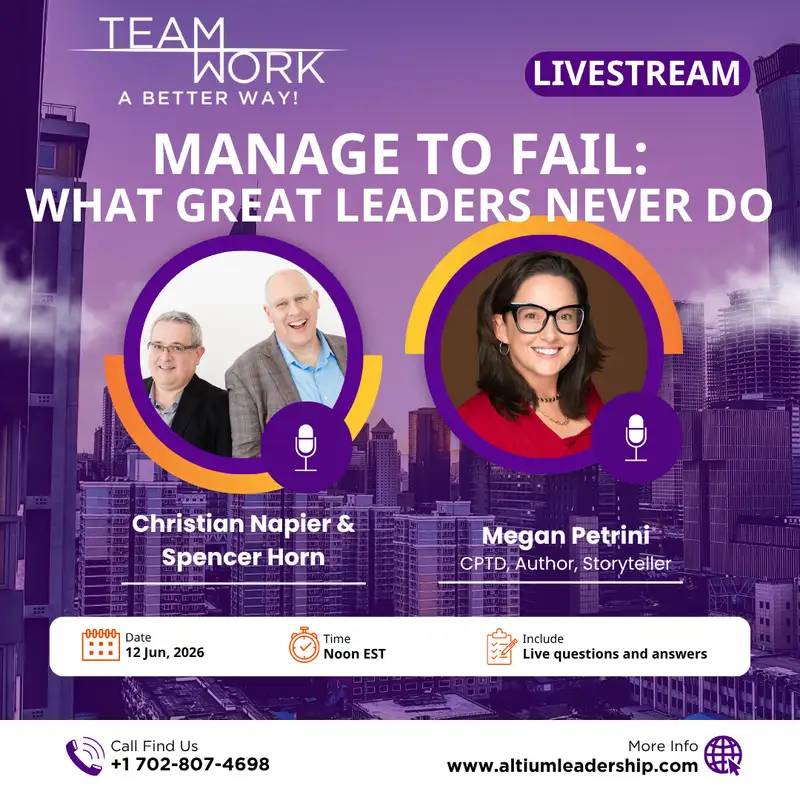
Manage to Fail: What Great Leaders Never Do
Christian Napier
00:12 - 00:26
Well, hello everyone and welcome to another episode of Teamwork, A Better Way. And I'm joined as always by my amazing co-host, Spencer Horn. Spencer, how are you doing?
Spencer Horn
00:26 - 00:34
I am very, very well, Christian. Thank you. Good to see you. It's been a minute since I think we last saw you on your birthday, right?
Spencer Horn
00:34 - 00:37
We went and had some mole for the first time in a long time.
Christian Napier
00:39 - 00:50
Yeah, that was great. There's nothing better than free food with friends. Very true. It's great.
Christian Napier
00:50 - 00:54
Great to see you. Where in the world have you been here lately?
Spencer Horn
00:54 - 01:17
You know, I am on a home stretch, although I did just book a trip to Singapore and then have to complete the extension to Bali or Denpasar here. But lots coming up. This is just, summertime sometimes is slow, but fall is crazy. It's going to be so fun.
Christian Napier
01:18 - 01:45
Well, that sounds awesome. I'm sure you're going to have a great time there in Southeast Asia. Speaking of awesome, let's talk about our guests for a minute, because we were in the green room, because just for our viewers and listeners to know before we start the show we have a few minutes and you and our guests were swapping stories. And it was fascinating to listen to.
Christian Napier
01:45 - 01:53
And so I am super excited for you to introduce her and for us to jump in and dive into a conversation. So Spencer, go ahead.
Spencer Horn
01:53 - 02:10
Absolutely. Today, our topic is manage to fail. And I put what great leaders never do. And what if a faster way, Christian, to build a high performing team is to learn how leaders accidentally destroy trust?
Spencer Horn
02:10 - 02:31
In this episode today of Teamwork a Better Way, we have Megan Petrini, CPTD, which is a talent development expert. She is certified in trust work and she's the author of Manage to Fail. She's going to share with us some great insights. Read a little bit of her bio here.
Spencer Horn
02:32 - 02:53
She is a talent development veteran with 18 years of experience building world-class teams from the ground up. That's what a certified professional in talent development does. And certified in trust at work. And she's really on a mission to prove that trust isn't a vibe.
Spencer Horn
02:53 - 03:19
It's a mastery level skill that can be learned, practiced, and perfected. Good news. And as the author of her book Managed to Fail, she uses this reverse motivation, which that's my first question. And raw stories from front lines of leadership, which is what we were talking about, to show exactly what not to do when building a culture.
Spencer Horn
03:19 - 03:41
When they aren't deconstructing leadership mishaps or helping teams hit peak performance, you can find them busy with a crochet hook in hand, proving that whether it's a sweater or high-performing team success is all about how you loop the threads together. And welcome, Megan. We were talking about some crochet stories as well.
Megan Petrini
03:42 - 03:50
Absolutely. I'm so excited to be here. I'm not great at crochet, but I managed to fail at it quite a bit, and I learned a lot every time, thankfully.
Spencer Horn
03:51 - 04:02
Well, we're so glad to have you. So talk to us about this idea of reverse motivation. Why take that approach to leadership?
Megan Petrini
04:03 - 04:31
I like taking the approach of what happens when things go wrong. Throughout my career, I've always ended up kind of being the trainer for bartending and restaurant work and bakery work, whatever it is, call center work, whatever it was that I was doing at the time. And I learned very quickly that just sitting and saying, Hey, here's how we do this. And here's why that works sometimes.
Megan Petrini
04:32 - 05:10
But what really works, and what really creates that emotional connection, when I'm trying to teach somebody something very quickly, like in the restaurant industry, For example, you've got to learn very fast. Hey, here's why we do this, because when you don't do this, this is what happens. They get angry, they get upset, or you're late with whatever it may be. So I learned very quickly, very early in my career as a trainer, unofficial or official, that sharing stories of my mistakes and kind of making them laugh and showing that vulnerability not only made them trust me sooner, but they learned a lot faster.
Megan Petrini
05:10 - 05:29
And I've kept that throughout my career. So we know that storytelling evokes emotion and emotion helps us with short-term and long-term memory retention. I just happened to learn it because I didn't have time to teach why it was important to bring the bread to the table. But if you don't bring the bread, they're going to escalate a lot faster.
Christian Napier
05:33 - 05:42
I want to really get into the topic, but I got a little distracted by the bass guitar hanging on your wall. So are you a bass guitarist?
Megan Petrini
05:43 - 05:56
No, no. Most of this is my husband's stuff. The Mickey Mouse ears, the Harry Potter, the Van Gogh, that's mine. My certificates over here, those are mine.
Megan Petrini
05:56 - 06:09
This really horrible talking about mistakes in crochet. My little, really ugly penguin that I love so much took me way longer than it should have to create. But all the really cool stuff, that's all my husband.
Christian Napier
06:10 - 06:42
Okay, cuz I was like hey Meg is playing a Fender P bass. I'm I'm a fan immediately like I am I am all in so I apologize He was did you see him he was scoping out what's what's going on behind There's another guitar there. You can't see I can see the top of it. But anyway, so sorry the the aspiring and managing managing to failing musician and me, you know, it was like I nerding out over the fact that Megan's got a pee base hanging on her wall.
Christian Napier
06:42 - 07:26
So I apologize for getting a little bit distracted. I want to ask a question basically from the promo that Spencer sent out, which says, most leaders don't wake up thinking, how can I destroy trust on my team today? Of course we don't do it, but none of us intend to fail, but it happens. So why is it that we continue to fail even though we intend to succeed, particularly in this area?
Christian Napier
07:26 - 07:42
of trust, what are you seeing and what have you seen? And you're such a great storyteller. I'm hoping you can give us some examples. What are you seeing out in the world where we're just not living up to our intention?
Megan Petrini
07:44 - 08:33
When we don't have a framework for trust and we think that, oh, I have a really strong connection with this person, so I can lean into you know, them making sure that they're always giving me the best assumption, or we kind of, we do this with our friendships, I think, a lot, too, where, well, they know me, and they know me for a really long time, so I can kind of lean into that and get away with pushing something off, or maybe I made an offhand comment. We lean into that a lot. But trust is, if we think about what trust means, which is, and I take the definition from the Thin Book of Trust, which is a huge inspiration and motivation for me in a lot of the work that I do, which is choosing to risk something that I value,
Megan Petrini
08:33 - 08:46
right? So choosing to make vulnerable something that I value to another person's actions, right? And if we think about the definition of distrust, which is what I value isn't safe. with this person.
Megan Petrini
08:46 - 09:16
So when we don't think about the framework of trust, when we're not very deliberate about the actions and the words that we use all the time, even with people that we've known for a really long time, or we feel like we have a really strong connection with, then our actions can actually be damaging trust. So here's one of the best examples I have. So a few years ago, I was at Zappos at the time, I was in HR, we were experiencing a lot of like a lot of change.
Megan Petrini
09:16 - 09:28
In in four years, I think I had six different HR directors. And one of the last HR directors I had, there's a lot of new leaders coming in and they wanted management training. Perfect. No problem.
Megan Petrini
09:28 - 09:42
So it was on a Monday, I remember she messaged me and said, I need this training. I need it to be built by Friday, like super high urgency. We need this done so fast. It was something very small, like maybe a fixed versus growth mindset.
Megan Petrini
09:42 - 09:48
I can't remember specifically. And I said, oh my gosh, no problem. I stopped everything I was doing. I only worked on this.
Megan Petrini
09:48 - 09:57
I made it the priority. I got it done. I sent it to her on Friday morning, hit send on the email, and got an automatic reply. I'm on vacation.
Megan Petrini
09:58 - 10:03
That feels weird. You said send it by Friday, and I did. But you know what? People go on vacation.
Megan Petrini
10:04 - 10:17
I can go ahead and extend the most generous assumption. But the next week, I didn't hear anything back. And like two weeks after that, I finally heard like, oh, things changed and we're actually not going to move it forward. OK, that happens.
Megan Petrini
10:17 - 10:24
No big deal. I've been in this company for a long time. I've been working for many years. You know, things like that happen.
Megan Petrini
10:24 - 10:33
And then like a month later, at the beginning of the week, I got another message. Hey, We got something else. Let's work on this. I need it by Friday.
Megan Petrini
10:33 - 10:42
And I was like, all right. I didn't drop everything, but I got it done. Sent it on Friday. Two weeks went by and I didn't hear anything.
Megan Petrini
10:43 - 10:55
And then I actually never heard anything. about it and it didn't move forward. And then a couple of months later, I mean, all this happened within like six or seven months. Another message Monday morning, Megan, I need you to drop everything.
Megan Petrini
10:56 - 11:04
I need this work done by Friday, this course, this e-learning, whatever it was. I didn't even build it. I didn't even reply. And nothing happened.
Megan Petrini
11:05 - 11:36
So from that leader's perspective, from that HR director's perspective, they were just following what was being given to them and priorities change and things shift and you're getting pulled in a lot of different directions, not even probably realizing like you're showing me a pattern that I don't matter. that you don't care enough to follow up. Like you can't even follow up and say that this has been canceled. You can't share that a priority has changed, like just ghosted, which is that hurts your feelings, right?
Megan Petrini
11:36 - 11:45
So it was like over six or seven months, I lost all trust. in this leader. You're not reliable. I don't think you care about me.
Megan Petrini
11:46 - 12:00
I don't think your requests are sincere. And now I'm starting to doubt your competence, which are the four domains, the framework for trust, right? Care, sincerity, reliability, and competence. So all it took was three times asking for something and not following up.
Megan Petrini
12:00 - 12:07
And what I value, my time, my energy, isn't safe with this person. So I stopped.
Spencer Horn
12:18 - 12:53
I hate to say that I love that story. I don't love that story. The reason that I appreciate you telling that story, because my next question was, what's the fastest way that a leader can destroy his trust? And you absolutely just described it as not caring about your direct reports and the impact Well, I think one of my definitions of leadership is what is the impact you have on the people that work with you and do they feel valued?
Spencer Horn
12:54 - 13:26
One of the number one things, we've said it on this show so many times, that people love about their job is they know that they make a contribution. They're making a difference that what they do matters and they feel that. You were robbed of that opportunity because you brought your talents to bear, and you were probably excited to say, look at what we can do, and it wasn't even acknowledged. I mean, ghosted, that's like the unforgivable curse, right?
Spencer Horn
13:27 - 13:51
I see the Harry Potter behind you. You just don't do that. I also really loved your definition of trust, and I know you got that from the book that you quoted. I don't think I've ever heard it described that way in choosing to make something that you value vulnerable or withholding what is important to you when you don't have that trust.
Spencer Horn
13:52 - 14:30
It is absolutely true that every action that we take adds to or takes away from trust, and even though that happened over six or seven months, I mean, trust was eroded immediately that first time, and you were on your guard, and you were giving, you know, okay, well, I'm giving some grace, but then you will look for evidence, probably, that that behavior is potentially gonna continue again. So what's the biggest trust myth, do you think, in the workplace?
Megan Petrini
14:32 - 14:48
Uh, there's a couple of things that come to mind, uh, for, and I just wanted to call out too. I love that you called out, um, mastery and purpose because there's three pillars to employee engagement, which are autonomy, mastery, and purpose.
Spencer Horn
14:49 - 14:59
And it's such just a great tie in to trust because the other thing is that you're challenged that you have an opportunity to grow and develop. Right.
Megan Petrini
14:59 - 15:07
A hundred percent. That's that mastery piece. Right. So if we want highly engaged employees, then those tend to be high trust teams.
Megan Petrini
15:08 - 15:43
And research shows over and over and over that high trust teams are actually high performing teams. So it's something that leaders definitely need to to take advantage, knowing that trust is a skill that can be learned and practiced and mastered. And just for anyone listening, if they're not super, super clear, employee engagement, not the team building, not like the bingos and the raffles, not that type of engage, but engagement meaning that we have employees that are willing to go above and beyond. They give that discretionary effort.
Megan Petrini
15:43 - 16:01
Highly engaged employees are high-performing employees, typically. Disengaged employees are low performers. I think one of the biggest myths about trust is that it's all relationship-based, and it's not. It's actually behavior-based.
Megan Petrini
16:01 - 16:18
in my experience. So every action we take builds trust or damages trust. It's not, again, going back to you can't always count on that strong relationship that you have. You have to really be aware of what your behaviors are signaling to other people.
Megan Petrini
16:18 - 16:51
And we need to recognize that trust isn't necessarily a gut feeling. We give our guts a lot of credit, but it's our brains constantly processing the data that's coming in, the behaviors that we see other people demonstrating, even if it's not to us. If you see somebody in the break room gossiping, your body and your brain are going to remember that and say, I don't know if we can trust that person completely, right? If your best friend says, I don't trust that person, then you're going to take that data and use it like, my best friend whom I trust doesn't trust that person.
Megan Petrini
16:51 - 17:23
So I'm probably not going to trust that person. But we give our guts a lot of credit. And we really need to start recognizing what behaviors am I witnessing that are making me trust or distrust somebody else. Because when we recognize what behaviors there are and how they fit into the framework, is it care, sincerity, reliability, or competence, then recognizing that is taking the first step towards being able to connect with that individual and saying, here are the actions and behaviors that are damaging trust
Megan Petrini
17:24 - 17:25
in one of these four areas for me.
Christian Napier
17:27 - 18:02
So kind of expanding on Spencer's question to you there, when he asked about what's the biggest myth, one that popped into my mind right away is that once trust is broken, I mean, that's pretty much game over, right? And so is that a fact or is that a myth that trust can be regained or repaired, you know, because Some, you know, if it is truly behavior based and people can change behaviors, then you could say, well, then trust could be potentially regained. But oftentimes people feel like, you know, you, I don't trust you anymore and I will never trust you again. Maybe we feel like that in the moment.
Christian Napier
18:02 - 18:10
Maybe our minds have changed later, but how do you feel about that? You know, can trust be regained? Can it be re-earned? Can it be re-repaired?
Megan Petrini
18:10 - 18:34
Yes, with the caveat that both people have to be willing to do so, right? So very rarely is trust all or nothing. We can have different levels of trust in different areas with lots of different people. Like I always like to say for my baby sister, I trust her with my child's life 100%, but I cannot rely on her to be on time.
Megan Petrini
18:34 - 18:43
Right? So there's different levels. There's just different levels of trust we have with everybody. And trust can be all or nothing, but it's very rarely all or nothing.
Megan Petrini
18:43 - 19:03
That's usually an extreme case. So as long as both people are willing to change those behaviors or recognize behaviors that are damaging trust with another person, it is in fact a skill that can be learned and practiced where you can build back that trust. Absolutely.
Spencer Horn
19:11 - 19:15
Do you think it's possible to be a high performer and not be trustworthy?
Megan Petrini
19:19 - 19:45
I think depending on the dynamics of the organization, yes. We very often end up promoting toxic leaders. So we'll lean into competence more than any of the other frameworks. So there's a lot of, and I'm sure you too have worked with a lot of people that were super, super competent, but you absolutely didn't want to share information with them or they hoarded information, right?
Megan Petrini
19:45 - 20:05
Or they wanted to make sure that it was their way or the highway. So you can be a high performer in one area, I think like competence wise or output wise, but it doesn't necessarily mean that you're a high performer, highly engaged, high trustworthy. So there's a lot of different moving parts to that, absolutely, depending on the health of the organization.
Spencer Horn
20:05 - 20:41
You know, that's interesting that you say that, because so many maybe job seekers or people who are looking for for promotions focus on competency. We promote our competency when, you know, the question is, which is more valuable warmth or ability? Put another way, psychologists say it's this trust versus capability or competency, which is more important. And psychologists say the order matters.
Spencer Horn
20:42 - 21:08
Warmth or trust comes first. And it goes back evolutionarily to call it the caveman days. I don't care how good you are, Christian, at building a fire. If I think you're going to kill me and drag my kids and wife off, You don't get the chance to display your competency unless I trust that you're not going to murder my family or murder me and take my family.
Spencer Horn
21:08 - 21:20
So both are equally as important, but the order is really important. So you don't get the right to demonstrate your competency, I think, unless there's trust, I think.
Megan Petrini
21:21 - 21:55
I can absolutely 100%. I always used to say when I was in charge of hiring people a long, long time ago that it's easier for me to teach you the skills that you need. but I can't teach you to act trustworthy, right? If we, like, I can't, if I can't connect with you, if I can't, you know, if I, if I think that your attitude or personality is not going to match with the attitude and personality of the team, and we're being very deliberate about scaling like a good culture,
Megan Petrini
21:55 - 22:19
then oftentimes it's more important to hire for a culture alignment than it is to hire for skills, because most of the time I can teach the skills. I can teach you the skills you need. But if your personal values and the values of the organization don't align, then it doesn't matter how good you are because nobody wants to work with you. And then we're going to have another problem.
Christian Napier
22:21 - 22:35
All right. So. I know you take the approach of this reverse motivational approach. Let's look at our failures.
Christian Napier
22:35 - 22:57
We can learn a lot from our failures. So you shared the example that you had at Zappos. But I am curious to know if there are any positive examples. Like, is there an example, particularly in an organization, as Spencer, you pointed out, sometimes a system is set up and you can't beat the system.
Christian Napier
22:57 - 23:44
But what can I do if I'm a project manager or I'm a, you know, I'm a mid-level director or something like this in an organization? what can I do, or are there any experiences, are there stories that you have seen, experiences you've had, where somebody has kind of been in that maelstrom, but they've been able to actually build a functional team, you know, based on trust, and maybe they're in the eye of this storm that's blowing around all over the place around them, but they've been able to to kind of overcome it and establish themselves. Have you come across any examples of that?
Megan Petrini
23:44 - 24:05
100%. There's so many examples all the time of great mid-level leaders and high-level leaders. But first, shout out to mid-level leaders, because that's the hardest position, I think, when you're in leadership, because you're getting it from all the executives above you, and you're getting it from everyone that reports to you. It's a super hard place to be in.
Megan Petrini
24:05 - 24:40
So one of my very last bosses, managers, when I was at Zappos was actually you were talking about this earlier, but a certified coach. And she was so amazing at, one, being on time for meetings that she scheduled or we scheduled, being available in the chat when we'd say, hey, I need to talk really quickly. She worked really hard to be available to everyone on the team all the time. And when we would come in and let's say there was this huge a lot of change, a lot of maelstrom, right?
Megan Petrini
24:40 - 24:51
Happening, we're in the eye of the storm. We would say, oh my gosh, what's happening? And she would schedule a team meeting. We'd all get in there and she'd say, here's everything that I can share.
Megan Petrini
24:51 - 25:06
And she never pretended like she didn't know more. And that went a lot to building trust. She would say, here's what, there's a lot of different moving parts. Here's what I can share responsibly with everyone that I know the details of.
Megan Petrini
25:06 - 25:24
As I learn more, I will share more. And then she would always take the time to stop and listen, make sure everybody had an opportunity to talk and share their concerns. And even if she didn't have the answer, she would validate that. It's OK to feel like I don't love every single change that happens, right?
Megan Petrini
25:24 - 25:49
So she really worked hard. And every experience I have of this, what I try to do when I'm training new trainers is I will share all the different ways I have messed up. Just this week, for example, I'm in charge of one of the company calendars, and I accidentally put my blood work for my doctor's appointment on the company calendar. Everybody saw that I was going to get my blood work.
Megan Petrini
25:50 - 26:00
People get blood work. That's not that out of the blue, but did I want to share that with maybe 600 people? No. But when I share that with my team, it's like, listen, everybody makes mistakes.
Megan Petrini
26:01 - 26:08
Nobody's perfect. Nobody should be striving for perfection. Let's identify it. Let's work to make sure that it doesn't happen again.
Megan Petrini
26:08 - 26:40
But when leaders, whatever level they're in, work to create space, work to show up, work to make sure that they're available, even making sure that you're not constantly late to meetings or constantly moving meetings because something more important came up. Those are all signals, right? Those are all actions and behaviors that are building or damaging trust. So a lot of it is built in with or connected to the psychological safety that you bring to your team.
Megan Petrini
26:41 - 27:02
And a lot of that means you need to be vulnerable and share your mistakes. With training in particular, last thing I'll say, and I know I don't want to go off too much, but every time they make a mistake, I will try to share. Some of them are in the book, too. Really huge examples of mistakes I made.
Megan Petrini
27:02 - 27:10
Like, I didn't give them breaks. I swore in front of class. bunch of different things where it's like, listen, everyone makes mistakes. You are learning.
Megan Petrini
27:10 - 27:19
You are growing. This is just part of it. There's very rarely a mistake, at least in my arena, where it's like, this is egregious. You got to go.
Megan Petrini
27:19 - 27:37
Sometimes that happens. But being able to share it, honestly, regardless of what level you are in the manager role, Being able to share your vulnerabilities responsibly, being responsibly transparent with your team goes a long way towards building that trust, regardless of what's happening outside of that arena.
Spencer Horn
27:52 - 28:11
I love this story of your, uh, of your coach boss. I think what, what is, what was that called? Like a Collins, like a level five leader, you know, not the, not the big personality Christian. You want, when, when I thought of your answer, when I think of your answer or your question, sorry, I don't, my, my brain's not working today.
Spencer Horn
28:11 - 28:34
When I think of your question, I think of like a Lee Iacocca, right? Just a big personality, a hugely competent individual that saved Chrysler, yet the whole company revolved around him and his personality. When he was gone, then things went to heck. So really, to create that, this whole podcast is about how do we get the team engaged?
Spencer Horn
28:34 - 28:54
How do we get them to give their best discretionary effort, as you were talking about? And I love that you talk about failures because in my speaking and in my training and development, I talk often about my failures. And one of those experience was actually at a company that you and I have in common.
Megan Petrini
28:57 - 29:00
That's right. I also failed at that company.
Spencer Horn
29:00 - 29:10
Yeah, I was there seven and a half years. And after five years, I became the CEO. I think I've told this story a few times. But I was the fourth CEO in five years.
Spencer Horn
29:10 - 29:25
So that tells you a little bit about the culture that was people coming in and trying to change it. And I thought, oh, this time I've got the plan. I've got the system. I know how to make this organization change and grow.
Spencer Horn
29:26 - 29:47
And the system defeated me, right? I mean, we were so afraid to get rid of some of the toxic people on the team because we wanted their sales, their experience. that I, I, I set up a separate sales team, but the, you know, the old ones just cannibalized. You can't do it that way.
Spencer Horn
29:47 - 30:13
I mean, it was just, I'm like, I wanted to honor the legacy of the past while trying to create something new at the same time. Failed miserably. And I did not address the system. I, you know, I did my best to work with the individuals and, and I'm sure that I lost trust because here I am trying to change things and they're like, and they're all part of the system saying, no, we don't want, we want to survive beyond.
Spencer Horn
30:13 - 30:27
Listen, you're the fourth CEO in five years. We'll, we'll be here long after you're gone. And they were right. I talked to you 10 years after that experience that I left and you described your experience and the system was exactly the same as I left it 10 years ago.
Megan Petrini
30:27 - 30:43
That's right. I lasted 30 days. I lasted 30 days. And shortly after I was exited for not being a culture fit, which is correct, I was not a culture fit.
Megan Petrini
30:44 - 31:09
It was a good call for them to make. Three, four other people that I had worked with that I had good relationships with and strong trust with left, exited as well. And we all still keep in touch. And it was so interesting because within my first, I think it was my first day, I was going to say within my first week, but I think it was actually my first day.
Megan Petrini
31:09 - 31:26
Uh, one of the new executives reached out to me on chat and I was like, Hey, good morning. I'm happy to be here. You know, like, do you want to, you know, catch a virtual coffee so I can start building those relationships within 10 minutes? He was, he literally said, you know what?
Megan Petrini
31:26 - 31:34
I trust you. This place is wild. It's going to spit you, chew you up and spit you out. And I was like, wait, wait, what, what?
Megan Petrini
31:34 - 31:37
Like it was, he was,
Spencer Horn
31:37 - 31:39
You had no idea what I endured.
Megan Petrini
31:40 - 31:50
Right. He would and he'd been there for just a little bit longer than I had been there. And it was talk about like the four the four domains. Right.
Megan Petrini
31:50 - 32:08
So we're talking about like care, sincerity, reliability, competency. I had demonstrated that to him within an hour of starting. And he was so desperate for that without realizing that that's what he was looking for. He immediately started confiding in me within the first week.
Megan Petrini
32:08 - 32:17
I had different salespeople coming into my office just from, and I wasn't even trying to be deliberate about building trust.
Spencer Horn
32:17 - 32:20
I was really just- Oh, so then you were probably labeled as subversive.
Megan Petrini
32:21 - 32:25
I was subversive, right. I was just walking around- Threat to the system, Megan.
Spencer Horn
32:26 - 32:27
You are a threat to the system.
Megan Petrini
32:27 - 32:47
I'm disruptor. I'm a I'm a proud disruptor. I was just trying to build relationships because I'm the new person. But the president at the time, when I was getting like introduced and walked around, introduced me to someone and said, if she doesn't like you, you won't last here.
Megan Petrini
32:47 - 32:56
And that was one of the first. That was one of the first red flags. And I was like, all these little flags. I met with this other executive.
Megan Petrini
32:56 - 33:09
And within an hour, he was confiding all these concerns in me. Within the first week, salespeople were coming in and confiding and asking for advice. And I was like, this place is so desperate for extra money.
Spencer Horn
33:09 - 33:33
I seriously want you to have those people reach out to me, because I want to talk to them. Because I felt gaslighted for years. 100%. And it's so interesting that—but you said trust is not about relationship, yet I find it very interesting that the behaviors that develop trust are the same ones that actually create relationships or a positive relationship.
Megan Petrini
33:33 - 33:34
Absolutely.
Spencer Horn
33:34 - 33:37
So there's a causation there, is there not?
Megan Petrini
33:38 - 33:55
There is, and it's very similar. I think the challenge that people have sometimes is thinking that because I have a good relationship, I have strong trust. And it's not always that, right? I have a really good relationship with a lot of people that I don't trust in all fours.
Spencer Horn
33:55 - 33:59
Well, you talked about with your niece, for example, right?
Megan Petrini
33:59 - 34:16
Right, right. Yeah, there's so it's, it's, it's, we want to avoid leaning into, oh, I can, I can do this, or I can say that because we have a really good relationship when it's like every action builds trust or distrust. So you really need to be deliberate about.
Spencer Horn
34:16 - 34:24
That's something that that organization actually taught, by the way, when I, when I started there.
Megan Petrini
34:24 - 34:40
That's where the gaslit came in because you go to the course and you're like, OK, like where you teach it way different than I would teach it. Right. Like these are not adult learning principles. This is very military.
Spencer Horn
34:40 - 35:19
No, there's a process at Christian and what they do is basically emotionally hijack you so that they're basically creating a new neural pathway to break you open and open you up and to get you to change your behavior. And for a lot of people, that's actually a great process and it can help. I mean, there are people that are in executive coaching that hit a plateau and they're not vulnerable, they're not open, and sometimes they just need that wrap on the skull to say, hey, open up. And it can be productive, the process can, but it can also do damage.
Spencer Horn
35:19 - 35:23
So you have to use it very, very carefully and judiciously.
Megan Petrini
35:25 - 35:30
That is not what I witnessed. Not careful, not judicious.
Christian Napier
35:30 - 35:54
So I'm listening to this conversation, I think it's fascinating. One of the questions that's popped into my head as you guys have been talking here is, the impact of unintended consequences. So when it comes to the company culture, companies roll out a lot of initiatives and programs and say a lot of things. And they have good intention.
Christian Napier
35:55 - 36:28
But sometimes it doesn't always work the way that they anticipated. I'll give a rather, I don't know if this is kind of a weird example. So in, in high tech, you know, there are organizations that are, they're very competitive, you know, and every year they may, they may lay off the, you know, the bottom X percent of, of performers, right. And the idea is that, Hey, you know, we're going to continue to have the creme de la creme in our organization because we're calling out these underperformers.
Christian Napier
36:29 - 37:13
Well, one of the unintended consequences of that are teams. who need to fill jobs intentionally hiring bad people to preserve their own jobs. So they know that the, you know, but then, you know, people inside the organization start catching on to what these teams are doing and say, okay, well, I'm not going to go work for that team over there because the approach that they're taking is a perverse approach, right? They keep cycling through these junior level engineers or, or project managers or whatever it is, because they're intentionally bringing on people that they know they're going to weed out, you know, in the next year.
Christian Napier
37:13 - 37:33
The executives who set these policies, that's not their intention, right? It's like, Hey, we have a high level desire to have a really high performing workforce. And. And it can be a traumatic thing for a lot of people.
Christian Napier
37:34 - 38:14
And so the way they're coping with that is like, hey, we got this kind of Lord of the Flies thing going on where we're just gonna hire sacrificial lambs every year. And so I am curious, when you're working with organizations and you're trying to get them to put into place practices and behaviors that are gonna build trust, how do you also ensure that we're not setting ourselves up to fail by allowing others to game the system and achieve their own outcomes, which admittedly are self-centered outcomes. For many people, it's like a matter of survival.
Christian Napier
38:14 - 38:49
I have a family to feed, and I got a mortgage to pay, and I need this job, and the job market out there sucks right now, so I'm gonna do whatever I can to preserve this job, and if that means that I'm gonna throw another co-worker under the bus at the end of the year, then that's what I'm going to do. So how do you overcome those things or help executives kind of identify potential booby traps that they are unintentionally setting for their companies by putting in policies and processes and practices that ultimately cause more damage?
Megan Petrini
38:50 - 39:27
Yeah, I think that's a great question, and it's absolutely happening all over all over the place right now right and it's survival it's a scarcity mindset it's a survival mindset. So that's generally where I start with any executive team is if you. kind of like assessments, make sure that you're measuring what you intend to measure because there's a lot of really bad assessments out there and there's a lot of really bad policies out there. I strive to really teach that there is no one side, there is no universal There's no one size fits all.
Megan Petrini
39:28 - 39:54
We should not be having these big, dramatic, sweeping, generic bottom 20% every single year because this is the mentality that you end up with. And it's frustrating because you know that the executive team knows that this is happening. This is not happening on an island, in a bubble, in a vacuum. You know, at least anecdotally, they have heard of this happening.
Megan Petrini
39:54 - 40:10
So it's important to turn around and be objective. Is this actually getting you what you want? And let's talk about what employee engagement actually means. You want highly engaged employees because you have higher retention.
Megan Petrini
40:10 - 40:34
because you have higher trust, because you have higher performance. So if what you're really looking for, back to, are we measuring what we intend to measure? If you're truly looking for high performance, then you need to build in the pillars and the training that are going to lead you to highly engaged employees. Do employees have autonomy?
Megan Petrini
40:35 - 40:47
Do they have professional development opportunities to master their skills? And have you tied their work into the bottom line of the organization? Do they know that it has purpose? Do they know how they're making a difference?
Megan Petrini
40:48 - 41:18
And until they build those things in, they're never going to actually achieve what they want to achieve. And that's a whole other set of issues. Because if we're talking about, for example, a call center, and we're like, okay, you want highly engaged call center employees, you're gonna have to give them opportunity to master their skills, which means they get time off the phones to mentor, to be mentored for stretch assignments, right? To attend trainings and different professional development.
Megan Petrini
41:19 - 41:42
But as an executive, now that means you're gonna have to hire more so that you can overstaff the call center so that you can afford to have people getting paid at work to not answer phone calls and actually master their skills. So it's a much bigger issue, but I always start with there is no universal. And please make sure that you're actually measuring what you intend to measure.
Spencer Horn
41:55 - 42:10
What is the difference between trust and psychological safety? And then tied into that, why does feedback sometimes feel like a personal attack?
Megan Petrini
42:11 - 42:30
These are great questions. So I think the difference between trust and psychological safety is sort of like feedback and coaching. They support each other, but they're not the same thing. So if you want to have psychological safety, then you need to build trust.
Megan Petrini
42:30 - 42:39
So I would say that they're connected. It's difficult to have one without the other. And you shouldn't be striving to have one without the other. They work together best as a team.
Megan Petrini
42:40 - 43:08
So we build trust. And when you've built trust and you're recognizing behaviors that build trust in others and you're being very wise about the behaviors that you recognize as trustworthy, like in your culture and your team and whatever it may be, then you end up having higher psychological safety. So you have like more innovation, more creativity, more risk taking, that type of stuff. The second part of that, what was that?
Megan Petrini
43:08 - 43:10
Wait, what was that question one more time?
Spencer Horn
43:10 - 43:23
Just the idea that feedback often feels like a personal attack. Because you and I were talking about it in the green room. That's why I wanted to ask that question.
Megan Petrini
43:23 - 43:37
I love that question. So because it triggers fight or flight. Right, because feedback is, when it's not done properly, feedback is very scary. And it could mean that you're going to lose your livelihood, right?
Megan Petrini
43:37 - 43:56
So if we're providing feedback, like recognize that feedback is scary, and recognize that feedback is going to trigger fight or flight. It's stress. It's a stress response, right? And especially all the different ways that we've had terrible feedback.
Megan Petrini
43:56 - 44:16
So I've had everything from just an invite put on my calendar that says chat, same day from an executive, that immediately triggers a stress response. What did I do? Why am I in trouble? And when your body is in a stress response, you become defensive.
Megan Petrini
44:16 - 44:31
Because when we have high adrenaline, high stress response, we have lower reasoning, right? We can't have high reasoning and high stress at the same time. That's not how our body works. If we're running from a bear, for example, that's high adrenaline.
Megan Petrini
44:31 - 44:51
Let's say our brains are not also going to be able to like do math right then, right? Because all of our energy is going towards escaping and surviving and that type of stuff. So I think for leaders, when we're going to provide feedback to somebody, we need to be really clear. We need to make sure that they know that it's coming right.
Megan Petrini
44:51 - 45:12
We don't like kind of Drop it on somebody's lap same day and just say chat like be really specific about what we're gonna talk about Have a normal cadence for for feedback So if I always like to say to leaders like if everyone on your team is defensive when you give feedback Then what's the common denominator there?
Spencer Horn
45:12 - 45:38
So that that is a great question So I got to tell you a story about the company that you and I are talking about. I was I was the sales manager at the time. So I wasn't, and we had an acting president who happened to be the CFO and he, he, he messaged me, says, Spencer, I need to see you in my office right now. And I'm like, crap, what have I done?
Spencer Horn
45:38 - 45:53
Just like you were talking about Christian. I walked, I mean, it was on the other side of the building and I am in terror for my life in this environment. And I'm like, what did I say? What have I done the entire way?
Spencer Horn
45:54 - 46:05
And my heart was racing. I go into his office and he's just totally focused on, sit down. And then he turns to me and says, Spencer, I really need your help. I know you have great ideas.
Spencer Horn
46:06 - 46:08
And I just went.
Megan Petrini
46:08 - 46:14
We are so unaware.
Spencer Horn
46:14 - 46:48
Self-awareness is so important in this whole process of building trust. Like your manager that asked you to do those jobs at Zappos had no clue of the impact that they were having on you by—or maybe they did, if that's worse, but so often we're just unconscious about the impact. I have a pretty austere-looking face. Very flat eyebrows, I'm bald, you know, I've been bald for a long time.
Spencer Horn
46:48 - 47:07
Big nose, I'm pretty intense in personality. And I have to be aware of the impact, and I have in my life. I'm 6'7", so I'm intimidating already. And so, I mean, I choose these glasses to be a little less intense and stark and just to soften my features.
Spencer Horn
47:07 - 47:17
But I remember at one time I was in a position of leadership in a church. And I'm sitting on the dais, right? A dais, whatever you, what is it? How do you say it, Christian?
Spencer Horn
47:18 - 47:34
Dais? And I'm listening to the speaker and I'm doing this. And I look down at my wife and she's like, I look like I'm angry.
Megan Petrini
47:35 - 47:35
Right.
Spencer Horn
47:35 - 48:02
And I'm not. I'm just concentrating. And so often, we're so focused on what we're doing, we're not understanding that when we have positions of authority or just the ability to interact with others, our body language, our words, our questions, our focus has an impact on everyone. Those are behaviors that we can control.
Spencer Horn
48:03 - 48:17
Yes. And if we're not aware of the impact of those behaviors, then we create, as you said, Christian, unintended consequences that can absolutely be eliminated. Well, anyway, I've been monologuing Christian. Go ahead.
Christian Napier
48:18 - 48:39
Oh, we can't hear you. Oh, I'm muted because we had a little baby that was screaming over there for a minute. Yeah, we've got two of our grandkids over here and one of them, I guess, took a little spill or something and was fussing a bit. So anyway, sorry for the putting on the mute.
Christian Napier
48:39 - 49:26
But I actually want to kind of take what you said there, Spencer, and put it into a question. We've said here before, you know, I heard it on weird survival show but one of the principles was that someone talked about there you know when it came to like hunting animals was like your your circle of awareness has to be bigger than your circle of influence right so you've talked about some behaviors already that are simple like showing up to meetings on time following up with people but if you had to like come up with a list of say the top five behaviors that people are quietly doing that are undermining their ability to build trust, what would those behaviors be?
Megan Petrini
49:28 - 49:56
I think to your point about body language, it's not being self-aware. And I know that that's a huge thing. So I hate to say that that's just one thing, but even how you stand, how you look, your facial expressions, like if we all did an exercise right now, and we don't have to do it for real, but think about this and try it later. Think about being in an office and someone that you have absolutely no trust with, distrust with even.
Megan Petrini
49:56 - 50:11
And you don't want to work with this person. You don't like this person. Maybe you don't get along with this individual. And your manager comes to you and says, you are going to be working very closely in person with this individual for the next six months because we've got a project.
Megan Petrini
50:12 - 50:40
And think about and reflect on how does your body react to that? Because the first time I did it, my stomach sank and I started sweating. And I was like, I know exactly who I would hate to have to spend that time with the most in all of my different positions that I've held in different organizations. There was like two people that came up and I was like, I'd probably quit, honestly, if my manager came to me and said, you need to work with this person.
Megan Petrini
50:40 - 50:59
So recognizing that our bodies are going to react to distrust and our brains are going to start sending us signals real, real quick. So being aware now, now for that individual, let's take that a little bit farther. I don't like this person. I'm going to work to be professional.
Megan Petrini
50:59 - 51:32
but my facial language, the tone of my voice, the words that I'm using, how I'm standing, how close I am to them in the room, all of those behaviors are sending that person a message about whether or not I'm trustworthy. So my behaviors, because I know that I don't like this person, are probably influencing them. What if they have no idea, but now because of my behaviors, they're like, well, I don't trust Megan. So then we just keep perpetuating and making it worse and worse and worse and worse.
Megan Petrini
51:32 - 51:45
So being self-aware, knowing what is trustworthy mean to you? And are you actually extending trust wisely to others? And are you letting them trust you? What behaviors are you displaying?
Megan Petrini
51:46 - 51:53
Just knowing how you take up space in a room with that person.
Spencer Horn
51:59 - 52:01
There you go, it happened. Yeah, we got her.
Megan Petrini
52:03 - 52:05
I've been so good about it too.
Spencer Horn
52:05 - 52:08
Yeah, what were you going to say?
Megan Petrini
52:08 - 52:22
I was going to say, then the other part is just being responsibly transparent. I think especially I mean, we know all the things that we learned in kindergarten, right? Don't lie. Don't gossip.
Megan Petrini
52:23 - 52:28
Don't hit, right? Don't hurt. All those different things. Don't bite.
Megan Petrini
52:28 - 52:29
No biting.
Spencer Horn
52:29 - 52:32
Don't steal someone else's marshmallows.
Megan Petrini
52:32 - 52:39
That's right. Or, you know, and now there's even like no hugging and no kissing in kindergarten. That's, that's a new rule.
Spencer Horn
52:39 - 52:40
Oh, wow. I didn't know that.
Megan Petrini
52:40 - 52:56
Right? Yeah. So, which, you know, there's just, as you grow up, you know, like when I was little, I was like, Oh, we always hugged and stuff. And then, but as you, as an adult, you're like, no, I can see why we should be like, Hey, don't don't touch people without permission.
Megan Petrini
52:56 - 53:09
Right. So even even that type of thing, though, like how many times, particularly for women? Right. If we've got let's say you're six, seven, if you come up to I'm five foot two on a good day.
Megan Petrini
53:09 - 53:23
And I'm loud, but I'm not strong. And I'm not fast, right? So if I didn't know you and I didn't trust you, my body's going to start reacting, right? And then how I react is going to make you feel like Megan's weird, right?
Spencer Horn
53:23 - 53:35
And then you add positions of authority on top of that. On top of that. And so I've always been very aware of that, because it can naturally intimidate people. But I don't know that I've been very aware of it.
Spencer Horn
53:35 - 53:39
I've been aware of it. And so I try to mitigate the best I can.
Megan Petrini
53:39 - 54:06
Well, and for me too, I think up until I got really comfortable in my skin and with my height and all that type of stuff, I always distrust people who tell me that I'm cute or, oh, you're so fun or you're so peppy. And it drives me absolutely nuts in a meeting. I'm here in a professional capacity. We're not at a bar.
Megan Petrini
54:06 - 54:12
Stop telling me that that's adorable. I'm almost 50. That's not okay to say to me, right? You are not.
Megan Petrini
54:12 - 54:24
It bothers me. Right. It bothers me when people assume that because you're cheerful or you're optimistic or you're playful that you're also not competent. That actually bothers me.
Spencer Horn
54:24 - 54:28
Do we have time for me to tell one more little story about a joint?
Megan Petrini
54:28 - 54:30
I said yes, it's not my question.
Spencer Horn
54:30 - 54:38
Christian, are you going to be okay? You got a meeting? Do it. So we talk about unintended consequences or having an impact.
Spencer Horn
54:40 - 55:18
I have experienced that my behavior, even though not directed to other people, had an impact on their trust on me by how I was interacting with an individual. One of the CEOs at the company, when I was sales manager of this company, knowing how I was doing business development, which was different than everybody else, I was outreaching and talking to businesses. She pulls me and she says, hey, would it help you if we kind of punched up your title a little bit? Let's call you Associate Vice President, because sometimes titles matter to people just in opening doors.
Spencer Horn
55:19 - 55:25
I said, yeah, I think that would probably help. And it wasn't an ego thing. I promise you. Christian, you know me.
Spencer Horn
55:26 - 55:43
Associate Vice President is not a strong title. But it's better than what I had, which was called a Leadership Training Advisor, an LTA. Nobody outside the company even knows what that means. And so, you know, who's this LTA coming to talk to me?
Spencer Horn
55:43 - 55:51
But, you know, a vice president, people perk up and say, all right, it might be somebody worth talking to. So we changed my title. She was fired. The CEO was fired.
Spencer Horn
55:52 - 56:25
And our HR manager who was a part-timer, she was at the same time working for Las Vegas Metro as their HR person. Just a more senior individual, lots of experience, had worked for our company for 16 years, had been a trainer, tough, hardcore, 5'2", really short individual. One day I hear her coming into the office and she's talking to the people out in the open. secretaries, and she goes, did you hear that Spencer changed his title to assistant vice president?
Spencer Horn
56:26 - 56:42
And I'm sitting in my office thinking, well, it's associate vice president, but okay, and I'm just listening to her, right? And then she comes into my office and she leans on my desk, Christian, and leans over and says, why did you change your title to assistant vice president? Aren't you proud of being an LTA?
Christian Napier
56:42 - 56:45
And I said, it's not about that. I said, here are the reasons.
Spencer Horn
56:45 - 56:54
You know, I was doing my best not to get emotionally hijacked because I teach emotional intelligence, of course. Right. I work at a leadership training development company. I'm not falling for that.
Spencer Horn
56:55 - 57:10
She walks out of my office and the bullpen, the sales pit, and one of the guys who she named now works for Grant Cardone. If you know who that is, he's one of his top sales people. But he was working for us at the time. And he says, hey, Dave, what do you want your title to be?
Spencer Horn
57:12 - 57:27
And I'm watching this with my hands on my hips and finally I was just like triggered so bad. I said, enough is enough. She needs to be confronted. And so in front of the entire sales staff, I go after her.
Christian Napier
57:27 - 57:30
She's yelling at me and I'm like.
Spencer Horn
57:31 - 57:52
And one of our new salesperson after I was done look over and she was just like, she was mortally frightened because of this conversation that everyone else was just invisible in the room because I had to put this person in her place. But I fired her when I was the CEO.
Megan Petrini
57:53 - 58:13
They probably bought her back after I left, but... That wasn't the HR person I knew when I was there. The person I knew also part-time, actually contractor, contractor. And I had been pushing the leadership team in the meetings to like, hey, can we hire like a full-time real...
Megan Petrini
58:13 - 58:15
A real HR person.
Spencer Horn
58:15 - 58:33
This is our HR person, you know, and I was in the wrong. I was in the wrong, Christian, and I talked about that. There's, you know, you can't lose your temper like that, but I was so incredibly triggered. I worked so hard not to get hijacked and it just, I couldn't help it.
Spencer Horn
58:35 - 58:37
Have I scared you, Christian?
Christian Napier
58:37 - 58:47
Yeah, I'm like shaking in my boots over here. I'm like, that's not the Spencer that I know. Oh, no. Yeah.
Christian Napier
58:47 - 58:54
It's funny because I'm looking at the clock here and we've gone almost an hour already. Do we have time for a quick lightning round, Spencer?
Spencer Horn
58:54 - 58:58
Yes. I have some questions for you. One word answers are super fast. You ready?
Spencer Horn
59:00 - 59:02
Okay. One word that defines trust.
Megan Petrini
59:04 - 59:05
Love.
Spencer Horn
59:05 - 59:06
Trust is earned quickly or slowly?
Megan Petrini
59:08 - 59:10
Slowly.
Spencer Horn
59:10 - 59:12
Most underrated leadership skill?
Megan Petrini
59:14 - 59:14
Showing up.
Spencer Horn
59:15 - 59:17
Transparency or consistency?
Megan Petrini
59:18 - 59:19
Consistency.
Spencer Horn
59:20 - 59:21
One habit every leader should practice?
Megan Petrini
59:23 - 59:24
Say good morning.
Spencer Horn
59:25 - 59:27
Biggest mistakes managers make?
Megan Petrini
59:29 - 59:30
Being busy and not productive.
Spencer Horn
59:31 - 59:33
Feedback, give it or ask for it?
Megan Petrini
59:34 - 59:34
Both.
Spencer Horn
59:35 - 59:37
Culture is built intentionally or accidentally?
Megan Petrini
59:38 - 59:41
Intentionally, although culture already exists.
Spencer Horn
59:41 - 59:46
Yeah, so I say it's both right. One word that describes a great team.
Megan Petrini
59:47 - 59:48
Safe.
Spencer Horn
59:49 - 59:51
Finish the sentence. Great teamwork happens when?
Megan Petrini
59:51 - 59:53
We come together.
Spencer Horn
59:54 - 59:55
Trust grows when?
Megan Petrini
59:55 - 59:57
All the time.
Spencer Horn
59:57 - 1:00:01
Leaderships fail when? Leaders fail when?
Megan Petrini
1:00:01 - 1:00:03
They don't show up.
Spencer Horn
1:00:03 - 1:00:28
Oh, yes. Hey, you know what? I want to let our listeners know that if you want to know and measure the trust on your team, I have a validated psychometric assessment from our sponsor, Team Coaching International. If you take a picture of this, you can get what's called a team diagnostic and measure the safety on your team and the trust on your team.
Spencer Horn
1:00:28 - 1:00:33
It's a fabulous, fabulous tool. So Christian, that's it. That's all I got.
Christian Napier
1:00:34 - 1:00:57
All right, so one thing that we, me personally, I didn't do a very good job of is making sure that listeners know that you actually have a book talking about this stuff called Manage to Fail. So why don't you tell people where they can find the book, and if people are interested in the work that you're doing with organizations, what's the best way for them to connect with you?
Megan Petrini
1:00:57 - 1:01:09
Thank you. Everything can be found, workshops, book, links, YouTube, Instagram, all of it can be found on my website, which is www.managedtofail.com.
Christian Napier
1:01:11 - 1:01:20
So listeners, viewers, go there. And for Spencer and I, just look us up on LinkedIn. You can find us there. We're happy to connect with people as well.
Christian Napier
1:01:20 - 1:01:41
Megan, you've been a fantastic guest. Thank you so much for spending an hour telling us these really amazing stories and sharing really practical insights that I think anybody can implement to change our behaviors and help us build trust with our teams and our organizations. Listeners and viewers, thank you for participating as well. We're really, really grateful for you.
Christian Napier
1:01:41 - 1:01:44
Please like and subscribe to our podcast. We'll catch you again soon.