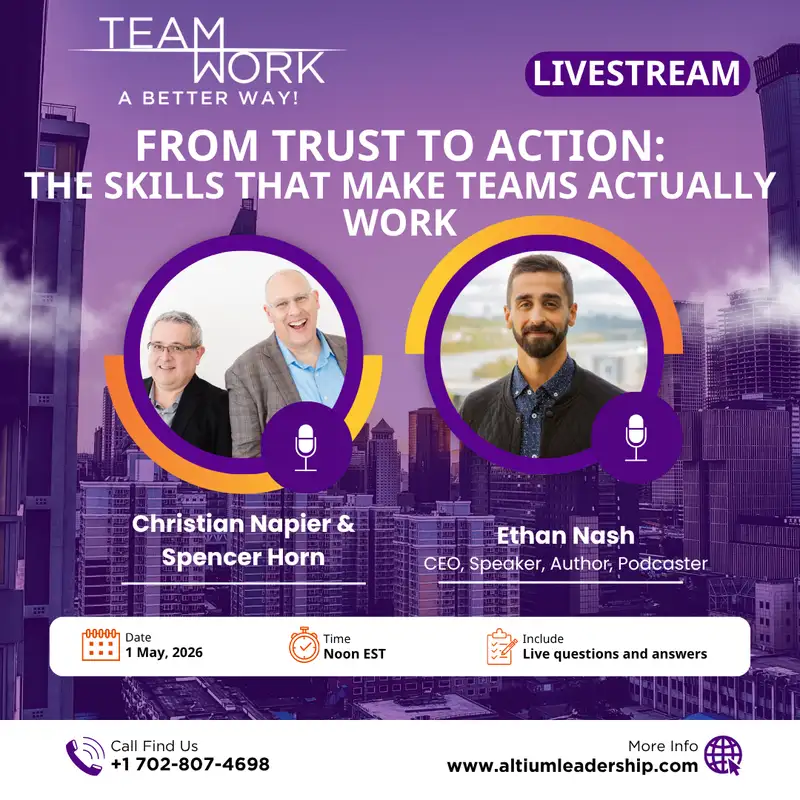
From Trust to Action: The Skills That Make Teams Actually Work
Christian Napier
00:14 - 00:22
Hello everyone, and welcome to another episode of Teamwork A Better Way. I'm Christian Napier, and I am joined by the very colorful Spencer Horne. Spencer, how are you doing?
Spencer Horn
00:23 - 00:28
I'm doing well. Yes, and I have a little more color in my face than usual.
Christian Napier
00:30 - 00:35
And in your shirt, your shirt is amazing. It's got all the patterns.
Spencer Horn
00:35 - 00:39
Yes. Little paisleys. We got gray. We got red.
Spencer Horn
00:39 - 00:42
We got blue. Yes. I like this shirt.
Christian Napier
00:42 - 00:50
Yeah. Well, you got to tell me what you were up to this week, because I understand that you went to one of the world's most wonderful cities.
Spencer Horn
00:50 - 00:59
Yeah, San Diego, beautiful, beautiful place. I was there last week, which was wonderful. Got to sit out on the beach in Coronado. And this week, Jan and I went down.
Spencer Horn
00:59 - 01:24
I was speaking at a conference right there in downtown San Diego. But we went to Torrey Pines State Beach, right there by La Jolla, right between Del Mar and La Jolla in this beautiful little spot. There are peregrine falcons being hatched. you know, on those cliffs up there above, you know, Torrey Pines and everybody's, you know, taking pictures.
Spencer Horn
01:24 - 01:38
And then you've got those paragliders, whatever those are called. It's just beautiful sun. And so I fell asleep on the beach. I, you know, I wasn't fully uncovered, had some shorts on and a long sleeve shirt, but my face got.
Christian Napier
01:42 - 01:43
I hope you're recovering. Okay.
Spencer Horn
01:44 - 01:46
Yeah. This is some peeling here and there, but you know,
Christian Napier
01:47 - 02:01
Yeah, but it looks good. You look good with a tan. Looks lovely. Well, I was telling you just before we came on air here that I ran into a couple of your National Speakers Association buddies, Hall of Fame speakers down in Las Vegas.
Christian Napier
02:02 - 02:07
And it was by chance going to one of your favorite restaurants.
Spencer Horn
02:07 - 02:11
My favorite restaurant, yeah, Din Tai Fung. That's so awesome. I'll have to talk to you about that.
Christian Napier
02:13 - 02:32
And ran into two former guests. Jason Hewlett, amazing individual and performer, and then Ty Bennett, not in Din Tai Fung, I actually ran into him at the airport there in Las Vegas, but it was great to see some of your colleagues there in Las Vegas.
Spencer Horn
02:32 - 02:36
And you were there with some technology whiz-bang.
Christian Napier
02:36 - 02:45
I was there for Google Next. So that's Google's huge annual conference. So I was down there for Google Next. And then I went from there back to Philadelphia.
Christian Napier
02:46 - 02:54
So I was in Philadelphia. Just got back Wednesday for the National Association of State CIOs. That's a conference that's put on.
Spencer Horn
02:55 - 02:58
One of my favorite places to go. Great food in Philly.
Christian Napier
02:58 - 03:12
Yeah, it was wonderful. So I was asked to speak on AI there. So I gave a little speech there. But enough about all this fun stuff that we're doing, because really the highlight of our week is right now.
Christian Napier
03:12 - 03:21
This week is capping off on a high note. So we've got an amazing guest here joining us. And Spencer, why don't you do the honors and introduce them to our listeners?
Spencer Horn
03:21 - 03:49
I'm going to bring them up on the screen. We've got Ethan Nash with us today, who is a second generation CEO of Nash Consulting, a 30-year-old leadership and organizational development firm that helps organizations build healthy, high-performing workplaces while improving the lives of the people who work in them. That is our whole theme on this show, isn't it? So we were so excited when when we were introduced to Ethan.
Spencer Horn
03:50 - 04:13
And he holds an MS in Organizational Performance with a decade of management experience from frontline supervision to senior leadership. Always great to cut your teeth in the real world and not just in academia, right Christian? Absolutely. And he's had nearly a decade of coaching and consulting leaders and teams across a wide range of organizations.
Spencer Horn
04:13 - 04:38
And Ethan is known for translating psychology and leadership theory into practical skills teams can use immediately. Out the door and on the floor is what we like to say, right? And his work emphasizes trust, honest candor, and shared behavioral commitments grounded in systems thinking. I want to hear all about that.
Spencer Horn
04:38 - 05:11
And he partners with organizations ranging from small nonprofits to some of the largest public institutions in the Pacific Northwest. He's also the co-host of Managing the Mind and Heart podcast, a writer and speaker on workplace culture and outside of work, a mountaineer and ultra endurance athlete. Dude, I wish, I love to climb mountains. I'm gonna be going to Olympia National Park and I've wanted to do the Cascades, but such beautiful mountains.
Spencer Horn
05:11 - 05:24
I'm getting, I just wish I could even keep up with that. But born and raised in Washington State, you have such beautiful outdoors up there. Lives in Seattle with his lovely wife and daughter. Welcome, welcome to our show today, Ethan.
Spencer Horn
05:24 - 05:25
We're so glad to have you.
Ethan Nash
05:27 - 05:37
Thank you. Yeah, Spencer, Christian, good to be with you both. And can I just say that I agree with Spencer on your shirt. Or sorry, Christian, on your shirt, Spencer.
Ethan Nash
05:39 - 05:43
Just a really nice shirt. I just got to say that. So anyway, it's good to be with you.
Spencer Horn
05:43 - 05:58
And anything I get that's nice like this, it's usually my wife's doing. But I didn't get this in Las Vegas, Christian. But today's episode, trust. to action, skills that make teams actually work.
Spencer Horn
05:58 - 06:07
And that's a great one. Just complimenting somebody, a stranger, makes me feel so good. So thank you for the compliment. And we're glad to have you here.
Spencer Horn
06:07 - 06:25
So why do so many teams, Ethan, understand concepts like trust and communication, yet they struggle in that day-to-day interaction. I mean, it's just, we understand what trust and communication is, but it seems that there's still problems. Why does that happen in your opinion?
Ethan Nash
06:28 - 06:50
Because from what I've seen, agreement on concepts isn't the same thing as alignment on behaviors, right? Like alignment on behaviors is actually how we create what I would just call collective group intelligence. Right. So, you know, for example, teams say and agree that, hey, we want trust.
Ethan Nash
06:50 - 07:04
We want to behave in a way that earns trust. And they might even take that a step further and say, well, what is trust? It's it's it's character and competence combined, which is great. Or they say, hey, we want to have open communication.
Ethan Nash
07:05 - 07:12
We want to have psychological safety. We want to be able to disagree with each other. And everybody nods their heads and say, that's great. And we're committed to that.
Ethan Nash
07:13 - 08:03
But I mean, at the end of the day, those are just words unless we define what they actually look like behaviorally or in terms of skill sets. And the reality is when we say things like trust or you know, respect in the workplace or things of that nature, we all have slightly different definitions of what that means and what that looks like. So we walk around with our own definitions and somebody thinks respect is giving me direct, honest, unsolicited feedback because, you know, Respect is honesty, but the person receiving that feedback is thinking that's disrespectful because a respectful person would wait until I asked for feedback. So I think it's just the gap between idea and concept and what those look like behaviorally and then.
Ethan Nash
08:03 - 08:04
Earning alignment on those behaviors.
Spencer Horn
08:05 - 08:31
I love that answer so much I mean some person it's like you're talking about love languages ethan, right? I mean I'm thinking i've given trust by by by candor and the other one's like, oh, you're totally disrespecting me That's breaking trust and it's so right I think that's really the perfect answer. So the question then becomes How do you create that alignment? And and how do you create that that you know, how do you do the defining?
Spencer Horn
08:32 - 08:55
um I think one of the things that I see most organizations skip is creating actually agreements, right, where they sit down and say, you know, and actually define those. But how do you keep that up? Because organizations are dynamic, people are dynamic. I mean, it seems like it's going to be an ongoing labor.
Ethan Nash
08:56 - 09:12
Yeah, yeah. Well, I mean, I would agree that it is, it is an ongoing labor, right? Teams are dynamic, our environment's dynamic, the economy's dynamic, right? We have to adjust and build new commitments to, yeah, the evolving environment.
Ethan Nash
09:12 - 09:40
But I think you, I mean, you put it how I would put it, which is, Yes, we have to actually reach agreement. Now, that sounds pretty simple in concept and practice, maybe a little more complicated, but really what I encourage teams to do is engage in a common commitment process. And what that often looks like is, hey, let's define what matters for our team. And I'm often in my work focusing on team dynamics.
Ethan Nash
09:40 - 10:02
So relationally, what does a healthy team look like? And people always come up with things like, again, trust, psychological safety, and things like that. And then I think the process from there, again, is just taking those concepts and breaking them down behaviorally. And then, yeah, I'm happy to speak about how a team would then kind of sustain those commitments.
Ethan Nash
10:02 - 10:08
But do you mind if I, can I tell a story? Can I tell a quick story? Is that all right with you guys? Please do.
Ethan Nash
10:08 - 10:22
All right, you like stories? All right, good. I had an employee in a previous job that I was in. And this employee, he basically kept getting feedback from his colleagues that he was being a jerk.
Ethan Nash
10:22 - 10:35
And so he was getting feedback like, hey, you're disrespectful, you're hard to work with. And he was a really smart guy, a high performer, but people just didn't want to collaborate with him. And so it escalated to me. And so I asked him, hey, why do you think people feel that way about you?
Ethan Nash
10:36 - 10:53
And he said, I don't know. And I said, OK, well, honestly, Like, I don't really care what people mean in terms of being a jerk. And I don't even really know what that means. What I care about is that people want to work with you and that people aren't coming to me to complain about you.
Ethan Nash
10:53 - 11:04
I could kind of be direct with them like this. And so I asked him, what is the opposite of a jerk then? And he said, well, I guess somebody that is respectful. And I said, great.
Ethan Nash
11:04 - 11:15
OK, so what does a respectful person do? Like, what do they actually do? And that's where things started to shift with him. He said, well, I guess they wouldn't interrupt people.
Ethan Nash
11:16 - 11:25
They don't raise their voice at people. And so I said, OK, great. Now we have two specific behaviors that you can start doing. And then I played along.
Ethan Nash
11:25 - 11:36
And we landed on things like, when you're in a group with people, do airtime math. OK, so there's four of you in this group. How much of the airtime is yours? About 25%, great, use that amount.
Ethan Nash
11:36 - 11:52
How about asking two questions before you disagree with somebody? How about not being on your phone when other people are talking? So all of a sudden, he had five actual behaviors that he could start doing. And this is the gap, again, I think most teams have.
Ethan Nash
11:52 - 12:13
We understand the concept of respect, but we need clarity on what that looks like in practice. So when working with a team on creating our commitments, I think it's a similar process. It's taking the high level concept, it's breaking it down into behaviors, and then it's practicing them as actual skill sets together.
Spencer Horn
12:14 - 12:26
I love that you actually coached him on that process. I'm curious with the suggestions, did he come up with those or did you come up with those together? In this case, it started with him, right?
Ethan Nash
12:26 - 12:29
He came up with a few and- Excellent, excellent.
Spencer Horn
12:29 - 12:38
Yeah. Because now he's more committed to his idea of what it means to not be a jerk, right? So focusing on the engaged team member that's respected. I love that.
Spencer Horn
12:39 - 12:42
So, Christian, I'm sorry. Absolutely.
Christian Napier
12:42 - 13:28
Yeah, you know, that's a really, really great example. And one of the things that I really like about it is The way that you framed it and presented it to us, the complaints that were coming to you were complaints of character, like this person's a jerk, right? It's hard to address character, but when you transform or reframe it to let's focus on behavior, then all of a sudden, the cognitive dissonance in this person's mind starts to fall away. Because he's thinking, I'm not a jerk, but he's behaving like a jerk, right?
Christian Napier
13:29 - 14:01
But he doesn't see it. And then when you started asking these questions, then he started to identify specific things that he could work on that would help other people not perceive him as a jerk. So I thought that was actually really, really brilliant. And I wanna know what the outcome of this story is because it's like, okay, you gave him, not gave him, he identified five different things that he could potentially work on.
Christian Napier
14:02 - 14:22
How does he actually go about doing it? Because it's one thing to kind of recognize like, okay, these are things that I need to do. But sometimes it's difficult to follow through and actually work on those things and you stumble as you go through that process. So I'm curious with this person, how did you actually, or did it even happen?
Christian Napier
14:22 - 14:30
Did the person change behaviors? If so, what was the impact? If not, what was the impact? Can you kind of give us the rest of the story?
Ethan Nash
14:31 - 14:37
Yeah, yeah, absolutely. Yeah, no, he's still a jerk. No, I'm just kidding. Of course, no.
Ethan Nash
14:38 - 14:54
It, um, that's, that's a really good question. And by the way, maybe, maybe we'll circle back to this later, but yeah, just the idea that there's very few people in the world that actually think they're a jerk. So getting, you know, feedback about someone's character, that's a jerk. We're automatically going to be resistant.
Ethan Nash
14:54 - 15:20
It's going to build more resentment and we might end up behaving more like the thing people are asking us to stop behaving like. Um, so to, to finish this story, you know, one of my favorite sayings, I can't remember who said it is, is, is if everything is your focus, then nothing is. So in this conversation with this guy, we identified five behaviors and it wasn't just like, Hey, here are five behaviors. Um, good luck.
Ethan Nash
15:20 - 15:31
Try your best. It was with this guy. It was like, Hey, this is, this is what you're focused on over the next 90 days, over the next three months or whatever it is. Right.
Ethan Nash
15:31 - 16:01
And you know what, I want to support you through this because behavioral change is not easy. I've been through my own behavioral change before and I'm still going through it. And so on our, you know, bi-weekly one-on-one, let's talk about when you put this into practice, maybe some missteps you've had, because setbacks is always part of the experience. But With this person, and I think in general when we're doing coaching, is like focus on just a couple of those behaviors at a time, if not just one.
Ethan Nash
16:01 - 16:14
So for the next two weeks, your primary goal is to just not interrupt. Like just practice that for a week or two. How does that feel? And then let's layer on another behavior for a couple more weeks.
Ethan Nash
16:15 - 16:23
And I think that is far more sustainable than here are 10 things, good luck. So I don't know, what do you guys think about that?
Spencer Horn
16:23 - 16:30
So here's what I do. So I have a process. It's called the daily questions. I mean, Marshall Goldsmith talks about it.
Spencer Horn
16:30 - 16:51
He learned it from, from other coaches probably goes all the way back to like Ben Franklin, right? When he was doing his, uh, you know, his self-improvement, but if instead of saying, uh, not interrupt, what's the behavior you want instead? Remember it is. wait patiently before speaking, or make sure that I'm doing the air math.
Spencer Horn
16:51 - 17:02
So stated in those positive terms like you stated. And I have a spreadsheet. And what you do is you rate yourself every day on a scale from 1 to 10. So today, did I do my best?
Spencer Horn
17:02 - 17:32
to wait patiently before responding. On a scale from one to 10, being completely honest with yourself. And when you struggle, and you're going to, I mean, you're not gonna do it perfectly, because you're just starting, the request is, instead of, oh my gosh, I failed, instead of self-judgment, replace that with curiosity. It's found that curiosity is really one of the most powerful behavior-changing mechanisms that we have.
Spencer Horn
17:32 - 17:44
Willpower is not enough. But if we say, why did I struggle paying attention today? Now, it's all about the self-awareness, right? Because before, we didn't have the self-awareness because we have this fundamental attribution error, right?
Spencer Horn
17:44 - 18:14
We judge our behavior as, well, the reason why I was being a jerk was they deserved it and they needed it. But everybody else when they do the same thing we do they're doing it because they're they're actually a jerk but that's the you know, we judge ourselves based on our Our intentions and everybody else based on their impact and that's that fundamental attribution here But if you can if you can measure every day, okay, I had a terrible day. I was a three today Why did I struggle the curiosity gets your mind focused on what was going on?
Spencer Horn
18:14 - 18:37
It creates awareness And you're focused on the behavior you want, and you're learning about where and how and why you're struggling. And it is a powerful force to start getting those shifts happening. And you're doing exactly that. I put a little of a framework around it on top of what you just did so brilliantly.
Ethan Nash
18:38 - 18:47
I love that. I love that idea. I think that would actually take this to kind of the next level of actually, I mean, being able to track first off to have the.
Spencer Horn
18:48 - 19:01
It's subjective, but you still are adding a value to it. So if you, if you're at, Hey, I'm at a patiently listening at five, which I just interrupted you. But the goal is, is after three weeks, maybe you're at an eight. Now you can work on something else.
Ethan Nash
19:02 - 19:17
I like that. Thanks for adding that. I would also just briefly add that, or echo, you're also getting at something a little bit deeper there, which is kind of the self-awareness curiosity, which is a key part. It's not just, hey, start doing these behaviors, right?
Ethan Nash
19:18 - 19:36
Listen patiently, whatever. It's also, I think there's something deeper, which is there's a reason why someone is doing these things. And it's often a, you know, it's also it's also something deep that we have to kind of start unpacking over time and getting curious about, right? Is it that I want to feel respected?
Ethan Nash
19:36 - 19:41
And this is my way of showing that. And just being curious about that. I think that's that's powerful.
Christian Napier
19:55 - 21:03
So Ethan, another question that I've got is when you're on this journey of self-improvement, self-awareness, whatnot, sometimes things seem to be going okay when things are going okay. But then a conflict may arise, something might happen that could be unexpected, and that adds pressure. And in those moments, sometimes our ability to to improve our behaviors it kind of falls by the wayside because we're just caught in the moment of the thing and then we've revert to the way that we always do things and so I'm curious to hear from your perspective like how how can we you know work on on these behaviors but especially when we're operating under pressure and you know because Sometimes we just, we just lose that awareness and curiosity when situations become stressful and we revert to old habits.
Ethan Nash
21:05 - 21:09
Yeah. Yeah. What's the saying? How's the saying go?
Ethan Nash
21:09 - 21:35
That we don't rise to the level of our training, we fall to the level of our habits, right? And so, yeah, in moments of tension and pressure, you know, we revert back to our habits, which, you know, to me, it just means that we have to start building new habits. And you know, that takes time. And if we're with, you know, a team in a group, that means giving each other some grace and patience as we're learning new habits.
Ethan Nash
21:36 - 22:13
But, you know, not to sound too much like a like a one trick pony here, but maybe I am. I think this is why it comes back to not just having ideas and concepts that we want to start living by, but actually breaking those down into skills and behaviors and then continuously practicing them, practicing them, practicing them until we build some muscle memory and they start becoming new habits. And, you know, so I will, maybe I'll give you an example here, right, when someone, well, coming back to an earlier point that was made, you know, when I need to give someone feedback.
Ethan Nash
22:14 - 22:40
and maybe I'm upset at them, maybe the tensions are high, it's very easy to get to back to those character words, right? You're incompetent, you're lazy, you're reckless, you are fill in the blank with a negative adjective there. And so I think we need a new framework that we can access in the moment. Do you mind if I share a framework for giving feedback as just an example here?
Spencer Horn
22:41 - 23:00
No, I think that's absolutely perfect. I mean, because that's, That's something that I think backfires a lot with people is giving feedback. And I'm so excited to also hear how you practice, because I think that's so key. We teach a principal, or we have a workshop, or somebody comes in and does a workshop, and we're like, OK, now we're going to be great.
Spencer Horn
23:00 - 23:07
No, you've got to actually build that the habit and the muscle memory. So I'm totally excited to hear about this.
Ethan Nash
23:07 - 23:10
Let's, yeah, roll. Yeah. Yeah. Yeah.
Ethan Nash
23:10 - 23:19
No, nobody changes behavior just because they showed up to a training one time, right? Like it, it takes ongoing work and practice. So, um, so yeah, given feedback. Okay.
Ethan Nash
23:19 - 23:45
So we, we've established, um, to avoid character words because character words are literally insulting to another person. Um, so remember my story earlier with the guy that was being told he was a jerk and stuff like that, um, being told he was disrespectful. Um, again, in his mind, that wasn't true. Um, and the feedback that he was getting, the problem with disrespectful and jerk is it's not specific, right?
Ethan Nash
23:45 - 24:09
It doesn't actually communicate specifically what people want to see differently. All right. And so, The tool, like I like to keep things super simple. So I know there's tons of gray area nuance in this, and I'm sure we could poke holes in it, but let's just give a simple tool because when it comes to those moments when under pressure, we need something very simple to rely on.
Ethan Nash
24:09 - 24:27
So the method that I like to use is just what we call the BIR method. It's probably nothing new. You've heard of it before, but the BIR method is simple. When I'm giving someone feedback, I focus on the behavior, the impact of that behavior, and the replacement behavior.
Ethan Nash
24:28 - 24:48
So BIR. Now, when I'm in that intense moment, and I've practiced this and kind of drilled BIR, it's much more likely I can remember BIR when I need to give this person feedback. So I'm giving someone feedback. The behavior is the thing that you actually saw or heard from that other person.
Ethan Nash
24:49 - 25:04
So with my guy from earlier, the things that people were seeing and hearing were him raising his voice, him interrupting people, and things like that. Now, giving feedback on that, you see how different that is than giving feedback on you're a jerk, right?
Spencer Horn
25:04 - 25:11
You even said to him, I don't care what did you say? I don't care that people call you a jerk. I'm focused on the behavior.
Ethan Nash
25:11 - 25:28
Exactly, exactly. So behavior, and then the impact of that behavior, right? The impact of that behavior could be real, like it's already happened, or it could be potential. And with our guy, the impact of that behavior was both real and potential, which is you're kind of shutting down creativity.
Ethan Nash
25:28 - 25:36
People don't want to speak up. People don't want to collaborate with you. That's a real impact. And then a replacement behavior is what you would like to see them do instead.
Ethan Nash
25:36 - 25:51
And coming back to your earlier point, this is a great opportunity not to just dictate the behaviors you think they should do, but to invite curiosity. What would be a replacement behavior here? Rather than interrupting, what is something you could do instead?
Spencer Horn
25:52 - 25:59
And that gets their creativity rolling. And the ownership is with them instead of with you. So that's so important.
Ethan Nash
26:00 - 26:34
Yeah, absolutely. So again, you know, This is a simple tool, we can remember BIR and with, you know, I will say with, anytime we were building kind of collective skill sets, like the BIR method, it's not just, hey, let's commit to this, let's learn it once. Like we actually have to create like a relationship team charter. All right, we're committed to giving feedback well, here's what we're committing to in terms of how we're gonna give it.
Ethan Nash
26:35 - 26:57
And then as a group, if you really actually wanna be committed to this stuff, I mean, I will keep this simple. That group needs to repeat, repeat, repeat, meaning practice, practice, practice, meaning like setting aside time weekly or monthly in which you review one of these skills. and you role play it together, you have scenarios, right? You discuss it.
Ethan Nash
26:58 - 27:12
So repeat. The other thing is measure. What you measure, you get more of. Meaning, you know, our performance reviews are actually based on us showing up in this way and putting these skills into practice.
Ethan Nash
27:12 - 27:43
And then as a leader, reward people. When you see people using these skills and putting them in the practice, especially other times of tension, don't miss an opportunity to give that person some public recognition. Because what you as a leader reward publicly is what tends to get repeated. And then last but not least is, actually I'll just leave it there, repeat, measure, reward, and this actually starts to become a group collective habit over time.
Spencer Horn
27:55 - 28:09
Okay, Ethan, would you do me a favor? So you, that's great model for feedback. So you've had the BIR conversation, here's the behavior, here's the impact. What is the behavior that you want instead?
Spencer Horn
28:09 - 28:24
So in a sense, you're having them solve their own behavioral issue, which is wonderful. Then what? I mean, because now you've got to get into, OK, so you've got to agree with their assessment. All right, here's what I want instead.
Spencer Horn
28:24 - 28:36
They might say, well, I'll just try harder. Well, that's not really a good answer. So, so they come up with an answer that, that you like, well, here's what I want. Then what, I mean, what's the plan?
Spencer Horn
28:36 - 28:41
How often do you meet with them? How do you measure that? Uh, and so forth.
Ethan Nash
28:41 - 28:46
Yeah. So, so when someone, so when you've kind of landed on an agreement of how they will start showing up instead.
Spencer Horn
28:47 - 28:48
Yes, exactly.
Ethan Nash
28:49 - 28:56
Yeah. Yeah. Well, you know, if we're looking at. kind of at the group commitment level, you know, we'll take it there.
Ethan Nash
28:56 - 29:21
Then when it comes to measure, again, I like to keep it simple, which is like quarterly, we, we give each other as teammates, an assessment on the skills and commitments that we've agreed to. Right. And sometimes that's just like a one through five. So, you know, Spencer over the last month, how have I seen you show up in terms of, this way of giving feedback.
Ethan Nash
29:21 - 29:42
I'll give you a four out of five, and I'll write some comments of why that is. And so just that kind of peer feedback, that measurement, is a simple way to go about it. And at the same time, everybody's going to have their specific growth areas that they're working on. Some people on their team are really already pretty natural at giving feedback in this way, and other people have some growth areas to work on.
Ethan Nash
29:42 - 30:00
And I think that's why it's on the manager to kind of manage to the unique person, right? And figure out what are their specific replacement behaviors that they might need and stick with them through that, right? Yeah, but I'm also curious. I know you work on a lot of measurement and things like that.
Ethan Nash
30:01 - 30:06
I'm looking to learn from you guys as well. So how might you approach that? Any ideas for me?
Spencer Horn
30:06 - 30:18
Yeah, great question. One of the things that I use is a team diagnostic. And they're around behaviors of productivity. There are seven measures that we look at there.
Spencer Horn
30:18 - 30:39
And then seven measures of culture that enable us to sustain productivity. But so you got the team diagnostic, but sometimes teams overestimate themselves, right? And so there's actually a 360 that you could do. So you can say, all right, this team thinks they're doing so well, but they don't have this self-awareness.
Spencer Horn
30:39 - 31:13
You could have, just like you're giving feedback, which I love, and I want to hear more about your assessment for peers, but you could do a team 360. Of course, individual 360s and, and I think a lot of organizations do those wrong. Uh, you know, they use them as a hammer. They really need to be used in a, uh, you know, in a way for, uh, for self-awareness, but also that is empowering and not, you know, not because we have, I mean, I'd love to see them done proactively instead of when we just have a problem.
Spencer Horn
31:13 - 31:25
And that's what I hear you doing, which I think is fantastic. We do this quarterly. We're actually doing little assessments as we go. And I think that's a really powerful process and idea, Ethan.
Spencer Horn
31:26 - 31:41
Because 360s are done, like I say, when there's a need for remediation. And that's when then people get defensive. I mean, there needs to be a time when you do that. But what if you did those 360s regularly?
Ethan Nash
31:41 - 31:45
Yeah. Yeah. I mean, I'm a big believer in that. Like it's, it's systematic.
Ethan Nash
31:45 - 31:51
Again, what you measure, you get more of. If quarterly we are measuring this, we're going to be paying more attention to that.
Spencer Horn
31:52 - 32:02
Yeah. And I have what's called a team leader view, which I will happily send to you. And it's your perspective of the team. So you can kind of see how the model works.
Spencer Horn
32:02 - 32:34
And I use that with teams. And it's just a start, but it's multiple layers of evaluation that is super helpful. But I really want to get your perspective on systems thinking. Right, you talk about systems thinking and I'll tell you personally as a leader of businesses in the past, I failed in some cases because I failed to take into account system dynamics.
Spencer Horn
32:35 - 32:50
You know, typically I'm working with individuals and I ignored the overall system. I mean, I'd really like to hear your take on what is systems thinking and how does that impact the team and team engagement and team performance?
Ethan Nash
32:51 - 33:14
Absolutely. Yeah, I mean, I'm a big believer that systems thinking in general is a leader's, you know, best friend. And I think it's, you know, using systems thinking is the difference between, you know, playing whack-a-mole with problems that crop up versus actually solving, you know, those problems at the root in a sustainable way. Right?
Ethan Nash
33:14 - 33:57
So, you know, systems thinking is just seeing kind of the whole and recognizing that there are no parts that are operating independent, right? They're all interconnected and adjusting, tweaking one part of the system will always have ripple effects elsewhere in the system. And so then I think the, you know, the cool thing about that is once we recognize that, it gives us the power to be more intentional about the tweaks that we make or don't make once we see kind of the system as a whole. I'm a big fan, again, coming back to it, I love simple frameworks, simple models, but I'm a big fan of the framework called the waterline model.
Ethan Nash
33:58 - 34:01
Are you familiar with the waterline model at all? I'm not. Christian, are you?
Christian Napier
34:02 - 34:02
No.
Ethan Nash
34:03 - 34:05
Is that where the boat has the holes at a certain level?
Christian Napier
34:05 - 34:06
Teach us today.
Ethan Nash
34:08 - 34:36
I don't, I'm not, I'm not sure what you're talking about, but yeah, no, no. Uh, you can, you can Google it, just a waterline model. Um, it's, it's easier to explain with a visual, but just think of it this way for our listeners out there is, um, when we are, when we are aiming, when we see a problem show up, it shows up what we call above the waterline. And there are then levels below the water in which we could intervene.
Ethan Nash
34:37 - 35:10
And it is natural for us as humans, I think, before we're considering the system, to try to resolve the issue at the lowest level before below the waterline. But what we really want to do is resolve it closest to the waterline, because when we resolve it closest to the waterline, it trickles down. All right, let me get more practical and specific with that. So we're seeing this is take a low performing individual in general and maybe even struggling with receiving feedback well, things like that.
Ethan Nash
35:11 - 35:34
Our natural instinct is to say there is something wrong with that individual. We need to give them training. We need to give them new skill sets. Yet there's a body of research that indicates that when there is a performance issue, roughly 70 to 80% of it is due to factors within the structure of the group process rather than the individual's skill set or knowledge or mindset or aptitude themselves.
Ethan Nash
35:35 - 36:02
And so what we would do or what I would do as a leader is I would look at the structure level and the group process level and see if there are gaps there that I can close that would help resolve these issues. So for example, at the structural level, these are things like, I mean, are our goals clear? Do we all understand our goals as an organization or as a unit? Are expectations clear for people?
Ethan Nash
36:04 - 36:37
Are decision-making authority and processes clear? And it's solving these things that have positive ripple effects down the line. And it tends to, when we solve those, it tends to make it so those performance problems are not cropping up as often, because we've solved that the structure. And of course, the last thing I'll say is not to say that that person that's low performing doesn't also need some quote unquote intervention, although I hate that word when it comes to humans, but you know, that person also might need some trainings for skill or some guidance.
Ethan Nash
36:38 - 36:46
But it's very possible that I just have not been clear on my expectations. And that's a gap in the structure.
Christian Napier
36:47 - 37:14
I love this Systems Thinking. It reminds me of a book which has really been a kind of bedrock book for me called Analyzing Performance Problems which came out like several decades ago. But it's a really good read, and it provides a simple kind of flow chart to diagnose and correct these problems. And you're right, before you get to the skills, you have to address those systemic things.
Christian Napier
37:15 - 38:02
Providing feedback and setting expectations is important, but organizationally, sometimes we incentivize bad behavior. So we need to take a look and say, are our employees experiencing positive consequences for negative behavior or negative consequences for positive behavior? Or perhaps there aren't any consequences for behavior And we need to address those because you can do the training, but if your organization structure is set up in a way that negative behavior is promoted and positive behavior is punished, then it doesn't matter how much training or skills development you do.
Spencer Horn
38:03 - 38:04
The system always wins.
Christian Napier
38:05 - 38:06
The system will win, right?
Spencer Horn
38:06 - 38:13
So you have to, you got to fix the system. Put them back in that dysfunctional system and they just get pulled right back into that orbit.
Christian Napier
38:15 - 38:56
Exactly and that you know sometimes is hard to do because you know sometimes those structures are challenging to unwind and they take some time and they may take money. and they could have impacts on people's attitudes and behaviors, especially when it comes around like, for example, changing compensation structures. If you're saying, okay, we're not getting what we want or need out of the performance of these individuals, so we're gonna change our approach to compensation. Man, people get really protective of how they're compensated And unless they see it as immediately favorable to them, then they will push back hard.
Christian Napier
38:58 - 39:23
And so sometimes it's easier said than done to change the system's thinking. I'm curious in your work, Ethan, that you've done with organizations. How prevalent are the systems thinking challenges in the organizations? And how do you go about addressing those challenges with the people that you're interacting with?
Christian Napier
39:23 - 39:25
Because that's a big job.
Ethan Nash
39:26 - 39:33
Yeah. How prevalent are the kind of system gaps or issues? Yeah. Yeah.
Ethan Nash
39:34 - 39:57
Well, I think, I mean, in every organization, in my organization, I mean, there's system gaps and challenges. I think that's the dynamic nature of a system is it, you know, you'll never have a perfect system that completely does everything you always want it to do. Yeah, that's a lost cause to think that you can get it perfect. Because again, things are changing, the environment is changing.
Ethan Nash
39:57 - 40:14
So I think there's always gaps to look at there. You know, I think the one thing that I am clear about with leaders and managers I'm working with is taking a systems approach to solving problems is not quick. All right. And we want to move quick.
Ethan Nash
40:15 - 40:20
And I hear this all the time. What's the easy fix? What's the quick fix? And it's like, we can talk about that.
Ethan Nash
40:21 - 40:31
And it will be a Band-Aid fix. And you might experience some relief for some time. But are you looking to build a sustainable organization? You have to look at the you know, at the system.
Ethan Nash
40:31 - 41:02
And so, you know, it's prevalent and it just takes organizations and leaders that are committed to slowing down to speed up in a sense, right? You know, one example I'll give is, and this is kind of a classic systems thinking example, but I've seen it happen in an organization I was working with a couple of years ago, which is a sales team. So they, the values that they were espousing in the organization is collaboration, right? We want collaboration.
Ethan Nash
41:03 - 41:25
It's on all the posters with the mountain in the background on the walls and stuff like that. And you know, in all the CEO speeches, yet they look at the sales team and how is their compensation set up? It is set up as a when I when I succeed, I get compensated. And that created a competitive environment.
Ethan Nash
41:25 - 41:51
It created people hoarding information. And so, you know, again, because I had seen this situation before just in the literature, I could easily point out that, well, I mean, if you want collaboration, why not base your compensation on collaboration? And so that was, I wouldn't call it a quick, easy fix because it takes time to implement those things. But it was one of those things that it's like, hey, that's kind of low hanging fruit.
Ethan Nash
41:52 - 42:06
And what that took is just the leaders to be able to sit back and say, yes, we are going to look at this through the lens of incentives and systems and do the hard work to get there. So it takes effort. And I think that's the bottom line.
Spencer Horn
42:21 - 42:44
I'm going to throw something out here. I agree with you, Ethan, that the system will take time to shift, but that initial shift can actually happen quite quickly. So for example, if you will take your example of the conversation you had with, I don't know what we want to call him, the jerk. That's fine for now, yeah.
Spencer Horn
42:45 - 43:18
Such, you can have that exact same conversation with a system. And that team coaching approach is the fastest growing segment of coaching today because coaching individuals without coaching the system, again, creates those problems that we've been talking about. If you can help the system become aware of itself, They can just as proactively, part of the mindset that you need to have that you had with this individual, you called him smart. He was a high performer.
Spencer Horn
43:20 - 43:41
So he was worth saving, right? I mean, somebody that you valued in the organization. If you look at individuals within a team, we have this mentality that people are whole, they are meeting well, they have it within them to excel. People want to be on a winning team.
Spencer Horn
43:42 - 44:10
So if you have this positive intent, even if there's a dysfunction in the system, you can create an environment where you create awareness, where you're not coaching individuals, but you're coaching the entire system. And it's a skill set that's very, very powerful. That can cause a shift very, very quickly. Then you add everything else that you're adding on top of that, which is ongoing support and training and making sure you're rewarding the correct things, that there's not perverse incentives.
Spencer Horn
44:11 - 44:36
And that's really magic. And so there is hope. But rather than just working on all the individuals on the team, hoping that's gonna fix the team, You can do that, and you're actually working on the system. I've learned this over the last 12 years, and it's magic.
Spencer Horn
44:36 - 44:52
I've made many, many, many mistakes in coaching individuals, and like I said before, just focusing on the individuals. But once you create this team coaching approach, it's pretty powerful. Sorry, did you want to respond to that?
Ethan Nash
44:53 - 44:59
I just, no, I just think that's, that's great. I got so many follow-up questions, but maybe more than that.
Spencer Horn
45:01 - 45:42
I want to ask you, I love, it's so important what you're doing and really focusing leaders on just things that they can instantly apply out the door, like we said, and immediately put to work. When there's disagreements, and there's disagreements a lot, I mean, you gave the example of someone building trust by giving candor to another buddy, thinking that was a lack of trust. How do you How do you get people to listen with respect in disagreement? There's always disagreements in the workplace, but in society as a whole right now, we have so many disagreements.
Spencer Horn
45:42 - 45:53
How can we get better as leaders and as humans at listening to each other when we disagree?
Ethan Nash
45:58 - 46:24
Disagreement and conflict are not inherently bad. And I think we would probably agree on that, I would assume. Yet, I think as human beings, we tend to have an inversion to it. you know, disagreement is part of the human nature and it's part of what we need to be successful organizations, successful families, successful communities.
Ethan Nash
46:24 - 47:03
We need to be able to disagree with each other because that's how we reach better outcomes, make better decisions. And so, you know, this is kind of echoing something you alluded to earlier, Spencer, but I don't know if you two have noticed, but there seems to be a vibe in the culture right now that there's a shift away from assuming good intent. I see this a lot on LinkedIn now where I'm active, maybe overly active. But, you know, it's just kind of this idea that hey, we shouldn't assume good intent, right?
Ethan Nash
47:03 - 47:10
That's setting you up to be a fool. You're gonna get burned. Not everybody has good intent. And I push back so hard on that.
Ethan Nash
47:11 - 47:27
Like, I do think that the vast, vast majority of people have good intentions, right? They do mean well. We might not like how they approach things or their behaviors. We might not even like their worldviews or understand their worldviews.
Ethan Nash
47:28 - 47:48
but they want very similar things in life than we do, right? They wanna be happy, they wanna be successful, they want connection, they want meaning, they want purpose, right? This is our shared humanity. And so when I hear, you know, don't assume good intent, that's not a good principle for teams to be operating from, I ask, well, what's the alternative?
Ethan Nash
47:49 - 48:15
Is the alternative to assume bad intent of everybody? What is that going to do for us? And I think by assuming good intent, whether or not that person actually had good intent, maybe they are manipulating purposefully or not, the reality is when I assume good intent, when I go into a conflict with somebody or a discussion with somebody, I am going to be more likely to exercise curiosity.
Ethan Nash
48:16 - 48:38
I'm going to try to understand where they're coming from because I'm assuming that they're coming from a good place. I'm going to be here to prove myself right to win and we're not going to be able to reach an agreement. So this is a mindset piece and there's, there's behaviors and skills, but I always start there.
Spencer Horn
48:40 - 48:46
Keep pushing back hard. Keep pushing back hard. Did you get roasted for that online? A little bit.
Ethan Nash
48:46 - 48:50
Yeah, a little bit, but I'm okay with that. You know, I love it.
Christian Napier
48:51 - 49:14
I do, too, because we're living in an age of cynicism. And the challenge there is that even if you are trying to do the right thing, your actions and behaviors can be interpreted by the other party, as you said, as just being manipulative. Like, this person really doesn't care about me. My boss doesn't care about me.
Christian Napier
49:14 - 49:37
My boss cares about results. And my boss is telling me to do these things, not because he cares about me as a person, but he just wants something from me. And then it's viewed more as transactional rather than sincere. And so the question that I have to you is, in an organization, how do you overcome this cynicism?
Christian Napier
49:37 - 50:02
Because it's, you're right, I see it in my own work where people are just very, Yet they just look at everything, you know, like, eh, you know, very skewed perspective. Um, and that's not necessarily easy to overcome. So how do you overcome cynicism? Uh, you know, even if your actions are sincere, but they're being interpreted as being manipulative.
Ethan Nash
50:04 - 50:40
Yeah. They did this study a couple years ago, and they basically took individuals that were kind of on opposite ends of the political spectrum with each other. And, you know, they kind of asynchronously shared the other person's worldviews so that they could both see that they very much disagreed on these worldviews. What they did in the experiment is they brought these people together, and they gave them some questions, some prompts that were very curiosity-driven prompts, and they had a conversation.
Ethan Nash
50:40 - 51:12
And guess what? Those people walked away, not necessarily now agreeing with the other person's worldview, but they rated those people much more desirable, kind, that they like them, and they're much more likely to say, I don't agree with where they're coming from, but I understand. And in many of these cases, these people maintain their friendship for years past the experiment. And so this isn't rocket science, I think, at the end of the day.
Ethan Nash
51:12 - 51:58
Human connection, human conversation, go so far in overcoming cynicism around each other. And I'm a big believer in Patrick Lencioni's five dysfunctions of a team model, and just the understanding that trust is the foundation for a successful team and a successful organization. And it behooves us as organizations and leaders to systematically build in time where our team members are just talking with each other, right, sharing about experiences they've had in life, challenges they've had in life. And what we find is we're much more similar than we are different as human beings.
Ethan Nash
51:58 - 52:26
You know, I mean, there's tons of research to indicate that just that type of, whether you want to call it ice breaking or team building, whatever, those type of like sincere interactions build trust and respect with people. And I think so often in the busyness of an organization, we say that's, you know, that's a nice to have, not a need to have, to have those type of interactions and conversations. And I wholeheartedly disagree. It's a need to have.
Ethan Nash
52:26 - 52:43
And this also means that we get off our Zoom where our screens are blanked out in meetings and stuff. We find time to interact in person. And if we can't do that, we at least turn our cameras on. I mean, there's just so many kind of low hanging fruit here to start building that connection with people.
Spencer Horn
52:44 - 53:27
Do you remember, Christian, when COVID happened, when we started this podcast, one of the things that you really keyed in about one of the benefits that Zoom had was we could start seeing people in their natural habitat, in their gardens, in their homes, and we could get a little more sense of who they were as people instead of just as coworkers and machines. And I think that's really important in building trust is we have to see people as whole and complete and not as just cogs in a machine. And that, you know, people have lives outside of work and we get to acknowledge that.
Spencer Horn
53:27 - 53:50
And that speaks to your go slow to go fast, right? I mean, what happens when you take the time to know somebody and their family and what's going on at home? What happens when somebody has an issue and they can come talk to you and you can solve that together? What happens to their commitment and engagement to you and your leadership and your organization when they know that they're cared for and loved?
Spencer Horn
53:53 - 54:08
It just goes to a whole nother level. And sometimes it's like, well, we don't have time for that. But you can't afford not to is what you're saying, and I agree with you. Pay now or pay later, right?
Spencer Horn
54:08 - 54:20
Yeah, no, 100%. You're going to pay for it one way. And the best way to pay for it is, how do you build trust? Well, invest in not money, invest time.
Spencer Horn
54:21 - 54:31
And that's the challenge. And it's one of the things I was going to ask you. You talked about having one-on-one follow-ups. You need to make sure that you're structuring your organization right now.
Spencer Horn
54:31 - 54:55
With the Gallup information that came out, manager stress and anxiety has just gone through the roof. Since 2002, manager engagement has gone from 31% to 22% in 2025. So the 2025 data just came out. a week and a half ago and two weeks ago.
Spencer Horn
54:55 - 55:35
And this is what we're seeing is that managers are managing more complexity, bigger teams, they're implementing AI and individually being more productive, but they're dealing with complexities of actually integrating AI into their systems that is making their lives right now more stressful, more complex. Christian, I don't know if that's accurate from your perspective, but their lives are hard right now. And they need some mercy. And we need to make sure that we're structuring our organization, that they're not spread so thin, that they can't give their time and attention, and I'm going to say love, to their direct reports.
Spencer Horn
55:35 - 55:37
Krishna, I'd love to hear what you think.
Christian Napier
55:38 - 55:55
I would love to, I, we could go on for hours about this, but we're running up against the time here, Spencer, we got to get the lightning round still. Um, so why don't you kick us off with our lightning round and then we'll wrap this up. But yeah, I think this conversation would keep going for hours personally.
Spencer Horn
55:55 - 56:01
Yeah. Thank you. Sorry for, I just, I mean, I, this is so such important stuff that you're talking about. So.
Spencer Horn
56:01 - 56:03
You got me on a soapbox. I'm sorry about that.
Ethan Nash
56:04 - 56:16
No, it's great. I mean, hey, stay up there on that soapbox. And I just want to briefly say before the lightning round, I love how you brought in love. I'm not at all shy in my own leadership to bring in love.
Ethan Nash
56:16 - 56:27
And like love is an ideal, right? Like when we kind of feel that and approach that in our day to day as leaders, it totally shifts how we're going to show up. And so again,
Spencer Horn
56:28 - 56:46
I've had mentors that taught me that. And, uh, and, uh, and it just, it changed, it changed my, my world. And, and it's, yeah, it's not transactional. It is truly transformational when we, and there's lots of different kinds of love, but, you know, care and, and, oh, anyway.
Spencer Horn
56:46 - 57:00
All right, here we go, Ethan. Um, one word that defines a great team. Trust. Listening or speaking, which matters more?
Spencer Horn
57:03 - 57:06
Listening. Most underrated leadership skill?
Ethan Nash
57:10 - 57:24
Oh, most underrated leadership skill. Okay, showing care and respect. And yes, I could be breaking down into a skill.
Spencer Horn
57:25 - 57:33
Yes. Feedback is a skill or a mindset? Both. One habit every team should build?
Ethan Nash
57:41 - 57:43
Receiving feedback non-defensively.
Spencer Horn
57:45 - 57:48
Biggest mistake teams make with communication?
Ethan Nash
57:53 - 58:06
Well, okay. First thing that comes to mind for me is too much email versus talking like, you know, the good old fashioned way.
Spencer Horn
58:06 - 58:17
Couldn't agree with you more. Substitutes for face to face trust building, pressing of the proverbial flesh. There we go. One word that describes high performance.
Spencer Horn
58:21 - 58:25
Resilience. Trust is built faster or slower than people think.
Ethan Nash
58:29 - 58:42
Huh, that's a good question. I think that it's built It can be built faster than people think if approached appropriately.
Spencer Horn
58:42 - 58:53
I agree. We think it can be destroyed in a second and it can, but we can, you know, people, anyway, we could talk forever. One behavior that changes team culture instantly.
Ethan Nash
58:59 - 59:20
Um, learning a group of behaviors. So this, I might be cheating here, but, but learning a set of, of skills and behaviors to handle your angst or negativity versus other people, rather than gossiping or spreading that negativity around and what we call, you know, avoiding triangulation.
Spencer Horn
59:22 - 59:39
Finish this great teamwork's happened when. We commit. Who has the best clam chowder in Seattle?
Ethan Nash
59:39 - 59:46
Oh, I'm the wrong person to ask about clam chowder. Not a big clam chowder fan. Sorry. I can tell you the best fish and chips, if that's all right.
Ethan Nash
59:46 - 59:50
OK. Best fish and chips. All right. Pacific in pub.
Ethan Nash
59:51 - 59:57
Shout out to Pacific in pub. Best fish and chips in Seattle. Yeah.
Christian Napier
59:57 - 1:00:07
That was awesome. We've now gotten to the top of the hour. Time for us to wrap it up here. I wish we could keep on going, but Ethan, it's been a pleasure to have you here with us today.
Christian Napier
1:00:07 - 1:00:17
If listeners, viewers, they want to connect with you, learn how you could potentially help them and their organizations, what's the best way for people to contact you?
Ethan Nash
1:00:18 - 1:00:30
Yeah, well, first gentlemen, thanks for the conversation. This was fun. It's like talking to two good buddies, even though we've only talked for the first or second time here. I digress.
Ethan Nash
1:00:31 - 1:00:39
Where can you find more about me? Honestly, just go... go to my LinkedIn, follow me on LinkedIn. Um, you can find my website through my LinkedIn.
Ethan Nash
1:00:40 - 1:01:03
Um, and I will just say that I'm rarely, very rarely promoting anything on LinkedIn. I'm mostly just trying to share lessons that I have learned, um, often the hard way through leading and managing. And I just feel that, um, you know, one of my purpose is to help managers be as skilled as possible and create wellbeing and other people's lives while building high performance.
Spencer Horn
1:01:03 - 1:01:07
You're obviously skilled, and I love your humility and the approach that you take.
Christian Napier
1:01:09 - 1:01:24
I'll second that. Spencer, you've been helping organizations build high-performing teams for decades. If organizations or individuals who lead organizations are interested in learning more about how you can help them, how can they reach out and connect with you?
Spencer Horn
1:01:24 - 1:01:32
You know what, LinkedIn, LinkedIn. And then when you connect with me, I'm going to introduce you to my good friend, Christian, who you've got to be connected with on
Christian Napier
1:01:34 - 1:01:43
LinkedIn, yeah. Everybody voting for LinkedIn here. So LinkedIn's the place. Well, this has been a fascinating hour of conversation, Ethan.
Christian Napier
1:01:43 - 1:01:54
We really appreciate you sharing your time and your knowledge and experience and stories with us today. Listeners and viewers, we're grateful for you too. Please like and subscribe to our podcast. We'll catch you again soon.