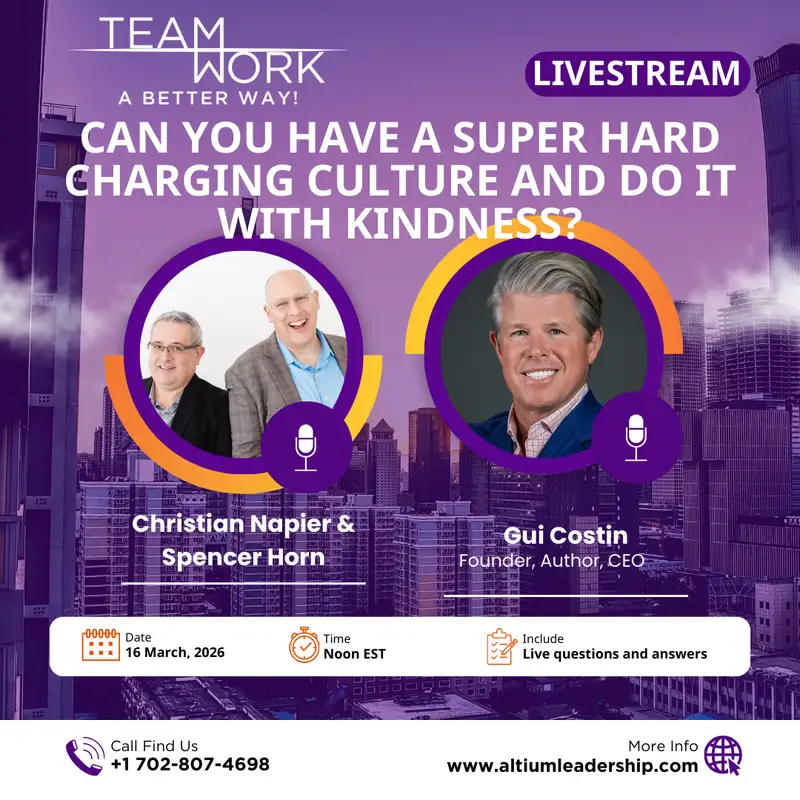
Can You Build a Hard-Charging, High-Performance Culture Without Losing Kindness?
Christian Napier
00:13 - 00:28
Happy Monday, everyone. Welcome to another episode of Teamwork, A Better Way. I am Christian Napier, and I am joined by my forever friend and amazing co-host, Spencer Horne. I can't even say your name right, Spencer.
Spencer Horn
00:28 - 00:33
Must be Monday. How you doing? I'm great. Excited to be here with you, Christian.
Spencer Horn
00:33 - 00:35
Good Monday morning. How are you?
Christian Napier
00:37 - 00:48
Well, I can't get through an intro without flubbing, so probably not amazing. But yeah, doing great. I had a nice little weekend. I had dinner with some friends.
Christian Napier
00:49 - 00:58
We celebrated our son's 27th birthday. So yeah, it's been a good, good weekend overall. And you, did you have a nice weekend?
Spencer Horn
00:59 - 01:14
Busy weekend. I mean, I was gone all last week, so I was in Las Vegas speaking at a conference. While I was there, I flew to Denver to speak at another event, back to Las Vegas, and spoke at a great conference. The associations out there are crazy.
Spencer Horn
01:14 - 01:18
The Government Investment Officer Association, that's who I spoke to.
Christian Napier
01:19 - 01:36
Oh my goodness. And I understand you also had a call at like 11.30 last night. This is what happens when you are working around the globe. You end up having to take calls at crazy times of the day and night to meet the needs of your clients.
Spencer Horn
01:36 - 02:08
Yeah, my client in Doha, you asked a question and obviously they have been challenged with the war that's going on over there and working from home, kids are not going to school. This is in Qatar, same with the UAE I'm sure is very similar in Kuwait and Bahrain. For them, they said it's calming down, things are starting to get a little bit better and back in the office. She was actually driving to the office when I spoke to her last night at 11, 11.30 my time, so.
Christian Napier
02:09 - 02:17
Nice. Well, I hope that continues. I really do. I hope that continues and we can find a Resolution quickly to all of this.
Christian Napier
02:17 - 02:28
Yes, let's not get sidetracked No with all of that that's going on because we have an amazing guest and we want to spend as much time with him as possible So Spencer, why don't you do the honors?
Spencer Horn
02:28 - 03:00
Yes, we've got Guy Costin today that I am so excited to introduce to you. Guy is the founder and CEO of Dakota, a financial software data and media company based in one of my favorite cities, Philadelphia, PA. And Dakota's flagship product, the Dakota Marketplace, is a database of institutional investors. which is used, Christian, by over 6,000 fundraisers and over 1,400 global investment firms.
Spencer Horn
03:01 - 03:13
Guy is a leadership expert. He's part of the Forbes book network. He's written three books. Millennials are not aliens.
Spencer Horn
03:12 - 03:40
The Dakota Way, which I hope we get to hear about, and his latest book, Be Kind, which is really the focus of our topic today. Really, the question that we have, can you build a hard-charging, high-performance culture without losing kindness, is kind of the thesis of, it is the thesis of our topic today. So your question is provocative, Guy. Can a company be extremely hard-charging and still operate with kindness?
Spencer Horn
03:40 - 03:47
And what inspired this question from you? And then answer it, of course. Welcome.
Gui Costin
03:48 - 04:00
Thank you. It's great to be on. Thanks for having me on. And what inspired the Be Kind book was I spent a lot of time building a business over the past 20 years.
Gui Costin
04:00 - 04:16
In the early days, there was a lot of volatility, right? And it was kind of a locker room mentality. And I had a lot of lessons learned. But I did learn five years in, from 2006 to 2011, that really, at the end of the day, it was about helping other people get what they want out of life.
Gui Costin
04:16 - 04:35
That was the mantra that I started on in 2011. And then as we grew the business and started the second product, we started hiring, you know, a lot more women. And we only had, you know, Tracy's been with us since 07. And I knew the locker room mentality and just, you know, wasn't going to work.
Gui Costin
04:35 - 04:51
And it wasn't especially not going to work when I hired my two best friends' daughters and they started in 2020. And so the question was really at the end of the day, if the most important thing for a leader is to keep their best people forever, How do you do that? Right? And you treat them like gold.
Gui Costin
04:52 - 05:18
But can you just do, can you have this thesis, like I said, like you just mentioned, of a ridiculously hard charging culture playing at the highest professional level, but do it with kindness. And we've proven that you can. And the reason I think it's such an important topic is because people spend more time at work than they do with their family. And can you make it where work is fun, enjoyable, everyone's become the best version of themselves, there's respect, but there's also not kumbaya.
Gui Costin
05:19 - 05:26
It's not to address thorny, important issues. You have to do that. That's kindness. And we've proven that it actually is possible.
Gui Costin
05:26 - 05:28
And that's what the whole book is about.
Christian Napier
05:31 - 05:44
That's really interesting. I was sent a link to a video last week. I'm trying to remember who the person was. But she delivers this TED talk on the super chickens.
Christian Napier
05:44 - 05:50
I don't know if you've heard this thing about the super chickens. These like chicken soldiers? What are they? I don't know what those are.
Christian Napier
05:50 - 06:21
No, what it was was this biologist conducted some experiments, and he wanted to see how he could optimize production. And so he basically had two flocks of chickens. One was just average egg-laying chickens and let them do their thing. And the other, he, over six generations, bred this super chicken that would had higher output than the average chicken, right?
Christian Napier
06:21 - 07:08
And so he let those chickens go over several, I can't remember what the timeline was, months or whatever. And what happened was that the average chickens were More productive than the super chickens the super chickens ended up pecking each other to death. There were only three alive by the end of the study and so, you know, it made me think about like okay the hard-charging alpha culture where we try to you know, we are optimized for maximum results and everything and and If we're all alphas, then chances are we can out-compete each other and create a very toxic environment that just eats everybody alive.
Christian Napier
07:08 - 07:35
And so I'm curious in the experience that you had, if you saw that, because what is the rationale to say, oh, well, I want to be kind. I want to create a culture that includes more women and so on and so forth. But why? I mean, if you can have the locker room culture and you bring in a bunch of alphas to do the thing, you know.
Christian Napier
07:35 - 07:59
Traditional logic would say, hey, then we're going to get more optimal results. But what you're telling me is something that seems more aligned with this like super chicken experiment, right? Where if you bring folks along that may not all be alphas, but they can get along with each other, and they can build relationships, and they can work together, it ultimately leads to a better outcome. I'm just curious to hear your thoughts on that.
Gui Costin
08:00 - 08:19
Yeah, I mean, as we were building this second business, we hired roughly 70 people, 75 people in the past seven years. And think of volatility, right? You don't need to be a jerk to get stuff done. You can be thoughtful with your words.
Gui Costin
08:19 - 08:29
You can be thoughtful of how you treat people. And you can treat people like adults. You can trust people. And if you create that environment, it leads to extraordinary results from the individuals.
Gui Costin
08:29 - 08:43
And I'm just seeing it, right? Where we don't have to sit there and spend any time talking about people or HR issues or any of that. It's just all about, we all want to be transparent. We want to set expectations.
Gui Costin
08:43 - 08:52
And we absolutely always want to be asking why. Why are we doing something? And why is that so important? Because you always want to be growing and questioning everything that you're doing.
Gui Costin
08:52 - 09:16
And as a leader, I don't need to demean people, put them down, poke fun, make jokes, stuff like that, which is, look, in the work environment, that's a little bit of the sort of the standard operating procedure. And people don't leave companies, they leave their bosses. And I don't want to lose our best people. And so I just made the decision, not that I was so bad at it before, but I just made the decision to kind of completely reverse course.
Gui Costin
09:16 - 09:50
and go super low vol, treat everyone like adults, adhere to the expectations. And look, along the way, we've had extremely low turnover the past three years, extremely low. We did have some turnover, probably 20 people, just that didn't kind of fit the culture and it just didn't work out. But also another important thing is that the institutional knowledge to get a job done, If someone comes in and they're there six months in a year and leave, then they never get into any kind of rhythm, if you will, and really know how to get the job done.
Gui Costin
09:51 - 10:18
And I think that's just another critical component of keeping people. And most people, as I said, you have to be intensely vulnerable to go down this kind leadership path, intensely vulnerable. Because there's so much stuff comes up, oh, they're going to take advantage of me, or they're not going to work hard, like all this noise, right? And I just, I haven't seen the evidence there, because then what ends up happening is everyone's performing, and they're having fun together, because that's one big part of our culture is you got to have fun.
Gui Costin
10:18 - 10:32
I got to love the people I work with. And, and we've built really two marvelous businesses doing this. I mean, our Dakota marketplace product is one of the, it's definitely the best in the industry today for what it what it does and who it serves. And it's only growing and growing and growing.
Gui Costin
10:32 - 10:43
And so that's, that's really the logic. There's no, it's not so like alpha type A, you know, all of that. It's just everyone's really cordial to each other. They're cool.
Gui Costin
10:44 - 10:58
And, and we don't have any managers. We have leaders, but we have 55 people that work in a downtown city office. There's not one manager overlooking all those 20 and 30 somethings. So we sort of proved it works.
Gui Costin
10:58 - 10:59
The science experiment works.
Spencer Horn
10:59 - 11:04
And everyone's really happy. So you're saying it's a holacracy?
Gui Costin
11:04 - 11:19
It works, you know, and we've been voted by Forbes, you know, 50th, you know, great place to work. That's been really cool. Philadelphia, you know, the Philadelphia Business Journal did the same thing and they looked at the results that we got back. She goes, we've never seen anything like this.
Gui Costin
11:19 - 11:33
So people really love coming to work and it works. And then all of a sudden, if you really care about your customers, don't you want to keep your employees and your teammates ridiculously happy, take care of them so they would then take care of your customers?
Spencer Horn
11:33 - 11:50
You know, it seems so obvious, Guy. And so, you know, I do, I'm a team performance coach, right? So I come in and assess where the cultures are on teams. And what you're talking about is, around 10% worldwide have that type of experience.
Spencer Horn
11:50 - 12:15
So when we have what would seem like so many smart people running organizations, why do we struggle with this? I mean, answer why you think the locker room mentality happens. Where does it come from? Where does this, where does this, uh, culture that actually, you know, defeats high performance, where, how does it generate, where does it come from?
Gui Costin
12:16 - 12:34
I just think people are intellectually lazy. And I, listen, I start the book off, the first line of the book is the most out of control line on the planet, right? And my ghostwriter's like, why are we, it's the only time I swear in the whole book. I use a, you know, and I said, cause when people read that, they're going to know exactly what it means.
Gui Costin
12:34 - 12:45
There's not one person who's going to read that line and not know exactly what it means. And I basically say it's easy to be a D. You know what I mean? It's easy to be a jerk.
Gui Costin
12:46 - 13:03
And what that means is it's so intellectually lazy to say whatever comes into your brain and let those words go out of your mouth. But we all know you've been in work situations where somebody said one word to you. And it's like, you've never forgotten it because it tweaked you out. And it was other rude and considerate, what have you.
Gui Costin
13:03 - 13:13
And there, if you can just not do that. So I had a lunch three weeks ago with a Navy SEAL named David Rutherford. seal to CIA. Now he's a coach.
Gui Costin
13:14 - 13:32
And he did the Boston Red Sox. He's like really pedigree, well pedigree guy. And he looked at me, he goes, I studied you before having lunch because it's his high school classmate where I've been in Florida together. And he goes, I've never seen a high performance culture, like coaching with kindness as its core principle.
Gui Costin
13:33 - 13:45
And I was like, well, you know, It's, it works really well with us. You know what I mean? And, and, but to answer your question even more deeply, I don't, I think people can be intellectually lazy. They're going to take the easy, easy street.
Gui Costin
13:45 - 13:58
So just say whatever comes into their brain. And listen, if you really want to go a little deep on it, cause I do talk about in the book. Every human being has some level of childhood trauma, right? It's not anybody who, you know, has some self-awareness.
Gui Costin
13:59 - 14:09
We all do, right? Parenting is imperfect. It is. But it's all that baggage that you carry with you unless you address it as an adult, as a leader, everything.
Gui Costin
14:09 - 14:23
Because you could have grown up and you said, hey, if you're nice to people, your dad says, if you're nice to people, they're going to take advantage of you. So the leadership style is then, well, I have to be a jerk because they're going to take advantage of me. My dad said you can't, you know what I mean? It's like, you have to have such self-awareness and understanding of yourself.
Gui Costin
14:24 - 14:36
And also, who wants to come to work and be teased or put down or made fun of or someone calls them out on their sweater, the color of their sweater, you know? I mean, who wants that?
Spencer Horn
14:36 - 15:00
You know, I think all of that is true and this is something that I – this is actually the thesis of my talk. It's called Stronger Than Your Strengths, my keynote. I talk about this all the time and I think one of the contributing factors is that we've also been told, how many books are there that talk about your strengths? Just focus on your strengths.
Spencer Horn
15:00 - 15:19
Just be you. false idea of what it means to be authentic, and that is, hey, I'm an alpha male, I'm a high D, or I'm a this or that, and we celebrate the fact that we are naturally Ds, right? We're naturally that jerk that you talked about. It's part of the culture right now that says, you know what, Guy?
Spencer Horn
15:19 - 15:45
This is who you are, and to be authentic, you need to be yourself. And we kind of celebrate people releasing the beast, thinking that's what's going to build trust with people, and it's not. And the best leaders are actually able to filter themselves. But you also gave an antidote to the problem in your description a minute ago, and you said you hired women.
Gui Costin
15:47 - 15:52
Yeah. Yeah. I mean, not, not, not by like, I didn't go out and say, we're just going to, you know, it's just, it evolved. Right.
Gui Costin
15:52 - 15:55
As you started. And as we're growing the business, we need to fill roles.
Spencer Horn
15:55 - 15:57
So how did that, how did that impact the culture?
Gui Costin
15:59 - 16:16
Well, I mean, I don't want this to come across as chauvinistic in any way, shape, or form, so I'm a little careful with my words. But we have 24 women on our team. And to a person, they are just the best people on the planet. And they are so much fun to work with.
Gui Costin
16:17 - 16:27
They are so productive. They are so reliable. They buy in. And listen, leaders, I believe, have to have their safe places that they can go if they're frustrated about something.
Gui Costin
16:27 - 16:43
Last week, I was frustrated with the ads that we were putting in our newsletter. And I thought I'd address this issue, right? So I called up our president, our head of product, safe place for me, I can be ridiculously direct, kind, right? But it wasn't like a comfortable conversation.
Gui Costin
16:43 - 16:56
I'm like, guys, like, are you kidding me? Like, this is like, you know, sometimes you just have to like, to, you know, I thought I had addressed it. And then they listened. And I said, Look, you know, and I call those, you know, in the old days, I called them geekinos.
Gui Costin
16:56 - 17:06
So finish the conversation with those guys, like 22 minutes. And we're going back and forth. And I'm just sort of having it out. But I need to, I needed a safe place to release my frustration of why this isn't getting done.
Gui Costin
17:06 - 17:12
And it's going to 31,000 people, and we can't figure out the ad. So it's not a small problem. You know what I mean? And that's just one issue.
Gui Costin
17:12 - 17:21
So I go, Pat, you know, love you guys. Sorry for the geekino. Pat goes, What? I wasn't even close to a geek, Hannah, stop.
Gui Costin
17:21 - 17:29
So my point is, is that you develop that trust and that you can, you know, I'm not Kumbaya and I called them up and I was legitimately ticked off, very ticked off.
Spencer Horn
17:29 - 18:00
But here's the point, you have built enough rapport and relationship, trust with those that if you do need to let off a little bit of steam, they know where it's coming from. And I think, you know, that's what Stephen Covey called the emotional bank account, right? You have a surplus because you have built that trust with them. And I've had, you know, with my mentors, same tough conversations where I knew it came from a place of love, not because he was being a jerk, because I needed to hear something that got my attention to move the needle.
Spencer Horn
18:00 - 18:22
I love that. Well, let me just say one thing before we, I know Christian's got a question here, but I speak to CEO groups all over the US and Canada. And when I go to groups that are all men, the locker mentality is usually more present. When there are a few, even a couple of women in the group, they all behave better.
Gui Costin
18:24 - 18:43
Yeah, I mean, listen, it keeps you honest. And, you know, my two best friends' daughters, I don't want that Rosantics going back to the kitchen table to their moms, you know, who I adore. So, yeah, I mean, we have two heads of renewals. I mean, we really, I mean, one was a waitress, you know, one had left us as an intern and she was just doing some modeling for J.
Gui Costin
18:43 - 18:56
Crew. And then we brought them in and they're literally killing it. I'm so proud of them, you know, and just watching them just evolve, how they relate to these procurement people and just how they, how they behave and how they do things. I mean, it's just, I mean, I can go through each one.
Gui Costin
18:56 - 19:13
I mean, we, we did something really neat. about a month and a half ago, we put it all over LinkedIn. I got all the boys, the company, okay, most of them are former Division One athletes, all the boys, a custom jacket as a Christmas present from this Habitat show up in New York. And I did it like 10 years ago.
Gui Costin
19:13 - 19:26
And I wanted to have everybody get an opportunity as a thank you to have their own custom jacket because they wouldn't do it on their own. I And of course, I told the girls about it. Hey, what do you think? And they're kind of like, we don't really like jackets, like we don't wear sport coats.
Gui Costin
19:27 - 19:42
So make a long story short, my wife had this idea. We're like, okay, we're going to do something else. Long story short, what transpired into is a bus ride from Philly to New York, called it Ladies Day. went, picked a restaurant, had an amazing lunch, all 24 of the women at Dakota.
Gui Costin
19:43 - 20:07
And then they walked one block to Bergdorf Goodman, and they all got their, they picked out their own present. And they said it was one of the greatest days, and bonded with everyone, had a ball. And when you put 24 great women like that, all together, I mean, it's really pretty special. And so yeah, and that's, that's just celebrating them because, listen, we work in an industry that there's, you know, the investment industry is heavily, heavily skewed to males, right?
Gui Costin
20:07 - 20:23
And, you know, and then we have three X, the female leaders and we do male leaders. So three X, at least a lot, most of our chiefs are females, like our CTO or CMO, right? Our head of our studio. So it's just been a blast and they're just, it's just awesome.
Gui Costin
20:24 - 20:31
There's awesome people. Listen, the boys and the girls, if you will, the men and the women, Like, they're all equally great. They all have equally great values.
Spencer Horn
20:33 - 20:41
We're not putting any men down here whatsoever. We know that men, we behave a little bit better when there's women in the room.
Gui Costin
20:41 - 20:55
I mean, there's no doubt it keeps you honest. You know, there's, there's no place in our culture for, you know, any attitude or any teasing or anything. We're not, there's like 0.0 that it's all self policing and, and everyone wants to get the job done. Right.
Gui Costin
20:55 - 21:11
And then, and also they know too, they can come to the leadership and we will remove any obstacle. right? So if someone wants to, there's no ceilings to the code, as we say, no ceilings, you can grow as much as you want. You know, Helen right now is going through a really cool thing where she just wants to, you know, do more around our integrations.
Gui Costin
21:12 - 21:31
And then we sort of set up a whole thing there. And we're just watching her blossom. You know, so it's just, and by the way, you know, women are great attention to detail. There's one thing I learned too, in general, you do not need, again, it's gonna, you never need to tell any of our female teammates to do something twice.
Gui Costin
21:31 - 21:40
You tell them once and they just get it done. It's responsible. And it's just so fun to work in an environment like that. And then sometimes, not all people are having a great day.
Gui Costin
21:40 - 21:55
And I'll give you another example recently, I asked our president, our head of marketing, Catherine, was just kind of, was a little off, not really herself. And like something just wasn't right. And you know, some people could go at it very differently. I said, Rob, just call her.
Gui Costin
21:56 - 22:04
Okay. And I want you to go the deepest, deepest, deepest compassion you can possibly have. Just seek to understand and listen. Just say, I'm just touching base.
Gui Costin
22:04 - 22:15
You know, what's going on? Well, it turns out we were trying to implement this new marketing, email marketing platform, and it was a complete disaster. And we tried to consult and she was just bearing the brunt. all that stress.
Gui Costin
22:15 - 22:21
So when we just sat down and she's like, no, no, it's just, it's killing me. It's killing me. And okay, we got it. We addressed it.
Gui Costin
22:22 - 22:43
And then, right. But we, you don't go at it as an accusatory, you know, why are you acting like this? Let's solve the problem. Yeah, you need to go with intense compassion, just to seek to understand what's and she back to normal in one minute, we have your back, we're going to do we end up flushing the whole platform, we just took is like, this is not working, Catherine, we're not going
Gui Costin
22:43 - 22:53
to implement this, we're going to move on to something. So and then it was like, you know, the stress went away. So those are just little examples every single day of it's how you treat people, right?
Spencer Horn
23:05 - 23:08
Christian, I think it's time for you to go to a haberdasher with me.
Christian Napier
23:11 - 23:37
Yeah, I'm ready to put something here on my rapidly balding head. So I've got a question for you. You touched on a couple of experiences that you had where things weren't going all sunny. People can have perhaps a skewed perception, like if I create this culture that everything is gonna go swell, right?
Christian Napier
23:37 - 24:10
But you run into hard times on a couple of occasions that you pointed out here. and you talked about how you handled them. I'm curious to hear your take on what's the difference between being nice and being kind. We have a little saying around here, which is, Utah Nice, which is, OK, we get along at the surface.
Christian Napier
24:10 - 24:32
We say hello, and how are things going? But we don't really get deep. And If I understand what you're saying correctly, being kind doesn't necessarily mean always being nice. You are understanding, but you mentioned in this where something wasn't working out, you had a meeting.
Christian Napier
24:32 - 24:41
You were very direct in that meeting. And so I'm wondering if you can kind of walk through the distinction between these two for you and your organization.
Gui Costin
24:42 - 24:53
Yeah, so it's in the book, we talk about kind versus nice, and you don't want to be nice, right? You want to be kind. And why is that? Because a lot of times being nice is probably the most unkind thing that you can do.
Gui Costin
24:53 - 25:08
I was talking to a young lady yesterday who dates my son's best friend. And she just had to take on five people that report to her. And I said, look, at the end of the day, people want to be led for the most part. They want to be led.
Gui Costin
25:08 - 25:32
They want to be having clear direction. They want to feel like they're being taken care of and led. And being direct, not being insulting, but you have to show people what good looks like. And if we're sitting there in a situation and it doesn't look good, it's not the way we do things, and you're just going to sit there because you want to be nice, you don't want to address the issue, you're doing such a disservice to that person.
Gui Costin
25:32 - 25:46
You're killing that person. Now, all you have to do is, as I say, look, guys, at the end of the day, it's my job to define for you guys what good looks like. And I think as we're going here, this is not what good looks like. Let's be clear, and this is why.
Gui Costin
25:47 - 26:08
And for instance, we have a very distinct logo, Dakota. Well, we were doing an invitation to an event, and somebody just decided, not really thinking, they just used the logo on the Dakota Way book. And so I said to them, I said, guys, why do we create a new logo? They're like, we didn't.
Gui Costin
26:08 - 26:16
No, I said, why do we create a new logo? Don't we already have a logo? That's the logo we want to use when we brand anything, right? And it took me like five times.
Gui Costin
26:16 - 26:24
And finally, they're like, oh, OK, I got it. I got it. Now, I could have let that slip, or this, or that. And then, no, you have standards.
Gui Costin
26:24 - 26:41
And that's why, if you're coaching CEOs, The absolute most underrated, most important thing a company can do is to write down what it stands for, your standards. People call them core principles. It's your standards. And then because all you have to do is come back to the standards.
Gui Costin
26:42 - 27:00
If you all agree on what you stand for, then that makes those conversations very, very easy. Like details matter is one of our core principles. Okay, if details matter, are we just going to be lazy and choose a different logo and we can get away with it? Or are we going to have our logo every single time?
Gui Costin
27:00 - 27:22
And so that's one teeny, teeny little thing. But defining your standards and one of our biggest standards is focus on what matters most focus on what you can control. So if you also come back to that, I just had to redo our investment sales, 1130 weekly check-in, right? Because it had gotten a little unwieldy and it was taking too long and people weren't focusing on what matters most.
Gui Costin
27:23 - 27:34
So when everyone reported, it's like, look, these are the six things that matter most. And everyone's going to go around the room for two minutes and talk about those from last week, opportunities you've moved forward, right? And then your plan for the week. right?
Gui Costin
27:35 - 27:51
And so those standards drive everything. And writing those down, because then when you're in a pickle, or you're in a situation, you can point to the different, you know, what, your core principles. Walk 8 feet, don't go cowboy. That's kind of tapping the collective knowledge of the group.
Gui Costin
27:51 - 27:58
Paralysis by analysis, throw your hat over the wall, right? Turn your brain off. Why do we say those things? Because people can get paralyzed.
Gui Costin
27:58 - 28:13
They overthink things. Well, I came up with a few core principles to address that, right? And then everyone has to vote, if you will, on their favorite core principle and why. And so if you just really get that into the fabric of the company, then all of a sudden it's like, hey, it's really clear what we stand for.
Gui Costin
28:13 - 28:17
We stand for responsiveness, right? Super, super valuable.
Spencer Horn
28:26 - 28:46
So important, Guy, when you talk about core values, it's basically this is the way we behave. And a core value, in my opinion, must be non-negotiable, which is why you shouldn't have too many of them because you don't want to restrict everything. I mean, you can have aspirational values, right? But a core value is non-violent.
Spencer Horn
28:46 - 29:07
I mean, it's just this is who we are, this is what we do. For example, let me back up and give you an example. When I go in and work with a team, I was just working with a major organization in Qatar, and my coach and I, we create what we call an alliance. It's basically how we're going to work together, how we're going to behave together.
Spencer Horn
29:07 - 29:21
And so that when something happens, we know how to correct it if we go outside of that, right? Which is what you're talking about. We do the same thing with the group of people that we're working on. We say, listen, what is going to make us wildly successful in this interaction?
Spencer Horn
29:22 - 29:27
What do you need from us? And then we tell them what we need from them. We need you to be all in. We need you to be present.
Spencer Horn
29:27 - 29:44
And then we all vote on, yes, these are agreements that we will live. And when people, as imperfect as they are, break them, then we go back and say, hey, do you remember the commitment that you made to pay attention to details? That didn't happen. What are you going to do about it?
Spencer Horn
29:45 - 30:12
It's not an argument because you've already agreed that that's what you're going to do and now because you've set those standards, and there are people that say, I don't want to live that standard. Okay, well then this isn't the place for you and that's totally fine. Right? And so I really think that's really key to being kind is have standards that people agree to so we don't have to fuss about it.
Spencer Horn
30:12 - 30:16
We can just say, hey, listen, that doesn't meet our standards. How are we going to get that back in alignment?
Gui Costin
30:18 - 30:36
Yep, 100%. And all of our standards have the through line. And I would say to our team, if I'm going to, you can sit down with me at any time and tell me from what I'm asking you to do is not in your best interest. And I have an open door policy for anybody to come to me and make that case.
Gui Costin
30:37 - 30:53
Because I'm not asking you to do stuff that's not in your best interest, the customer's best interest. Because back in the day when I was in sales, sometimes they would do activity for activity's sake. That was kind of a line that really makes no sense, right? It's like, what are the core things that drive whatever activity, right?
Gui Costin
30:53 - 31:03
Focusing on what matters most. And then when you do that, what people really feel refreshed by is they know they're not wasting time. They're not doing stupid stuff. People love that, right?
Gui Costin
31:03 - 31:11
Or conversely, since they don't do it at Dakota, they can't stand that. We also have something I think you'll really enjoy. We have a monthly offsite. We call them W days.
Gui Costin
31:11 - 31:26
What's working, what's not working. Each group comes in, whatever it is, the tech team, the product team, the marketing team, the sales team, HR and finance. And they talk about no presentations. They sit around like with seven or eight of us and run a big table on our third floor.
Gui Costin
31:26 - 31:40
What's working, what's not working. Rachel takes all the notes. we probably walk away with 45 to 50 solid ideas and takeaways from that day. It's and now people are like, Oh, yeah, remember that idea came out of the W day.
Gui Costin
31:40 - 31:55
So what we do is we create a very safe place where people can say, Hey, look, what is not working? And then another thing that I do, okay, everyone has to come up with one thing they should they want to stop doing. What is that? I'll send you like, I'll never forget it because we do QBRs, quarterly business reviews with our customers.
Gui Costin
31:56 - 32:09
And the CSMs, the customer success people had to schedule those. And this is a two years ago W-Day. I said, what would you like? They're like, well, I'll tell you, it's so time consuming scheduling these QBRs.
Gui Costin
32:09 - 32:16
I'm like, Saab, what do you mean? What are you saying? So I can, I can understand how to solve this problem. He goes, it's too time consuming to set up the meetings.
Gui Costin
32:16 - 32:28
It's killing us. I said, so are you saying that if we have one dedicated person to schedule those that didn't have your responsibility, he looks at me and goes, you, you would do that? I said, Saab, it's done. It's over.
Gui Costin
32:29 - 32:37
We're hiring it. Like, next item, he goes, you're kidding me. I said, no, we happen to have a woman, right, Isabel? So boom, she does that, boom.
Gui Costin
32:37 - 32:43
So that's what those days are for, is just to have the freedom. You think as much as we communicate. Yeah, go ahead.
Spencer Horn
32:43 - 33:03
I have a question about that. Sorry, Christian, I just, I want you to, the question I had a minute ago was, you know, you've built this platform with thousands of global investment firms. And so there's a lesson there about scaling, right? I mean, you got up to 75 employees and that's a good size investment firm, right?
Spencer Horn
33:03 - 33:25
I mean, how have these principles, the core values, the W days, how have they helped you in scaling something? Because I want people to listen to this if they are serious business people and they're saying, yeah, that's nice for the culture and stuff. But how does that relate to the actual growth of the business from your perspective?
Gui Costin
33:25 - 33:34
Because you keep your best people and they, over time, if they're good, what took them 30 hours to do is going to take them 10, it's going to take them 30 minutes, it's going to take them 5 minutes.
Spencer Horn
33:35 - 33:38
This is all about productivity. Amen, amen, amen.
Gui Costin
33:39 - 33:58
Yeah, I mean, that's, that's the name of the game, right? And that's what I was saying about our renewal team. I mean, watching them grow into these unbelievable, how they address really thorny issues around budget and procurement people and the whole, those aren't, those are not easy people to deal with. And I'm watching them just absolutely kill it.
Gui Costin
33:58 - 34:07
And they're not mean, but they're just very direct. They know how to interact with people. But yeah, it all comes down to productivity. It all comes down to keeping your best people.
Gui Costin
34:07 - 34:19
It all comes down to what it takes to get a job done. And then that knowledge. We can double our revenue in that business and not hire any new people. And so that means everybody gets to grow.
Gui Costin
34:20 - 34:23
And instead of just bringing in new people, right? And I love it.
Spencer Horn
34:23 - 34:28
And then they get to go to downtown Manhattan for lunch in a haberdasher.
Gui Costin
34:28 - 34:31
Exactly. Exactly. Got to have fun. That's 100%.
Gui Costin
34:31 - 34:34
100%.
Christian Napier
34:35 - 35:13
Okay, Guy, I've got a question for you based on something you said moments ago. You gave the example of, hey, one of our values, our standards is we are detail-oriented and a person using the wrong logo and you corrected that. So one of the questions that I have is how do you walk the fine line between being kind and helpful and micromanaging, right? Because another thing that you mentioned was like this analysis paralysis thing, which is real, and that is driven by fear primarily.
Christian Napier
35:13 - 35:18
Like, I'm afraid to make a decision. I don't feel confident that I have all the information.
Spencer Horn
35:18 - 35:22
Because he's going to open, what was that? You called it a can of
Christian Napier
35:22 - 35:45
How do you make sure that you give people latitude to do the things that they do so that they don't feel micromanaged while at the same time having high standards and making sure that people are living up to them?
Gui Costin
35:47 - 36:12
Yeah, I think micromanaging, I just have to say, is probably somewhat of a misnomer. Because really micromanaging is you're just saying, I don't trust you to get your job done. So I got to ask a bunch of dumb questions, right? Whereas if you set clear direction on how we're doing things, and you sit down and have a conversation, and people know what the goals are, they know the direction we're going in, and you let them do their job, That's what people want to be trusted.
Gui Costin
36:12 - 36:32
People want to be trusted. That's why it's so hard if you look at some parents, and trust me, I'm not perfect in any way, shape, or form, but if you make every single decision for your kids, they don't end up ever having or developing any self-confidence, because mom's just making every decision, answering every question. People ask your son a question, mom answers it.
Gui Costin
36:32 - 36:48
Well, can't the kid answer it? You know what I mean? That would be like examples, just clearly, visibly not trusting someone to get their job done. And then you and another thing that I think that I would say too, this is a little bit of a gold nugget, is that nobody's going to work, okay, for eight hours a day straight.
Gui Costin
36:49 - 37:06
It's just, it's just not going to, you know, if it takes somebody an hour to get their job done, or what have you, like, we've never had a vacation policy, take the time you need, we've never had a travel and entertainment policy. Just stay where you want to stay. Use the money like it's your own money. That's 20 years.
Gui Costin
37:06 - 37:17
We've never had an issue. And then we're so transparent. If we know something's going on and things look a little askew, we just address it. right?
Gui Costin
37:17 - 37:29
And say, Hey, tell me what you're thinking here. Is this is this the direction we want to go in? I was thinking about this. And then you just have to and once people know they're not going to get ripped apart, they'll take chances will take risks.
Gui Costin
37:29 - 37:43
And yeah, there's no micromanaging really is like saying like, I just don't trust you. And then it actually comes out in your personality. Because you're you're you're acting sort of incongruent with trust. if that makes sense.
Gui Costin
37:43 - 38:04
And it's just, it's so obvious, the person knows that you don't trust them to get the job done, because you're asking really weird questions. And we just don't, we just don't do that. That's just not part of our culture, you know, at all. Now, are we on do we do we have so many, like Mondays are really busy, because we do all of our check ins, and everyone listens for what's going on in that group, and the other groups in this group, and how are things going?
Gui Costin
38:04 - 38:11
So we monitor everything, we have great stats. But yeah, micromanaging just implies a total lack of trust.
Spencer Horn
38:26 - 38:45
You know, you've listed some great ideas to keep people motivated. And I'd like you to maybe summarize and add some others. Well, let me back up. Burnout is a huge issue right now all across the world.
Spencer Horn
38:45 - 39:08
I talk to people that are just, they feel like they're burning the candle at both ends. They feel pressure from society and geopolitical issues. My friends in the Middle East, they're not sleeping at night, obviously, for certain reasons. But even before that, there's so much brain space that is being taken up by, things that are happening in the world.
Spencer Horn
39:08 - 39:18
How do you create this high performance culture without burning people out? How do you help them renew and recharge and replenish?
Gui Costin
39:20 - 39:34
Well, number one is how you treat them, right? Number two, generally, we're kind of a ghost town at 5.15 in our office. So we're not like, you know, grinding people until 7, 8, 9 at night. We have a 7.45 sales check-in every day.
Gui Costin
39:34 - 39:57
So people kind of come in early. Right across the street from our downtown office, we have this really cool club where I buy everyone a membership, and it includes an incredible gym. And I encourage people during the day to walk around the block, go get some exercise, right? I mean, do you know, so, you know, hi, hi, I encourage to, you know, reset every day, because you can't just work eight straight hours.
Gui Costin
39:57 - 40:18
And that doesn't make any sense. And, and like I said, if you're just cool to people, and because a lot of the burnout comes from almost unrealistic expectations, right, where people are asking to do stuff, or you're, you're, you're pushing too hard, right. And I just don't think that's a winning scenario. Now, people feel like if I'm not pushing someone, they're not going to get the job done, I want to get the most out of them.
Gui Costin
40:19 - 40:39
And you're really saying that means they, they don't have the ability to get the most out of themselves. And You know, it might be in sports that you can kind of, you know, high school and college sports, but there's maybe more of a place for that. I don't think there's a place for that in the work environment. And you hire people, this is your responsibilities.
Gui Costin
40:39 - 40:53
You're going to report back against these and then just let them do their thing. So when I come to the downtown office, we have a huge open area with an eight foot by eight foot bar height kitchen table in this big room. There's 15 seats around it. I just come down there and sit down there.
Gui Costin
40:53 - 41:04
And people come in with their laptops, they're sitting in chairs, they're, you know, boo. There's no gi like saying, Hey, how come you're not in your office doing this? I never say any of that, right? I just hang, right?
Gui Costin
41:04 - 41:15
Say hello to everyone, you know, because they're going to feed off my energy. And so there's none of that. And so people feel that then there's nothing like, Oh, my gosh, why are you leaving at 505? Right?
Gui Costin
41:15 - 41:31
Well, I mean, that's just not, that's not what we're about. I think you can get your, if a customer calls at 530 or six or emails you, the expectation is you'll definitely respond. And I would say also that you respond at nine o'clock at night, right? Now I'm not going to, I never, I've never had to say that.
Gui Costin
41:31 - 41:47
I'm saying all right now, but I've never had to say that, but that's what people do, right? They get an email from a customer and they get right back to them. And, and I also think that that attitude, I believe that's the right attitude people should have. It shouldn't be like, well, If it's five o'clock, I'm out, right?
Gui Costin
41:47 - 42:01
I'll respond the next, that's just not there. I just don't think that's a good attitude for anyone to have. I think being, serving people is the greatest, to be of service is the greatest thing that you can do. taking care of people, that would be an example.
Gui Costin
42:01 - 42:16
So I would actually be doing somebody a disservice if I told them that, no, no, you shouldn't respond. If you're sitting there and your phone lights up at nine and someone has a question, you get back to them. I'm not saying spend an hour, right? But there's like a delicacy there.
Gui Costin
42:16 - 42:20
It's a delicate sort of fine line, but I think you guys kind of know what I'm getting at.
Christian Napier
42:20 - 42:41
Yeah, Guy, you mentioned that you work with thousands of global investment firms. And the main goal of any investment firm is to maximize a return, right? So I'm curious to hear from your perspective, what is the ROI of kindness?
Gui Costin
42:44 - 43:08
Oh my gosh, it's, you know, when people say, you know, you've changed, you know, you've changed my life, right? I mean, that's like, like, you know, that's, that's the, that's the goal, right? Is you, you really want to be able to change someone's life because we know what normal work looks like. But you go in and somebody's, you know, pretty unkind to you, or they say something weird, or, you know, or there's an unrealistic expectation.
Gui Costin
43:08 - 43:29
And then you go home, and you complain to your husband, your wife, boyfriend, girlfriend, dogs, you know, the whole thing. The ROI is off the charts. But it takes intense vulnerability on behalf of that leader. And I heard a story about a buddy telling me something about Southwest Airlines, Herb Kelleher.
Gui Costin
43:30 - 43:36
And this guy, I was telling him our story. And he goes, stop. He goes, did you ever hear Herb Keller from Southwest Airlines? I said, no.
Gui Costin
43:36 - 43:48
He goes, you ever heard of him? I said, sure I have. He goes, if he met you once, I mean, he treated everybody so well at that company, so well. And that just stuck with him.
Gui Costin
43:48 - 44:01
And we have a young kid down here that we hired. And I just took him out to his first birthday dinner in Florida with his girlfriend. And she looked at me. She goes, since he went from that one job to working for Dakota, you've completely changed his life when he comes home.
Gui Costin
44:02 - 44:09
He's happy. He's not complaining. He doesn't feel burned out. He doesn't feel put down by his other boss.
Gui Costin
44:09 - 44:16
Because it's way more gratifying. to help people get what they want.
Christian Napier
44:16 - 44:45
That makes sense for sure at that personal level. But organizationally, investors would be like, well, we were maximizing return for the shareholders. This is what we're trying to do. And here you are, you're spending a lot of money not having vacation policies, not having You know travel policies you fly whatever airline you want and stay in whatever hotel you want and by the way, here's a membership to this club over here and we're gonna go buy
Christian Napier
44:45 - 45:19
you new jackets and and so they'll be like You know, we can just cut all that out and we can earn a much higher return but what I'm hearing you tell me is actually I I'm guessing your thesis is, as an organization, you probably have greater return because you are investing in your people in this way than if you were not investing in them. And so I'm just curious, you know, how does that actually come, how does it actually impact the bottom line when you operate your organization with kindness like you have been doing?
Spencer Horn
45:19 - 45:22
Well, think about how much it costs to replace somebody that you lose.
Christian Napier
45:23 - 45:24
There you go.
Spencer Horn
45:24 - 45:32
And the time and training, you talked about if they're only there for an hour, right? When they know that job, how quickly they can get things done.
Gui Costin
45:34 - 45:50
Yeah, I mean, again, you're spot on. It's such a simple answer is that that's the cost of doing business. So just doing those things and showing people that you care about them. And you want low turnover, you want your best people to stay, and you want people to thrive in the workplace.
Gui Costin
45:50 - 46:06
And think about distraction, right? Well, if your boss comes in, if every business is a people business, and your boss is a jerk here and there, and they're distracting you, and then you're bummed out, you're like, why did it put me down? You know, you have to call your husband or wife and complain. He did it again, or she did it again.
Gui Costin
46:06 - 46:21
Oh, my God, you know, as you start to think about all that stuff, where you just want to take all that off the table, right? Where it's just like, look, this is all about you guys. And then, and they feel that you have their back, and that you actually care about them, right? And we have great snacks in the office, right?
Gui Costin
46:21 - 46:27
Yeah, we work out, you know, all of that stuff. But that's, that's all part of taking care of people.
Spencer Horn
46:27 - 46:31
And we're still- Wait a minute, what kind of snacks do you have in the office?
Gui Costin
46:31 - 46:55
Oh, it's like a laundry list of snacks, you name it. And they can order from Amazon whatever they want. So we have Amazon boxes coming in all the time. Yeah, I mean, I think some of the fan favorites are some of these like, you know, grass fed beef jerky, or whatever the things, but you have everything from, you know, bad snacks like Cheez-Its, you know, and Sun Chips to like, you name it, and we always buy
Gui Costin
46:55 - 47:00
lunch on Fridays. And so yeah, then what ends up happening is you create.
Spencer Horn
47:00 - 47:12
See, this is my love language. There's this place in Philadelphia, Gee, called Cook. I don't know if you've ever been there. It's a place where the chefs actually create the menu, and you sit around, and they cook for you.
Spencer Horn
47:12 - 47:21
It's like 15 people, and you're in the kitchen while they're making food for you. It's amazing. They sell out like the first day of the month.
Christian Napier
47:21 - 47:23
Have you heard of that downtown in downtown?
Spencer Horn
47:24 - 47:37
It's called cook. And it's, uh, it's awesome to have these visiting chefs and, and, and gosh, Christian, we got to go do that one of these times, but that's my love language. You got nice snacks and good food. And now, you know, I'm, I'm there.
Gui Costin
47:38 - 47:48
Yeah, great. And we have a Bevy machine, if you know what those are. We have, you know, fresh coffee, you know, like Starbucks kind of thing. And, you know, like the industrial strength kind of thing.
Gui Costin
47:48 - 48:03
So it's great. It's like, well, but why wouldn't you do that? Listen, if we were a struggling startup, and losing money, I mean, you know, it's profitable. So, you know, that stuff, but it's always been the case, and I want it to be a great place to work.
Gui Costin
48:03 - 48:04
I got to show this.
Spencer Horn
48:05 - 48:25
We have a sponsor to our show, and it's Team Coaching International, and I just want to just look at this model. The goal is, if you see where that little red arrow is, that's high productivity, high positivity. And less than 10% of companies get up there. What most of them look like is just like this little square that you see here.
Spencer Horn
48:26 - 48:34
On the bottom right, we have high productivity but low positivity, right? It's just a grind. It's that locker room. It's that competitive mentality.
Spencer Horn
48:34 - 48:46
It's not sustainable. you're going to lose people. On the top left, that's high positive, low productive, where nobody challenges each other. They don't have those tough conversations that you're talking about.
Spencer Horn
48:47 - 49:29
The bottom left is low, low, we're out of business. But to get to that top right, Guy, that's everything because that's where you're having those It's not kumbaya exactly what you said you can have tough conversations and people say you know what gee you're right I didn't I didn't follow through with what I committed to do I will make it right and there's not a defensiveness and you can have tough conversations But it's so much funner because it's so much more fun because people want to win they want to work hard and and then go have the you know the special days they want to You know, they want to be recognized for making, you know, for contributing to the success of the organization.
Gui Costin
49:30 - 49:50
One of the things I talk about in the book a lot, my dad died in 03 from a blood transfusion, you know, like 30 years before that, hep C. And like, his dad was really bad to him. And he just, he called me out on everything, like everything all the time. And if you think about it, right, no one's perfect.
Gui Costin
49:50 - 50:04
We all have foibles, right? But for you as a leader, any leader to go in and sit there and pick people apart, right? And just like expect there's like somehow perfection or constantly judging constantly all over people. No one wants that, right?
Gui Costin
50:04 - 50:13
No human being wants to be picked apart. But that's a lot of leaders, right? It's like, no, no, I got it. And it's just like, Because there's nothing perfect in any way, shape or form.
Gui Costin
50:13 - 50:21
That's why you focus on the big things and not on the little things, right? And just let the little things go, right? Because everyone's going to be their own individual. Everything's going to, right?
Gui Costin
50:22 - 50:26
That's the micromanaging thing. It's just like, you just got to let that go. It's just like as a parent, right?
Spencer Horn
50:26 - 50:39
That's what my wife always said about raising our kids. Is that, is that really important? You know, is that going to make or break them in the scheme of eternity? That's not that important.
Spencer Horn
50:39 - 50:49
So you got to take a bigger view of the future and success. Wow. We're kind of getting to the end of it, Christian. Time's gone quickly.
Christian Napier
50:50 - 50:52
Yeah, I think we need to get to the lightning round, Spencer.
Spencer Horn
50:52 - 50:57
Yeah, but I know you have a question before we get there. We have time for one more, Christian. Doesn't he have great questions?
Christian Napier
50:57 - 50:58
Do we have time for one more?
Spencer Horn
50:58 - 51:00
Yeah, we absolutely do.
Christian Napier
51:03 - 51:17
What does it look like for you in five years? People are really freaking out over all this AI stuff. They're concerned about their jobs. I sympathize.
Christian Napier
51:19 - 51:43
I work in AI for a living, so I get it. But we're looking at some potential upheavals. And one of the questions I have, just kind of future facing, is you look at your organization, how do you adapt to these rapidly changing times while still maintaining that core culture of kindness?
Gui Costin
51:44 - 52:02
I just make sure I'm communicating on a daily, weekly basis about what's going to, because you can go ask Claude right now, right? Hey, Claude, we're using you for all these things. So everyone's a professional analyst now, everyone's a copywriter, professional, everyone's AI. graphic designer, right?
Gui Costin
52:02 - 52:15
So you start to think about this, right? Everyone's like I said, everyone's an analyst. So now those things that used to be done by those people, you just have to repurpose that. And there's some of the most successful people in the world.
Gui Costin
52:15 - 52:33
for years and years and years done, hired subject matter experts, right? So you have literally have the top person in your field they hired, like the great hedge fund manager in New York, I won't name his name. What did he do when he wanted to teach his daughter chess? He hired a master or whatever grand champion, right?
Gui Costin
52:33 - 52:40
That's like just one super basic example, right? So he's not going to like the local guys. No, he's going to the best in the world. Okay, you have the money to do that.
Gui Costin
52:40 - 52:59
Well, today, everyone's that. Everyone has that because they have it in their pocket today. And so you have to be looking at utilizing these tools. It's really hard for AI to outsource relationships, getting along with people, making connections, judgment, where you point the gun, if you will, decisions, right?
Gui Costin
52:59 - 53:15
Just because everyone is AI, we have seven competitors in our database business, seven completely different strategies, which blew me away. I still, after seven years, I'm like, I thought everyone would want to do how I'm doing it. And it's not, it's literally seven distinct ways of doing business. So you know what I mean?
Gui Costin
53:15 - 53:27
So it's like choice, you know, choice is always going to be important. These are very exciting times. And you're going to have to step up. I mean, everyone's got to step up and not sit there and whine and cry, right?
Gui Costin
53:27 - 53:43
Just just figure out and by the way, you have it on your app, you can ask these questions. And Claude will tell you what he can do or she can do versus what you can't do and what we can do. You know what I mean? And it's like so funny when you type in.
Gui Costin
53:45 - 53:56
But there will be jobs, I mean, of course, right? We've set to send stuff to our graphic designer, 125 bucks an hour. Well, we don't need to do that as much anymore, right? So he's gonna have to figure something else out, right?
Gui Costin
53:56 - 54:06
It's not our fault, right? I mean, you went from a... doing math by hand to a calculator to an Excel spreadsheet. Now you've got, you know, cloud or chat, what have you.
Spencer Horn
54:07 - 54:33
I just saw an article, Christian, that said, AI is not actually making our life easier. It's making it more It's making it more, we're working harder now. I don't know if that's true, but I'm really interested to look into that. So we can do more, just like you said, Guy, we're now authors, we're now experts in everything, because we have these that are, you know, that's a great way of looking at it.
Spencer Horn
54:33 - 54:53
And that takes a lot of work, even though we're using these tools to augment our abilities. All right, we're going to do a lightning round. And so what I'm going to do is I'm just going to ask you 10 questions and these are like one word answers, super quick. We can go as fast as you can and just off the top of your head.
Spencer Horn
54:53 - 54:57
Are you ready? Yep. Okay. Hard work or smart work?
Spencer Horn
54:58 - 55:02
Smart. One word that defines great leadership.
Gui Costin
55:04 - 55:04
Compassion.
Spencer Horn
55:06 - 55:07
A leadership book everyone should read.
Gui Costin
55:10 - 55:36
Be kind besides your own Man you got me on this one So and then we need to let you need to let people know where they can get a get a hold of the be kind book Amazon.com or send me an email, gui at Dakota.com and I'll send you a free signed copy.
Spencer Horn
55:37 - 55:43
GUI at Dakota.com. Awesome. I want to get one. Biggest myth about company culture?
Gui Costin
55:46 - 55:49
That you have to be a jerk to get stuff done.
Spencer Horn
55:50 - 56:01
Early bird or night owl? Early bird. The most underrated leadership trait? Love.
Spencer Horn
56:03 - 56:04
One habit that drives success.
Gui Costin
56:06 - 56:07
Focus on what matters most.
Spencer Horn
56:08 - 56:10
A lesson that failure taught you.
Gui Costin
56:16 - 56:30
Well, I had so many. I've had so many. A lesson. My favorite one is from my mother, and that is when in fear, get into action.
Gui Costin
56:30 - 56:35
So if you fail, something happens, you're fearful, the way out of the hole is to just get into action.
Spencer Horn
56:36 - 56:41
Yeah. Stop thinking about it. That's right. One word that describes Dakota's culture.
Gui Costin
56:44 - 56:45
Well, kind.
Spencer Horn
56:47 - 56:50
Finish the sentence. Great teamwork happens when?
Gui Costin
56:53 - 56:54
you all trust each other.
Spencer Horn
56:55 - 56:58
Yeah. Excellent. Thank you so much, Guy.
Gui Costin
56:59 - 57:01
Thanks for having me on. This has been really engaging.
Christian Napier
57:02 - 57:13
So you gave the email address already, Guy, G-U-I at Dakota.com. Is that the way you would like people to contact you? Are there other ways that people should connect with you or your organization?
Gui Costin
57:14 - 57:22
They can connect with me on LinkedIn, Instagram, our website, Dakota.com. Those are the primary ones.
Christian Napier
57:22 - 57:28
All right, fantastic. Guys, go get the books. Go reach out to Guy. He's doing amazing things.
Christian Napier
57:28 - 57:37
Spencer, you've been helping people all over the world for a long time build high-performing teams. What's the best way for folks to connect with you?
Spencer Horn
57:37 - 57:46
Message me on LinkedIn. Just say hey. And I'd love to connect. And Christian, isn't he great?
Spencer Horn
57:46 - 57:56
He's got such great questions. He's so smart. Everywhere I go, I love to introduce Christian and I know people are listening to this and they want to find you. How do they find you, Christian?
Christian Napier
57:56 - 57:59
Thank you, Spencer. Very kind. Just LinkedIn as well.
Gui Costin
57:59 - 58:03
Just look up Christian Apia. You'll find me there and happy to connect with anyone.
Christian Napier
58:03 - 58:19
And it's been an amazing hour with you, Guy. We're so grateful to you for your time and sharing your knowledge and your experience and your wisdom with us and with our viewers and listeners. And speaking of viewers and listeners, thank you so much for joining us as well. Please like and subscribe to our podcast.
Christian Napier
58:19 - 58:20
We'll catch you again soon.